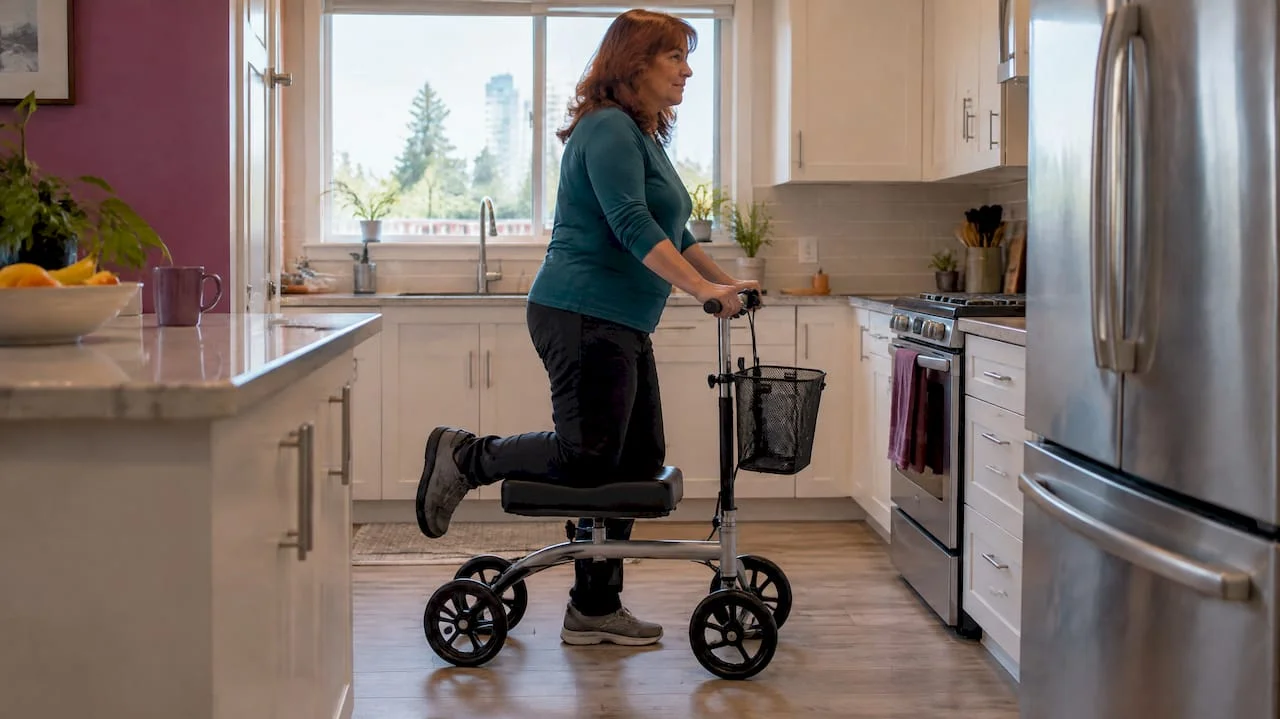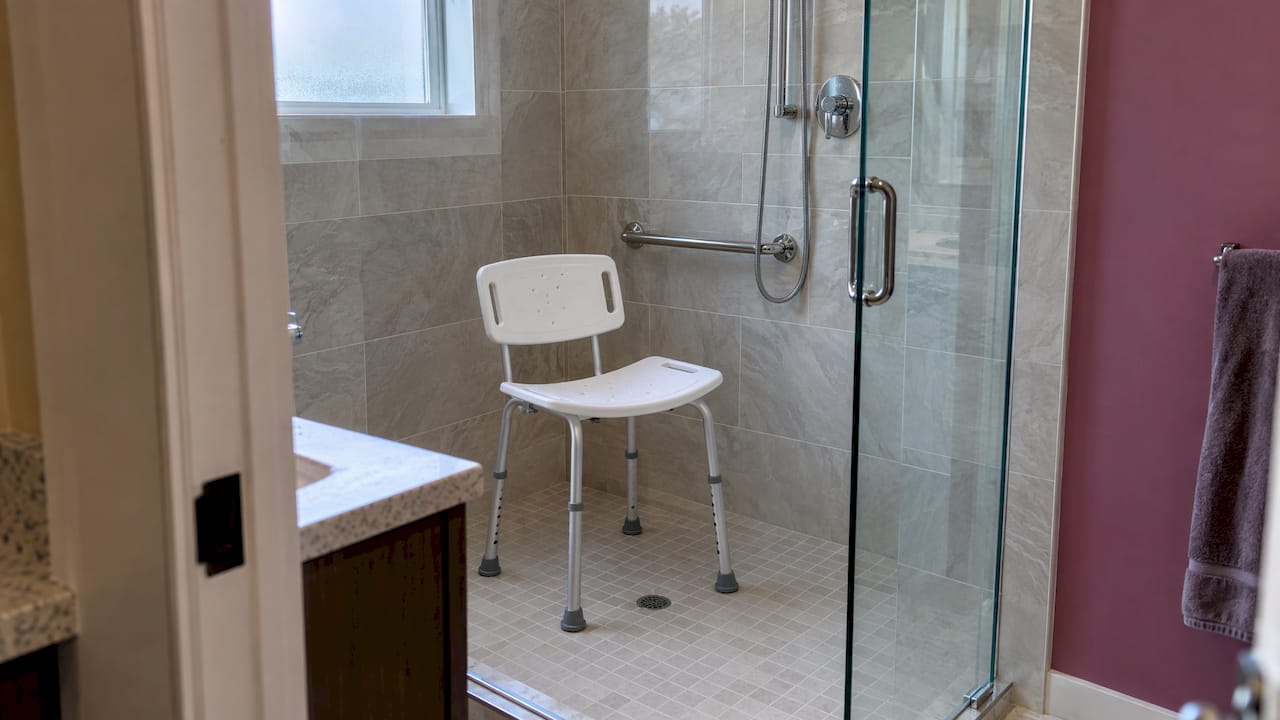
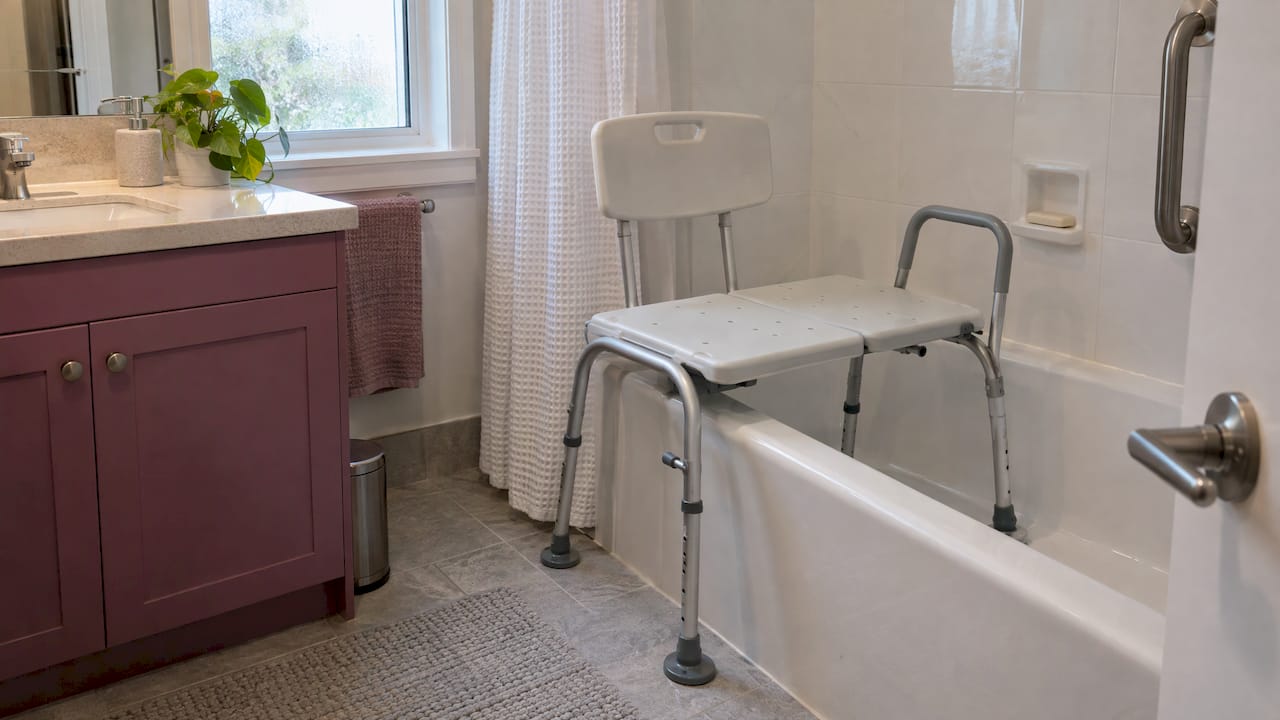
The bathroom is where recovery gets tested first: a low toilet, a slippery tub edge, a leg you cannot bend or load. The aids that matter most are a raised toilet seat or safety frame, a bath transfer bench or shower seat, grab bars and a non-slip surface. Which ones you need depends on your surgery, your restrictions and the shape of your bathroom. In Greater Vancouver, we deliver rental equipment the same day with no deposit, so a missing piece does not have to delay your trip home.
Key Takeaways
- Hospital teams in Canada list a raised toilet seat (with arms) or commode, a bath transfer bench or shower chair, grab bars and a long-handled sponge as the usual post-surgery bathroom kit.
- Equipment works best when it is in the home before surgery, and when your occupational therapist (OT) has confirmed it fits your procedure’s restrictions.
- Rental suits short recovery windows: we deliver across Greater Vancouver the same day, with no deposit, and sanitize every item first.
- Measure the toilet, tub and doorway before choosing, and clear loose rugs and cords before you move in.
Table of Contents
- Which bathroom aids help after surgery
- The toilet: when a raised seat is needed
- The tub and shower
- Choosing by surgery, mobility and layout
- Making the bathroom safer before you use it
- Beyond the bathroom: the rest of the recovery setup
- Renting, buying and coverage in British Columbia
- Get what you need in the house the same day
- Our perspective
- FAQ
- Sources
Which bathroom aids help after surgery
Hospital recovery guides across Canada converge on the same short list. Each aid solves a specific problem, so match the aid to the movement you cannot safely do yet.
| Aid | What it helps with | Typical after |
|---|---|---|
| Raised toilet seat with arms | Sitting down and standing up from a low toilet | Hip or knee surgery |
| Toilet safety frame | Hand support on both sides of the toilet | Hip or knee surgery |
| Commode | A seat near the bed when the bathroom is far or hard to reach | Hip surgery, limited mobility |
| Bath transfer bench | Sitting to enter the tub without stepping over the edge | Hip, knee, lower-limb surgery |
| Shower chair or bath seat | Sitting while washing when standing is tiring or restricted | Many procedures |
| Handheld shower | Washing while seated | Many procedures |
| Grab bars | A fixed handhold for balance | Many procedures |
| Long-handled sponge | Washing feet and legs without bending | Hip or knee surgery |
The lists come from Canadian hospitals. Sunnybrook’s November 2025 hip and knee guide names a raised toilet seat, a bath chair or tub transfer bench, grab bars and a long-handled sponge among the equipment to discuss with your occupational therapist before surgery. Island Health’s August 2026 lower-limb amputation guide says bath or shower seats, handheld showers and grab bars can make bathing safer, and that an OT can recommend the right equipment.
An occupational therapist is a health professional who assesses how you manage daily tasks at home and recommends the equipment and changes that make them safe. If you have one assigned, their advice about your procedure outranks any general list, including this one.
The toilet: when a raised seat is needed
A standard toilet can sit lower than your knees, and that is the problem. After hip surgery, bending the hip past a certain point is usually restricted, and pushing up from a low seat loads the joint.
London Health Sciences Centre says a raised toilet seat is needed after hip surgery when the toilet is lower than knee level, and that arms help you sit and rise. It adds that people after knee surgery may also benefit, because toileting can be difficult at first. Halton Healthcare’s August 2024 total hip guide says that if your toilet is at knee height or lower, you need a raised seat with arm handles or a commode, and suggests arranging to rent, buy or borrow one.
A quick way to check your toilet
Sit on the toilet in your normal clothes. If your knees are noticeably higher than your hips, or higher than the seat, the toilet is low. Measure from the floor to the top of the seat so you can compare it with the height of the raiser you choose. Then note whether there is a wall or vanity beside the toilet that could take a grab bar or frame.
Seat raiser, frame or commode
The three options solve slightly different problems. A raiser adds height. A frame adds arms to push from. A commode puts a seat where you need it, which matters if the bathroom is up a flight of stairs or too narrow for a walker. Our guide on choosing a toilet safety frame or a raised seat walks through the decision. If you already know you need extra height, we also carry a toilet seat raiser.
The safe transfer sequence
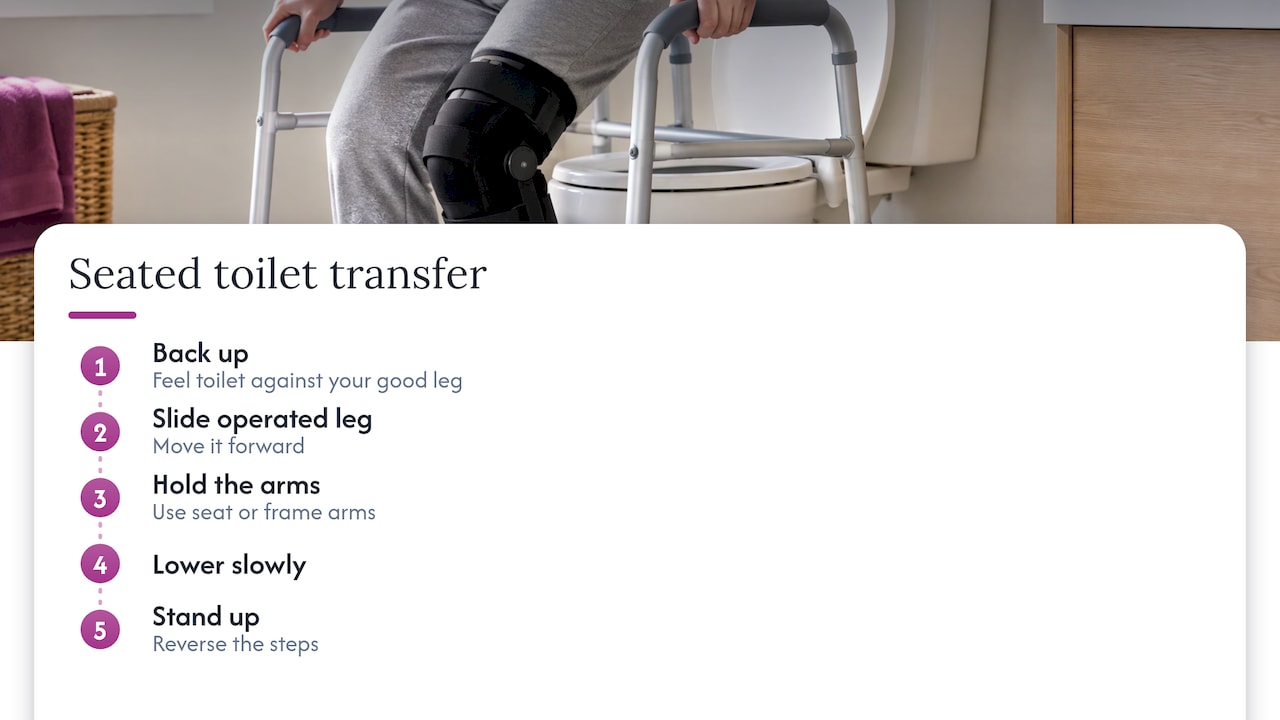
London Health Sciences Centre teaches a simple order for after joint surgery: back up until you feel the toilet against the back of your good leg, slide the operated leg forward, hold the seat or frame arms, and lower yourself slowly. Standing up reverses the steps. Practise it with your therapist or in hospital, not for the first time on the first night home.
The tub and shower
Bathing is the riskier task because it combines wet surfaces, balance and, usually, stepping over the tub wall on one leg.
A bath transfer bench sits across the tub edge. You sit on the outside part, swing your legs over, and slide in, so you never stand on a wet floor on one leg. A shower chair or bath seat lets you wash seated, which helps if standing tires you or your surgeon has limited how long you can bear weight. A handheld shower makes seated washing practical. Grab bars give you something fixed to hold when getting into and out of the tub.
If you want a bench for your recovery, see our bath transfer bench rental. Our short piece on measuring for a shower chair covers the three dimensions to check before anything arrives.
Timing matters
Equipment is only half of the answer; your surgical team’s rules are the other half. Halton Healthcare’s hip guide, for example, covers transfer technique, when you may shower, and avoiding tub immersion until the surgical team’s conditions are met. Another procedure will have different rules. Ask your surgeon or nurse which apply to you.
Choosing by surgery, mobility and layout
Start with three questions.
- What are my restrictions? Hip replacement, knee replacement, foot surgery and amputation each limit different movements. Your discharge paperwork or OT will say which.
- How do I move? A person using a walker or wheelchair needs door widths and turning room checked, not only the bathing aids.
- What does the room allow? Tub or walk-in shower, wall type for grab bars, space beside the toilet, and how far the bathroom is from where you will sleep.
The Canadian Association of Occupational Therapists says post-surgical home assessments and modifications can support discharge planning and recovery, and that OTs weigh the person, the environment, daily activities, supports and layout when they recommend equipment. That is the right framework for you too: equipment suits a person in a room, not a diagnosis in the abstract.
London Health Sciences Centre’s equipment page advises having equipment arranged and in the home before surgery. After hip surgery it lists a raised toilet seat with arms or a commode, a toilet frame, a bath transfer bench or a shower chair. Island Health’s general surgery booklet suggests asking your surgeon or nurse whether a bath or shower bar or other safety device is needed, and arranging purchase and installation before admission.
Measure before you order
- Toilet seat height from the floor, and the clearance on both sides.
- Tub rim height, and the inside and outside width of the tub.
- Bathroom doorway width, if you will use a walker or wheelchair.
- The route from bed to bathroom, including thresholds.
Write the numbers down. They save a second delivery.
Making the bathroom safer before you use it
Equipment cannot fix a slippery floor. Sunnybrook recommends a non-slip coating or mat in the shower or tub, and removing loose rugs, cords and other hazards to reduce the risk of falls. Do this before you come home: take out bath mats that slide, tuck or remove cords, and keep a lit path to the bathroom for night trips.
If you are also working on leg alignment and balance as part of rehab, a visual retraining plan for knee valgus shows how movement habits and surfaces interact. Your own surgeon and physiotherapist decide when that is appropriate for you.
A checklist for caregivers
- Is each aid stable when you push down on it with your weight, and are all legs or feet adjusted to the same height?
- Are tub-bench legs on the floor and the rubber feet clean and dry?
- Is everything the person needs within reach while seated: soap, towel, handheld shower, call device or phone?
- Has the person practised the transfer once with you beside them, following the therapist’s steps?
- Are the floors dry and the route clear?
If an aid does not feel stable, do not use it until the fit is corrected. Ask your OT before changing a setup that your surgical team has approved.
Beyond the bathroom: the rest of the recovery setup
Bathroom aids work best as part of a whole-home setup. Three items come up again and again for the people we deliver to, and they are the focus of our rentals.
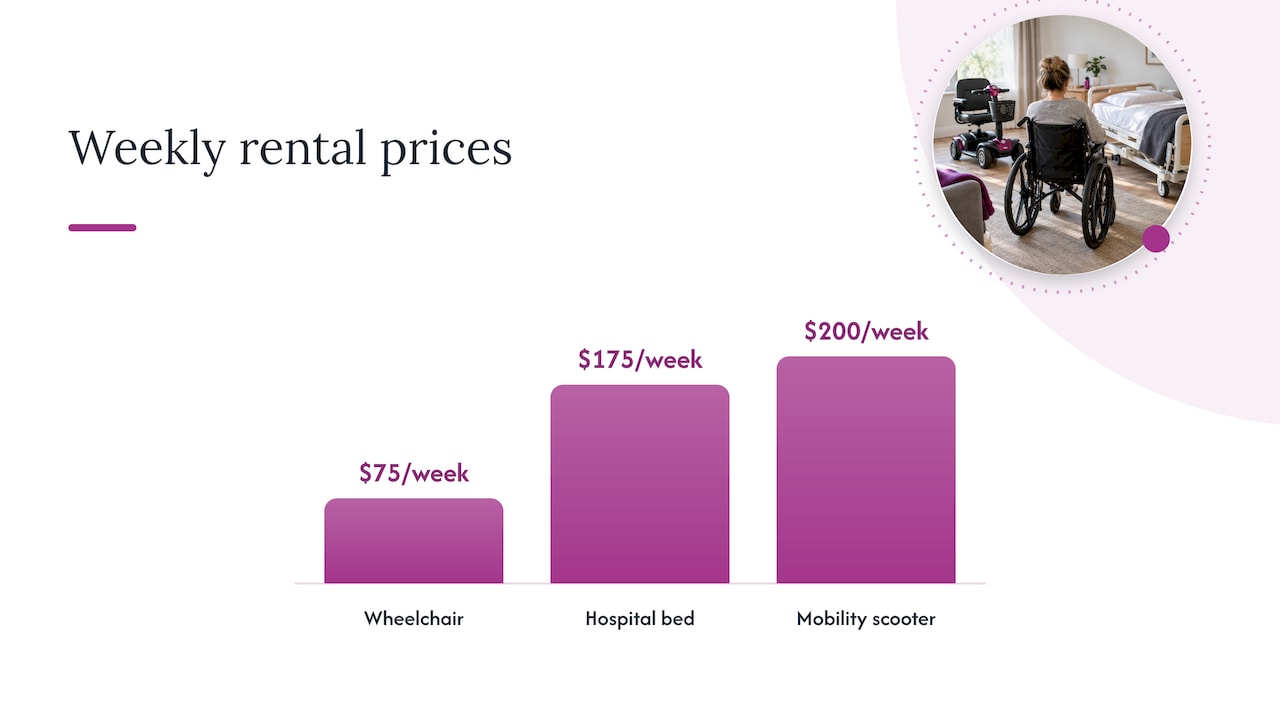
Hospital bed. If you cannot climb stairs, or sleep sitting up for a while, a bed on the main floor with the bathroom close by makes every bathroom trip shorter and safer. Our hospital bed rental starts at $175 per week for an electric, adjustable bed. A large install delivery is a $250 one-off fee. More on choosing is in our guide to the best hospital bed for home use after surgery.
Wheelchair. For longer trips around the home, appointments or the first weeks of limited weight-bearing, a standard wheelchair rental starts at $75 per week. Small item delivery and pickup is a one-off $30 to $60 each way, listed on our delivery fees page.
Mobility scooter. For longer outings once your surgeon permits, or for visitors who need to get around Vancouver quickly, a mobility scooter rental starts at $200 per week.
For a full list across the house, see our home discharge equipment checklist and our guide to knee surgery equipment. Readers looking at long-term needs may like our bathroom safety guide for seniors in Vancouver.
Renting, buying and coverage in British Columbia
Most recoveries last weeks to a few months, which is why many families rent instead of buying. Island Health’s general surgery booklet notes that medical equipment stores may rent or sell equipment and may deliver or install it, and suggests checking whether an extended health plan covers the cost.
Public help exists but has conditions. The Province of British Columbia’s medical equipment policy, last updated 17 December 2025, includes grab bars, bath or shower seats, transfer benches, raised toilet seats, toilet safety frames and commode chairs. Eligibility is limited to specified assistance recipients or qualifying medical-need cases, the equipment must be medically essential and pre-approved, and a therapist must prescribe or confirm it. The Vancouver Coastal Health equipment program says qualifying clients need an equipment need, no other identified funding source and a need to stay safe at home. If you think you qualify, ask your OT or care team; a decision can take time, and your discharge date will not wait.
When you need the equipment now, or you do not meet the criteria, renting from us gets it to your door the same day in Greater Vancouver (including Surrey, Burnaby and Richmond), with no deposit and with sanitized equipment.
Get what you need in the house the same day
We rent and sell mobility aids and medical equipment across Greater Vancouver. Tell us what your therapist or surgeon has recommended, and we will deliver it, set it up and sanitize it before it arrives, with no deposit. Hospital beds start at $175 per week, wheelchairs at $75 per week, and mobility scooters at $200 per week, and we can tailor terms to the length of your recovery.
See everything available on our rentals page, or visit seventhchakra.ca to book.
Our perspective
Most people call us from a hospital hallway or a kitchen table, a day or two before a discharge, with a list from the care team and no equipment. That timing is why we built our service around same-day delivery, no deposit and professional setup.
Our view is that the bathroom and the bedroom should be sorted together. A raised seat or bench is only useful if the person can get to the bathroom safely, and that often means a hospital bed on the main floor and a wheelchair for the days when walking is too much. Renting each piece for the weeks you need it keeps the cost in proportion to the recovery.
We also believe in transparent pricing: our weekly rates and delivery fees are published, so a family can plan before they call. And because every item is sanitized before delivery, you can put a frail or newly operated person on it without worry.
Chandan
FAQ
Do I really need a raised toilet seat after hip surgery?
It depends on your toilet height. Canadian hospital guidance says you need one when the toilet is at or below knee height, and arms on the seat or a frame help you sit and rise. Your OT will confirm for your procedure.
Is a commode better than a raised seat?
A commode suits situations where the bathroom is far, narrow or upstairs, since it can sit beside the bed. A raised seat with arms suits a bathroom you can reach safely. Your therapist can say which fits your layout.
When should I arrange bathroom equipment?
Before surgery if you can. Hospitals advise having equipment in the home before you are admitted. If plans change or you are discharged early, we deliver the same day in Greater Vancouver.
Can I shower normally after surgery?
Not always. Timing for showering, and whether you may sit in a tub, depends on your procedure and your wound. Follow the instructions from your surgical team, and use a seat or bench to stay stable when you are cleared.
Sources
- Sunnybrook: Having Hip or Knee Surgery guide, November 2025
- Island Health: Lower limb amputation surgery guide, August 2026
- London Health Sciences Centre: Using the Toilet
- London Health Sciences Centre: Equipment
- Halton Healthcare: Total Hip Booklet, August 2024
- Canadian Association of Occupational Therapists: Home Assessment and Modifications, Spring 2024
- Island Health: Getting ready for and recovering from surgery, 2019
- Vancouver Coastal Health: Medical Equipment Provision Program
- Knee valgus correction plan