
Hospital Discharge Equipment Rental in Surrey and Greater Vancouver

If you are going home from hospital and need a bed, wheelchair or scooter in place before the first night, you can rent them from us with no deposit and have them delivered, set up and sanitized. A hospital bed starts at $175 per week, a standard wheelchair at $75 per week and a mobility scooter at $200 per week. This guide covers what to line up before discharge, what the equipment costs, how delivery and setup work, and the safety checks that matter once it is in your home.
TL;DR
- Ask the discharge team what you will need at home, and confirm the bed, wheelchair or scooter is in place before you leave the ward.
- We rent hospital beds from $175 per week, standard wheelchairs from $75 per week and mobility scooters from $200 per week, with no deposit.
- Equipment arrives delivered, set up and sanitized. Large installs carry a $250 one-off delivery fee, and small items $30-60 one-off per way.
- Health authority programs can arrange equipment for eligible patients, so ask your hospital team about referrals and funding while we cover the gap.
- Lock the brakes, check the doorways and get an occupational therapist or physiotherapist to confirm the fit.
Table of Contents
- What you may need at home after discharge
- The three rentals most families ask about
- What it costs per week
- Funding and referral options to ask your hospital team about
- Delivery, setup and cleaning: what to confirm
- Safety checks once the equipment is home
- Our perspective on discharge rentals
- Book equipment for your discharge
- FAQ
- Sources
What you may need at home after discharge
What you need depends on the surgery, the injury or the illness, and your care team is the right person to name it. Their list usually falls into a few groups.
- Sleeping and resting: an adjustable hospital bed, an overbed table, or a power lift chair for someone who struggles to stand from a normal seat.
- Getting around the house: a standard wheelchair, a transport chair, a rollator walker or, after a foot or ankle injury, a knee scooter.
- Longer distances outdoors: a mobility scooter for errands, appointments and time outside.
- Moving someone who cannot bear weight: a full-body patient lift, usually for a caregiver handling a transfer.
We rent all of these. For a longer look at the whole category, see our guide to hospital equipment for home use.
The most common mistake is waiting until the day of discharge to think about it. Ask the nurse or discharge planner three questions while the patient is still on the ward. What will be needed in the first week? Can the person get into the bathroom and bedroom on their own? Who will help with transfers? Those answers become your equipment list.
The three rentals most families ask about
Our owner brief for this guide is simple: most discharge calls are about a bed, a wheelchair or a scooter. Here is how each one works.
Hospital bed rental
A hospital bed lets the head and feet be raised and the height changed. That helps the patient sit up to eat or rest, and it helps the caregiver provide care without constant bending. Our hospital bed rental is an electric, adjustable bed that starts at $175 per week. If you want more included, we also list a premium hospital bed package.
Beds are a large install, so the delivery fee is $250 one-off. A technician delivers and sets it up. Pick a room with space on both sides of the bed, a clear route from the front door and an outlet nearby. Measure the door of the bedroom and any tight turns in the hallway before the delivery.

Wheelchair rental
A standard wheelchair is the usual first piece of equipment after discharge. Our wheelchair rental starts at $75 per week. Several variations fit different situations:
- A lightweight folding wheelchair is easier to load into a car for appointments.
- A wheelchair with elevating leg rests, from $90 per week, supports a leg that must stay raised after surgery.
- A bariatric extra-wide wheelchair starts at $100 per week.
- A commode wheelchair combines seating and toileting support.
- A transport chair starts at $75 per week and suits short trips with a companion pushing.
Small items such as wheelchairs carry a delivery and pickup fee of $30-60 one-off per way. The full schedule is on our delivery fees page.
Mobility scooter rental
A scooter suits someone who can sit safely and steer but cannot walk far. Our mobility scooter rental starts at $200 per week. We list a 3-wheel lightweight scooter for indoor and outdoor use, a mid-size 4-wheel scooter and a heavy-duty scooter. Three wheels turn tighter indoors, and four wheels feel steadier outside. If you are unsure, tell us where the scooter will be used, and we will help you choose.
What it costs per week
These are our published starting prices. Delivery fees are separate and one-off.
| Equipment | Starting price |
|---|---|
| Hospital bed (electric, adjustable) | $175 per week |
| Standard wheelchair | $75 per week |
| Transport chair | $75 per week |
| Wheelchair with elevating leg rests | $90 per week |
| Bariatric wheelchair (extra-wide) | $100 per week |
| Mobility scooter | $200 per week |
| Lift chair (power recliner) | $175 per week |
| Electric patient lift (full body) | $250 per week |
| Knee scooter, indoor | $60 per week |
| Knee scooter, all-terrain | $80 per week |
| Rollator walker, 4 wheel | $60 per week |
| Overbed table, height-adjustable | $25 per week |
A common discharge setup is a bed, an overbed table and a wheelchair. At starting prices that is $175, $25 and $75, so $275 per week for the equipment itself. Add the one-off delivery fees, and the total is clear before you book. We do not ask for a deposit.
Funding and referral options to ask your hospital team about
Before you pay for anything, ask the discharge team whether any program applies to you. In BC the options depend on your situation, and your care team can refer you.
- The Medical Equipment Provision Program (MEPP): it arranges rentals through health authority contracts at no cost to eligible clients. Eligibility requires an equipment need and no other identified funding source, such as extended health benefits, Veterans Affairs, ICBC, WorkSafeBC or a ministry. The equipment must also be for use safely at home rather than in long-term care (VCH MEPP process).
- Fraser Health home health: staff help patients access items such as walkers, bath seats, wheelchairs and lifts, and can refer you to a local supplier. Costs may be covered by the Palliative Care Benefits Program or another funding source (Fraser Health). You can reach the Fraser Health Access Line at 1-855-412-2121, Option 1, for home health intake in Surrey and nearby areas (HealthLink BC).
- Palliative care: eligible B.C. residents can receive palliative medical supplies and equipment through their local health authority, and a physician or nurse practitioner registers the patient (Province of BC).
- Income or disability assistance: the Ministry of Social Development and Poverty Reduction supports medical equipment for clients with an essential medical need and no other resources (Province of BC).
Health authority equipment is meant to meet basic needs and may not have the extra features of equipment bought for long-term use (Island Health). Where a program fits, it is a good use of the system. Where timing, the type of equipment or the length of need falls outside it, a private rental fills the gap, and the care team can still advise on what to choose.
Delivery, setup and cleaning: what to confirm
Three things decide whether the first night at home goes smoothly.
- Timing. Tell us the discharge date and the address. We offer same-day delivery in the Greater Vancouver area, including Surrey, so the equipment can be in place before the patient arrives rather than after.
- Setup. Larger items such as hospital beds and patient lifts are installed for you. Health authority guidance also says a clinician needs to be present when lifts and floor-to-ceiling poles are installed under MEPP (VCH MEPP process). If a lift is part of your plan, ask your therapist to be there.
- Cleanliness. All of our equipment is sanitized before delivery.
Also confirm the room itself. Walk the route from the front door to the bedroom and bathroom. Not every home suits a mechanical lift: it needs room to move around furniture, doorways and corridors wide enough, and floors that let it roll safely (AJN).
Fit matters as well. A physiotherapist or occupational therapist can help the patient learn to use wheelchairs, scooters, walkers and lifts comfortably and safely (Fraser Health). Parkinson Society BC also suggests getting an OT or PT opinion before selecting equipment (Parkinson Society BC).
Safety checks once the equipment is home
A few habits prevent most avoidable problems. Check each one against your own care team’s instructions.
Hospital bed
- Keep the brakes locked except when moving the bed. Raise it to waist height when giving care to avoid reaching and bending, and set it so the person can sit at the edge with knees bent at 90 degrees and feet flat (Agrace).
- For someone who spends long hours in bed, Wounds Canada advises changing position often, following a turning schedule and avoiding raising the head of the bed more than 30 degrees for long periods. It also suggests using pressure-reducing surfaces as the manufacturer recommends (Wounds Canada). If you notice a red, warm, tender area of unbroken skin, change position more often and speak to the health care provider.
Patient lift
- Based on NIOSH guidelines, a care provider should lift no more than 35 lbs during patient-handling tasks.
- Before every use, check that the lift works and examine the sling and straps for damage or wear. Lock the wheels on the bed or chair and on the lift before raising the person (AJN).
Wheelchair and scooter
- Lock the brakes before every transfer, and have the first few transfers coached by a therapist.
- Practise the route indoors, including the turn into the bathroom, before the first outing.
A home safety assessment by an OT or PT is an important first step. They give advice on adaptive equipment, safety awareness, energy conservation and mobility, and help decide how long services should continue (Parkinson Society BC).
Our perspective on discharge rentals
Discharge day rarely goes to plan. The paperwork finishes late, the family is tired and someone realizes at 3 p.m. that there is no bed at home that raises. That is the situation we built our service around.
We set our rentals up so a family does not need to find a deposit in the middle of a crisis. We deliver the same day, set the equipment up and sanitize it first, so the person coming home walks into a room that is ready. Our pricing is published, and the delivery fees are listed, so you can add up the cost before you call.
We also think rentals suit recovery. Needs change in the first weeks: a bed may be wanted for three weeks, a wheelchair for six, a scooter once energy returns. Flexible weekly terms let you add or return items as the recovery changes, without buying something you will not need next season.
If you are unsure which model fits, tell us the diagnosis if you are comfortable doing so, the layout of the home and who is helping. We will point you to the right option, and your therapist can confirm it.
Chandan
Book equipment for your discharge
We rent hospital beds, wheelchairs, mobility scooters, lift chairs, walkers, knee scooters and more to families, caregivers and visitors across the Greater Vancouver area, with no deposit and same-day delivery. Start with the hospital bed rental or the wheelchair rental, or see the whole range on our rentals page.
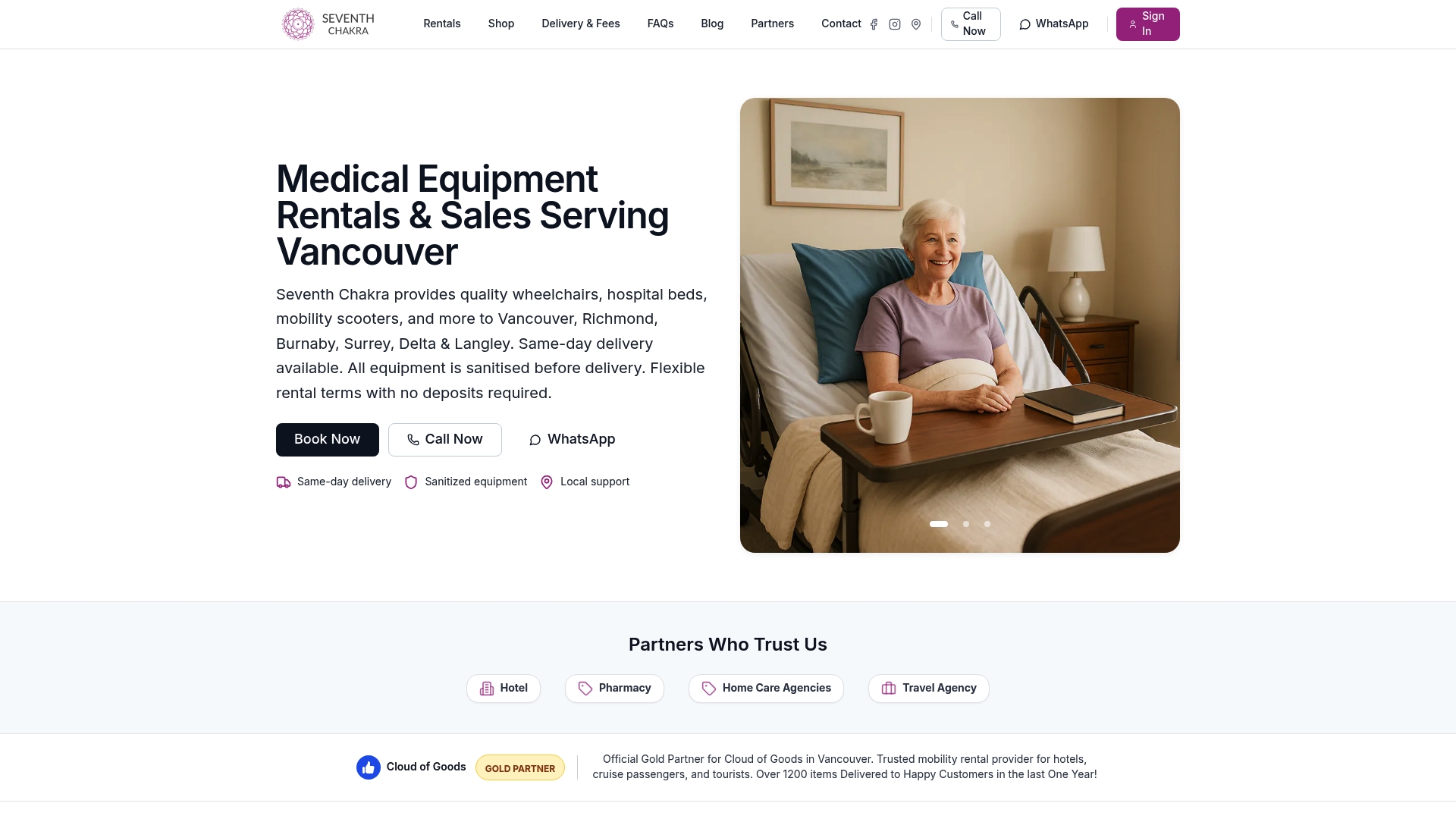
Give us the discharge date, the address and the items on your list. We will confirm what is available and the delivery fee before anything is booked. You can also read about medical equipment rental in Vancouver for the area we cover.
FAQ
Can I rent equipment for the same day I leave hospital?
Yes. We offer same-day delivery in the Greater Vancouver area, so the equipment can be set up before the patient arrives home. Call with the address and the items you need, and we will confirm the timing and the delivery fee.
Do I need a deposit?
No. We do not ask for a deposit on rentals. Weekly prices start at $175 for a hospital bed, $75 for a standard wheelchair and $200 for a mobility scooter, and delivery fees are listed on our delivery fees page.
How much does delivery cost?
Large installs such as a hospital bed carry a $250 one-off fee. Small items such as wheelchairs carry a one-off fee of $30-60 per way, which covers delivery and pickup.
Can the hospital or health authority arrange equipment instead?
In some cases, yes. MEPP can arrange rentals at no cost to eligible clients with no other funding source, and Fraser Health home health staff can refer you to suppliers or funding (VCH MEPP process). Ask your discharge team early. If your timing or equipment falls outside a program, we can deliver the same day.
How do I know the equipment is the right fit?
Ask a physiotherapist or occupational therapist to check it, especially for lifts, beds and wheelchairs. Fraser Health therapists can help patients learn to use this equipment safely at home (Fraser Health). Tell us about your home layout, and we will help you choose a suitable model.
Sources
- VCH MEPP: Medical Equipment Provision Program process
- Fraser Health: Medical Equipment and Supplies
- HealthLink BC: Home and Community Care Access
- Island Health: Medical Equipment Provision Program
- AJN: Using a Mechanical Lift at Home
- Wounds Canada: Caring for Pressure Injuries at Home
- Agrace: Mobility Techniques and Safe Transfers
- Parkinson Society BC: Obtaining Assistive Devices and Home Adaptations
