
Same day medical equipment in Vancouver, rentals from $75/week

You can rent wheelchairs, mobility scooters and hospital beds in Vancouver through local suppliers like Seventh Chakra, or through short-term loan programs such as Red Cross HELP and MEPP if you meet the referral rules. Private rentals offer same-day delivery and sanitized equipment with no booking delays. Public loans take longer but can be free of charge. If you need equipment today, calling a local supplier directly is the fastest route.
TL;DR:
- Same-day private rentals are the fastest way to get mobility equipment in Vancouver, ideal for urgent hospital discharges or emergencies.
- Public loan programs like Red Cross HELP and MEPP can be free but have longer processing times and depend on eligibility and availability.
- Having documentation, delivery instructions, and a clear space prepared in advance speeds up rental and loan applications significantly.
- Equipment condition and safety are managed through inspections and demonstrations; battery age and wear are key factors to verify with suppliers.
- Renting is generally best for short-term needs, while buying is recommended only for long-term use or when personalized equipment fit is essential.
Table of Contents
- Where to get medical equipment in Vancouver right now
- What you need before you can rent
- Choosing the right wheelchair, scooter or hospital bed
- What renting actually costs and how to get help paying
- What good delivery, setup and sanitization looks like
- Step-by-step checklist for renting equipment in Vancouver
- Why Seventh Chakra is a reliable local option
- Age and condition rules for rented equipment
- Cancellation, refund and rental terms to check before booking
- Questions worth asking before you commit
- Who’s responsible if equipment is damaged or lost
- Checking a supplier’s reputation before you book
- Renting versus buying in the Vancouver market
- Practical perspective: when to rent and when to buy
- How to book with Seventh Chakra
- Sources
- FAQ
Where to get medical equipment in Vancouver right now
Three main routes exist for Vancouver residents who need mobility aids or home-care equipment, and each fits a different situation.
Private rental suppliers are the fastest option. Companies with local inventory can typically deliver a wheelchair, scooter or hospital bed the same day it’s requested, without waiting for approvals or paperwork. This matters most for discharge day from hospital, a sudden fall, or a short-notice visit from a relative who uses a mobility aid.
Public loan programs move more slowly but can eliminate cost entirely for people who qualify. The Canadian Red Cross HELP program operates across British Columbia and the Yukon, offering short-term loans of basic items such as walkers, wheelchairs and bath chairs through local depots and health authority partnerships. For more advanced equipment like hospital beds, specialty mattresses and patient lifts, the Medical Equipment Provision Program allows health authorities to arrange rentals at no cost to eligible clients, but a clinician referral and specific forms are required before anything ships.
Hospitals and home-health teams sometimes arrange equipment directly as part of a discharge plan. When a clinician sets this up, the timeline and equipment choice are largely out of your hands: you get what the health authority’s contracted vendor has available, on the schedule that vendor can manage. This route works well when you’re not in a rush and want the process handled for you, but it isn’t built for urgent, same-day needs.
Here’s how the three routes compare for practical decision-making:
- Private rental suppliers: fastest option, broad inventory, cost depends on the item and rental length.
- Red Cross HELP: free or low-cost basic equipment, but availability depends on your local depot’s stock.
- MEPP (advanced equipment): no cost when eligible, but requires a clinician referral and can take days to process.
- Hospital or home-health arranged equipment: convenient if you’re already in the system, but you have limited choice over model or delivery timing.
Vancouver Coastal Health notes that most home health equipment is typically paid for by the patient, with third-party funders and community loan programs available as supports rather than default coverage. That’s worth knowing before you assume a program will cover your situation: public loans are generally meant as a bridge for people with no other funding option, not a universal service.
What you need before you can rent
Booking a rental or applying for a public loan goes faster when you have the right documents and home setup ready in advance.
- Photo ID and payment details. Private suppliers ask for identification and a way to pay (credit card or similar) before confirming delivery.
- A clinician referral, if applicable. MEPP and the advanced tier of Red Cross HELP require a referral or prescription from a doctor, occupational therapist or discharge planner; basic Red Cross HELP loans generally don’t need one.
- A clear delivery address and access notes. Tell the supplier about stairs, narrow hallways, elevator access or parking restrictions so the delivery team can plan the route in advance.
- Space and power for the equipment. A hospital bed needs a nearby outlet and enough floor space to raise the head and foot sections fully; a mobility scooter needs a charging spot and a place to park it that doesn’t block a doorway.
- Someone present at delivery. Whoever answers the door should be able to confirm the equipment matches what was ordered and, for powered items, sit through a quick operating demonstration.
If you’re going the MEPP route, the referral usually comes from whoever is managing your care, a hospital discharge planner, a home-health nurse, or your family doctor’s office. Vancouver Coastal Health lists specific funding routes including ministry programs, Veterans’ Affairs, ICBC and WorkSafeBC, and each of these has its own paperwork requirements. Ask early, since gathering the right form can take a few days if your clinician’s office is busy.
For private rentals, the process is simpler by design. You typically only need to know what item you want, confirm your address, and have a payment method on hand. That’s part of why private suppliers can turn around same-day delivery while public programs can’t.
Choosing the right wheelchair, scooter or hospital bed
Getting the right model matters more than getting the cheapest one, especially for equipment someone will use daily.
Wheelchairs. Seat width and weight capacity are the two numbers to get right first. A standard wheelchair suits most short-term needs, but a bariatric model is necessary for higher weight capacities and extra width. A transport chair is lighter and easier to fold for car trips but isn’t built for full-time self-propulsion. If the user has circulation issues or spends long hours seated, ask about a wheelchair with elevating leg rests (ELR), which reduces swelling by keeping the legs raised.
Mobility scooters. Indoor use calls for a smaller turning radius and slower top speed, while outdoor use on sidewalks or trails needs a sturdier frame and more battery range. Three-wheel scooters turn tighter but have less stability on slopes; four-wheel models trade some manoeuvrability for a steadier ride. Always confirm the scooter’s maximum user weight before booking, and ask how long a full battery charge lasts if the equipment will be used for full days out.
Hospital beds. Motorized adjustability lets the user raise the head or knees without help, which matters for anyone recovering from surgery or managing reflux. Pressure-relief mattresses reduce the risk of skin breakdown for anyone who’ll be in bed most of the day. Side rails add safety for a patient at risk of rolling out, and an overbed table makes meals and reading easier without needing to sit up fully. Because electric beds involve moving parts and a power connection, professional setup is worth insisting on rather than assembling one yourself.
Whatever you rent, a short arrival check catches problems before they become inconveniences:
- Test the wheel locks or scooter brakes before the delivery team leaves.
- Run the bed’s controls through a full range of motion, head up, head down, height adjustment.
- Press on the mattress to confirm the firmness matches what was ordered, especially for pressure-relief models.
- Ask for a hands-on demonstration of any powered function, not just a verbal explanation.
Pro Tip: Take a phone video of the delivery team’s operating demonstration so anyone helping with care later can watch it back instead of guessing.
What renting actually costs and how to get help paying
Rental pricing in Vancouver generally follows a weekly rate, with the total shaped by the equipment type and rental length rather than a flat daily fee. As an illustrative example only, a caregiver renting a standard wheelchair for two weeks and a hospital bed for the same period would be paying two separate weekly rates added together, not a single bundled price, since suppliers typically bill by item.
MEPP: Medical Equipment Provision Program can eliminate rental cost entirely for eligible clients needing advanced equipment such as hospital beds, specialty mattresses or patient lifts, provided a clinician submits the referral and no other funding source is available. The program prioritizes contracted vendors first and generally uses the least expensive item that meets the clinical need, turning to alternate vendors only when contracted supply can’t meet the timeline. That’s one reason private suppliers sometimes act as a short-term bridge during acute situations, filling a gap while a public-program referral works its way through the system.
Third-party payers cover a meaningful share of home equipment costs for people who qualify. Vancouver Coastal Health lists extended health benefits, ICBC, WorkSafeBC and Veterans’ Affairs among the funding routes that can offset or fully cover a rental, depending on the circumstances behind the need. Each payer asks for its own documentation, so confirming what’s required before you rent saves a reimbursement headache later.
Deposit policies vary by route. BC government guidance notes that no deposit is generally required for ministry-funded rentals arranged through contracted providers. Private suppliers set their own policies. Some private suppliers do not require an upfront deposit on rentals, which removes one common barrier for families booking on short notice.
Health Equipment Loan Program (HELP) coverage offers short-term basic equipment loans at no cost through Red Cross depots across the province. HealthLink BC’s summary of the Health Equipment Loan Program lists regional contact numbers for health authorities including Fraser Health and Vancouver Coastal Health, which is the practical starting point for checking what your local depot has in stock.
What good delivery, setup and sanitization looks like
A rental supplier worth using should handle logistics without you having to chase them for updates.
Same-day delivery is realistic for most standard items when ordered early in the day, though larger installs like hospital beds and patient lifts take longer to schedule because of the setup involved. Delivery fees typically differ by item size, with large installs carrying a separate fee from smaller items that need only drop-off and pickup.
Professional installation matters most for anything with moving parts or an electrical connection. A hospital bed needs its rails, motor and mattress base checked before use, and a patient lift needs its sling and hoist mechanism tested with the actual user’s weight range in mind, not just switched on and left. Skipping this step is where injuries happen.
Sanitization is worth asking about directly rather than assuming. A supplier should be able to describe its cleaning process for equipment between renters, and ideally point to some form of sanitization record or standard procedure rather than a vague assurance.
- Ask what surfaces get disinfected and whether upholstery or mattress covers are replaced between uses.
- Confirm whether sanitization happens before delivery or only on return.
- Check the return window and whether late fees apply if you need a few extra days.
- Ask how extensions work: private rentals often just extend the weekly rate, while public loans like the advanced Red Cross program usually require a clinician reassessment before the loan period is extended.
Pro Tip: If a caregiver is recovering on a tight timeline, ask the supplier for the exact return date in writing at booking, not just a verbal estimate, since public program extensions can take longer than expected.
Step-by-step checklist for renting equipment in Vancouver
Follow these steps in order if you need equipment quickly and want to avoid backtracking.
- Identify the exact item and confirm with a clinician if the need is medical. A physiotherapist or discharge planner can confirm whether a standard wheelchair or a bariatric model, for example, actually fits the situation.
- Check whether you qualify for Red Cross HELP or MEPP. Basic items may be available through a local HELP depot without a referral; advanced items generally need one.
- Request a referral early if one is required. Ask your doctor’s office or discharge planner for the specific MEPP form rather than a general note, since the wrong paperwork causes delays.
- Contact a local supplier if you need something today. Give them the exact model, delivery address and any access notes (stairs, elevator, parking), and confirm the delivery fee and sanitization process before booking.
- Confirm payment and no-deposit terms up front. Ask directly whether a deposit is required so there are no surprises at the door.
- Inspect the equipment on arrival. Test brakes, controls and mattress firmness, and ask for a full operating demonstration before the delivery team leaves.
- Save the supplier’s contact details for returns or issues. Keep the return date, extension process and support number somewhere easy to find, ideally on the fridge or in your phone.
This order matters because the referral step is usually the slowest part of the process. Starting it in parallel with a private rental booking means you’re never stuck waiting on paperwork if you need something sooner.
Why Seventh Chakra is a reliable local option
Some local providers rent wheelchairs, mobility scooters, hospital beds and related home-care equipment across the Greater Vancouver area, often with same-day delivery for most standard items. Equipment is typically sanitized before delivery, and some suppliers do not require an upfront deposit, which removes a common friction point for families booking on short notice.
Rental terms are set up to flex around the renter’s timeline rather than a fixed contract length, and the same local knowledge that shapes those terms also means the team is familiar with Vancouver’s typical delivery challenges, apartment buildings, condo elevators, street parking.
That local presence also makes Seventh Chakra a practical option when a public program’s timeline doesn’t match an urgent need. MEPP guidance itself allows for alternate vendors when a contracted supplier can’t meet a client’s timeline, since discharge dates and acute situations don’t always wait for paperwork. A private supplier that can deliver the same day fills that specific gap without replacing the public program, it’s simply available while a referral works its way through the system.
Age and condition rules for rented equipment
Rented medical equipment should come with a clear picture of its condition before it arrives at your door, not just after you’ve raised a concern. A responsible supplier inspects each item between rentals for wear on wheels, brakes, upholstery and motors, and takes equipment out of rotation once it no longer meets a safe standard.

Ask directly how old a specific unit is and how often it’s serviced, especially for anything with a motor or battery, since a scooter or lift chair that’s seen heavy use needs closer maintenance than a newer model. You’re entitled to know this before committing to a rental period, and a supplier that hesitates to answer is a signal to ask more questions rather than assume the best. For powered equipment specifically, ask when the battery was last replaced, since battery age affects range and reliability more than almost any other factor.
Cancellation, refund and rental terms to check before booking
Every rental should come with clear terms on what happens if your plans change. Ask what the cancellation window is: some suppliers allow a full refund if you cancel a day or more before delivery, while others charge a portion of the fee once a delivery is scheduled.
Refund policies also matter if equipment arrives faulty or isn’t the right fit. Ask whether you can swap a model within the first day or two at no extra charge if it doesn’t suit the user’s needs, since this is common practice among suppliers confident in their inventory. Late return fees are worth confirming too: a per-day charge after the agreed return date is standard, but the rate should be stated clearly at booking, not left vague until you’re already past due. Finally, ask whether the rental agreement is billed weekly, since that’s the typical structure for most home mobility equipment in the Vancouver market, and confirm how an extension is handled if your need runs longer than planned.
Questions worth asking before you commit
A short phone call before booking can save a lot of frustration later. Ask these questions directly:
- How soon can you deliver, and what’s the fee for delivery and pickup? Fees often differ for large installs versus smaller items.
- Is the equipment sanitized before it reaches me, and how do you sanitize it?
- Is a deposit required, and what’s your cancellation policy?
- Who do I call if something breaks or malfunctions during the rental?
Red flags to watch for include a supplier who won’t confirm a delivery window in writing, one who can’t describe their sanitization process beyond a vague assurance, or one who asks for a large deposit with no clear refund terms. A legitimate supplier should also be transparent about pricing before you commit, not just once you’ve already agreed to the delivery.
Who’s responsible if equipment is damaged or lost
Renters are generally responsible for equipment while it’s in their care, which means normal wear is expected, but damage from misuse or neglect typically isn’t covered by the rental fee. Ask upfront whether the supplier offers any damage waiver or whether you’re fully liable for repair costs, since policies differ between suppliers.
If the equipment is being used to support a claim, such as after a car accident or workplace injury, funders like ICBC and WorkSafeBC may have their own requirements around how equipment is used and reported. Vancouver Coastal Health lists these funders as documented options for home health equipment costs, and each has its own process for confirming coverage. For broader questions about how insurance intersects with home-care equipment and services, a resource like this guide to hospice care coverage walks through how payer requirements typically work, which is a useful reference even outside a hospice-specific situation. Always clarify loss and theft policies too: some suppliers charge the full replacement cost of an item that’s lost or stolen while in a renter’s care, so confirming that detail at booking avoids a costly surprise later.
Checking a supplier’s reputation before you book
A quick reputation check takes only a few minutes and can rule out a bad experience before it starts. Google reviews are the most accessible starting point, look for consistent comments about delivery reliability, equipment condition and how the company handles problems, not just star ratings on their own.
The Better Business Bureau and local caregiver forums or Facebook groups for Vancouver and the Lower Mainland are also worth a search, since real complaints about late deliveries or hidden fees tend to surface there before they show up anywhere official. If a supplier has no online presence at all, that’s not automatically disqualifying for a smaller operation, but it does mean you’re relying entirely on the phone call to judge them, so ask more direct questions about sanitization, delivery timing and deposit policy than you might with a supplier who has a longer public track record.
Renting versus buying in the Vancouver market
Renting makes the most sense for short recovery periods, a visiting relative’s temporary needs, or an urgent replacement while a permanent solution is sorted out. Buying tends to make more sense for long-term daily needs, especially when the user needs a custom fit that a general rental inventory won’t have.
Local factors shift this calculation in Vancouver specifically. Storage space is often tight in condos and apartments, which makes owning a hospital bed or bariatric wheelchair impractical if it’s only needed occasionally. Funding availability matters too: if MEPP or a third-party payer covers a rental at no cost, renting remains the better financial choice even for a longer-term need, provided the eligibility holds.
Practical perspective: when to rent and when to buy
Most people overthink this decision. If you’re not sure how long you’ll need something, that uncertainty is itself the answer, rent first. A short recovery, a visiting relative, or an urgent gap while you sort out a permanent plan are all situations where buying locks up money for a need that might disappear in six weeks.
Buying only makes sense once the need is confirmed as long-term and the equipment requires a custom fit that general rental stock won’t cover. Even then, ask a supplier about rent-to-own options before assuming a straight purchase is the only path. Storage space in a typical Vancouver apartment or condo is often the deciding factor nobody mentions until the equipment shows up and there’s nowhere to put it.
— Chandan
How to book with Seventh Chakra
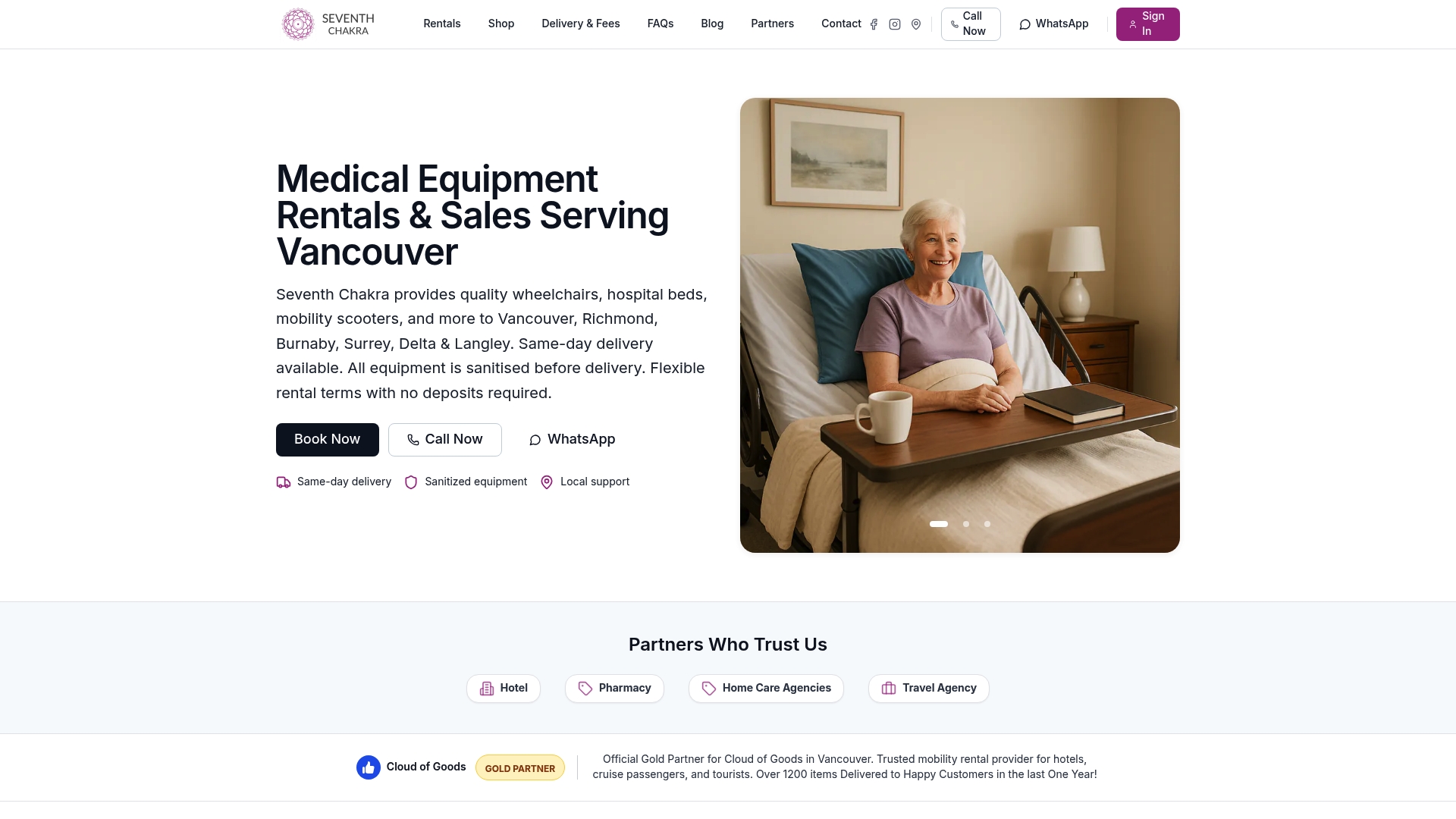
If you need a wheelchair, mobility scooter or hospital bed today, some local suppliers offer same-day delivery across Vancouver for most standard items, with equipment sanitized before delivery and no deposit required to book.
Start with the item you need most urgently:
- Mobility scooter rentals from $200 per week, indoor and outdoor models available.
- The full rentals catalogue if you’re comparing bariatric wheelchairs, patient lifts, lift chairs or knee scooters before deciding.
Delivery fees are listed clearly before you book: a flat fee for large installs like hospital beds and patient lifts, and a smaller per-way fee for items that only need drop-off and pickup. There’s no fine print on the deposit policy either, it’s simply not charged.
Call ahead or book online through any of the links above, and confirm your delivery window before the day you need the equipment in hand.
Sources
- MEPP: Medical Equipment Provision Program
- Home health equipment and supplies | Vancouver Coastal Health
- Health Equipment Loan Program | HealthLink BC
FAQ
Where can I rent a wheelchair in Vancouver?
You can rent a standard wheelchair from a local private supplier like Seventh Chakra, which offers same-day delivery, or through the Canadian Red Cross HELP program if you meet the basic loan eligibility. Private rental gets you a wheelchair the fastest, while HELP loans can be free but depend on local depot stock.
Where can I rent a hospital bed in Vancouver?
Hospital beds are available through private suppliers such as Seventh Chakra, delivered and set up the same day in most cases, or through MEPP if a clinician submits a referral and you meet eligibility. MEPP can provide the bed at no cost, but the referral and approval process takes longer than a direct private booking.
Can I get a Red Cross equipment loan in Surrey, BC?
Yes, the Canadian Red Cross HELP program operates depots across British Columbia, including the Fraser Health region that covers Surrey. Contact your local depot or check HealthLink BC’s regional listings to confirm current stock and any referral requirements for the equipment you need.
Is there a medical supply store I can visit in Vancouver?
Several private suppliers in the Lower Mainland operate storefronts alongside delivery services, offering equipment like wheelchairs, scooters and hospital beds for rental or purchase. Seventh Chakra operates as a delivery-focused rental service across Greater Vancouver, so confirm directly whether an in-person visit or a booked delivery suits your timeline better.
How much does it cost to rent medical equipment in Vancouver?
Pricing depends on the item and rental length, with private suppliers typically charging by the week. As one example, a standard wheelchair rental starts from $75 per week, while a hospital bed rental starts from $175 per week, and eligible clients may qualify for no-cost equipment through MEPP or Red Cross HELP.


