

Matching mobility aids to patient condition is defined as the clinical process of selecting assistive devices based on a patient’s balance, strength, endurance, environment, and medical diagnosis. The right device reduces fall risk, preserves independence, and supports recovery at home. The wrong one can cause serious harm. Patients recovering from stroke, hip replacement, or progressive neurological conditions each have distinct functional profiles that demand distinct equipment. This guide gives you a clear framework for choosing the right mobility aid, whether you are selecting one for yourself or helping a family member through recovery.
What factors determine the best mobility aid for your specific condition?
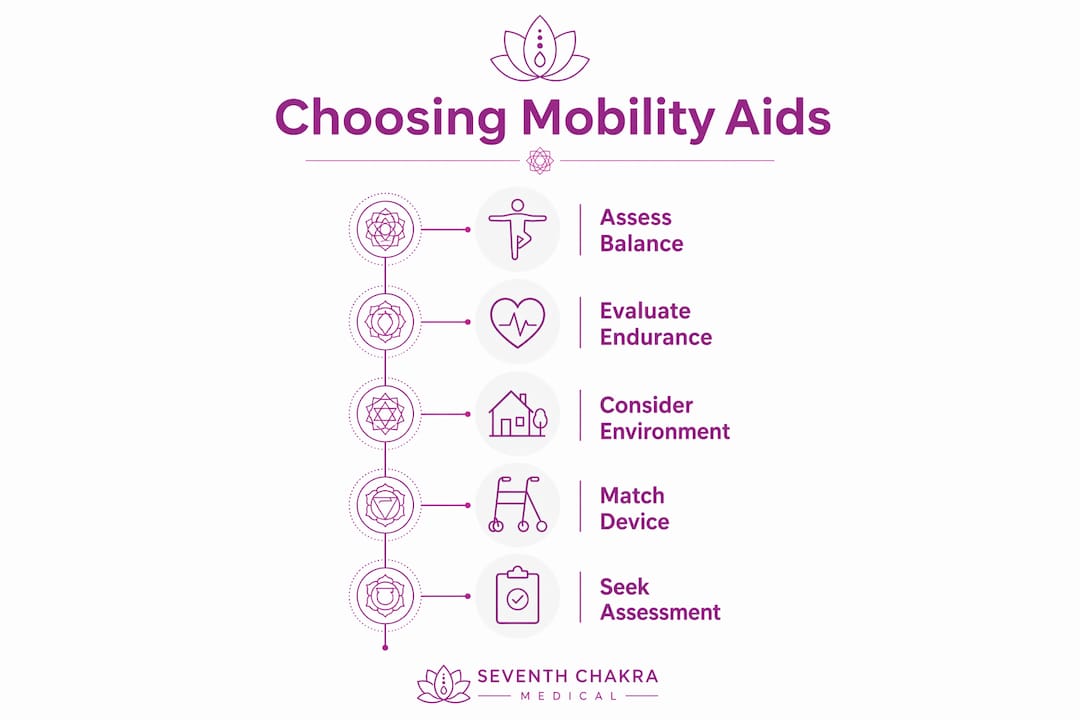
Matching mobility aids to patient condition starts with a functional assessment, not a diagnosis. Two patients with the same diagnosis can have very different balance, endurance, and home environments, which means they may need completely different devices.
The following factors drive every sound equipment decision:
- Balance and standing stability. Inability to stand unsupported for 30 seconds indicates a need for a walking frame. Patients who are unsteady but can stand independently are better suited to a rollator. Stable patients with good balance may only need a cane.
- Walking distance and endurance. Patients who regularly walk more than 50 metres benefit from a rollator with a built-in seat. Those who walk shorter distances indoors are better served by a standard walking frame.
- Upper body strength and motor control. Devices like standard walkers require the patient to lift and reposition the frame repeatedly. Patients with weak grip, tremors, or limited arm strength may struggle with this and need a wheeled alternative.
- Home environment. Narrow doorways, tight hallways, and small bathrooms all affect which device fits safely. A four-wheeled rollator requires a wider turning radius than a standard walker.
- Medical condition and trajectory. A patient recovering from a hip fracture has different short-term and long-term needs than someone managing multiple sclerosis. Recovery conditions improve; progressive conditions may require periodic upgrades.
Pro Tip: Measure your doorways before selecting any wheeled device. Standard interior doors in Canadian homes are 32 inches wide, and many rollators and power chairs require 24–28 inches of clearance to pass through comfortably.
How do you choose between walkers, rollators, canes, and scooters?
The four most common mobility aid categories each serve a distinct functional profile. Choosing the wrong category is the most common and most preventable mistake patients make.
Canes suit patients with mild balance issues or minor weight-bearing restrictions on one side. They provide minimal support and require the patient to have good core stability. A single-point cane offers the least support; a quad cane provides a broader base for patients with moderate instability.

Standard walkers provide the most stability of any non-powered walking aid. They are the right choice when a patient cannot bear weight through one leg or when standing balance is significantly compromised. The patient lifts the frame forward with each step, which demands some upper body strength.
Rollators are wheeled walkers with hand brakes and, usually, a built-in seat. They are suited to patients who have reasonable standing balance but tire quickly. Rollators do not offload limbs and are unsafe for patients who need to bear weight through the device. This is one of the most common misprescriptions in post-acute care.
Scooters and power wheelchairs serve patients who cannot walk functional distances at all. The distinction between the two matters. Scooters suit patients with good upper body strength who primarily need outdoor mobility. Power wheelchairs suit patients who lack core strength or balance for tiller steering, and who need advanced posture support and indoor manoeuvrability.
A practical clinical test separates scooter from power wheelchair candidates: if the patient can walk unassisted from bedroom to bathroom reliably, a scooter may be appropriate. If not, a power wheelchair is the safer choice. This single question prevents many costly and unsafe purchases.
Why do professional assessments matter for adaptive equipment selection?
Professional assessments are critical for any mid-to-high cost assistive device. A physiotherapist or occupational therapist evaluates balance, strength, transfer ability, home environment, and long-term mobility goals before recommending equipment. This process protects both the patient’s safety and their access to funding.
A thorough assessment covers the following steps:
- Balance and strength testing. The clinician measures how long the patient can stand unsupported, how they transfer from sitting to standing, and whether they can safely operate the proposed device.
- Environment evaluation. The therapist reviews the patient’s home layout, including door widths, floor surfaces, and bathroom access. A device that works in a clinic may be unmanageable at home.
- Fitting and adjustment. Handle height must be measured with the patient wearing their actual footwear. Posture and footwear change during recovery, and an incorrect handle height causes gait deviations that increase fall risk.
- Documentation for funding. Formal assessments produce the medical necessity documentation required for insurance coverage or government funding programmes.
- Reassessment planning. The clinician schedules follow-up evaluations as the patient’s condition evolves. A device that fits well at week two of recovery may be wrong by week eight.
Pro Tip: Ask your physiotherapist to assess you while wearing the shoes you plan to use most often at home. Handle height set with bare feet can be off by a full centimetre, which is enough to alter your gait and increase strain on your wrists and shoulders.
One finding that surprises many patients: cognitive and visual impairments are not automatic barriers to power mobility. Patients with mild challenges can safely operate powered devices in familiar environments, and power mobility itself supports psychosocial and cognitive health. A formal assessment determines candidacy rather than a blanket exclusion.
Common mistakes when selecting mobility devices during recovery
Most errors in device selection come from the same small set of avoidable mistakes. Recognising them before you purchase or rent saves time, money, and risk.
- Using a rollator when a walker is needed. Rollators require the patient to have adequate standing balance. Giving one to a patient who needs weight-bearing support increases fall risk significantly. If you are unsure which applies, default to a standard walker and reassess.
- Ignoring home space restrictions. Prioritising appearance or price over functional fit, and overlooking door widths and turning radius, leads to devices that cannot be used safely at home. A rollator that fits the clinic hallway may not fit the bathroom doorway.
- Choosing based on aesthetics or brand. Device mismatch driven by superficial criteria leads to frustration and non-use. A device that sits unused in the hallway provides no benefit and may delay recovery.
- Skipping the footwear check. Handle height set without the patient’s actual shoes produces a device that fits poorly from day one. Re-check fit whenever footwear or posture changes.
- Failing to upgrade during recovery. Equipment selection should be iterative, matching the patient’s changing strength and balance. A patient who needed a walker at discharge may be ready for a rollator within weeks.
“The most common mobility aid mistake is not choosing the wrong device. It is choosing the right device for the wrong stage of recovery. A rollator prescribed too early is just as dangerous as no aid at all. Reassessment is not optional. It is part of the treatment.”
When a patient’s condition improves, moving to a less supportive device is a clinical milestone, not a downgrade. When it declines, upgrading promptly prevents falls and secondary injury.
Key takeaways
Matching the right mobility aid to a patient’s condition requires assessing balance, endurance, environment, and medical trajectory, then reassessing as recovery progresses.
| Point | Details |
|---|---|
| Balance determines device category | Patients who cannot stand unsupported for 30 seconds need a walking frame, not a rollator. |
| Rollators require standing balance | Rollators do not offload weight and are unsafe for patients who need limb support. |
| Professional fitting prevents gait errors | Handle height must be set with the patient’s actual footwear to avoid gait deviations. |
| Home environment shapes the choice | Door widths and turning radius must be measured before selecting any wheeled device. |
| Reassessment is part of recovery | Device needs change as strength and balance improve; iterative matching produces better outcomes. |
What I have learned from watching patients get this wrong
Chandan here. After years of working alongside patients navigating recovery, the pattern I see most often is not ignorance. It is impatience. A patient gets discharged, someone hands them a rollator because it looks less clinical than a walker, and within two weeks they have had a near-fall in the kitchen. The rollator was not wrong in principle. It was wrong for that patient at that stage.
The clinical literature is clear: device selection must match the patient’s current functional status, not their anticipated one. I have seen patients push themselves to use a cane because they want to feel recovered, when their balance scores still indicate they need a walker. That gap between aspiration and function is where falls happen.
What actually works is treating device selection the way you treat a medication dosage. You start with what the patient needs right now, you monitor, and you adjust. A patient who moves from a walker to a rollator to a cane over three months of recovery has not failed. They have progressed through a well-managed protocol. That progression should be planned from the start, not discovered by accident.
The other thing I would tell anyone selecting adaptive equipment: do not underestimate the home environment assessment. I have seen clinically appropriate devices become hazards the moment they entered a narrow hallway or a bathroom with a tight corner. The device has to work in the patient’s actual life, not in a clinic corridor.
— Chandan
Seventhchakra: mobility aid rentals matched to your recovery
Patients recovering at home in Vancouver, Richmond, and Surrey often need the right device quickly, without committing to a purchase before they know what works.

Seventhchakra provides same-day delivery of sanitised walkers, rollator rentals, and mobility scooters with no upfront deposit required. Rental terms are flexible, so you can upgrade or change devices as your condition evolves without financial penalty. For patients in Richmond, Seventhchakra’s local equipment rental service covers the full range of recovery equipment, from walkers to hospital beds. Transparent pricing and no-deposit policies mean you can focus on recovery rather than paperwork.
FAQ
What is the safest mobility aid after hip replacement surgery?
A standard walker is the safest choice immediately after hip replacement, as it provides maximum stability and weight-bearing support. Patients typically transition to a rollator or cane as strength and balance improve during recovery.
Can a rollator be used by someone with poor balance?
No. Rollators require adequate standing balance because they do not offload weight from the legs. Patients with poor balance should use a standard walking frame until their stability improves.
How do I know if I need a scooter or a power wheelchair?
If you can walk unassisted from your bedroom to your bathroom, a scooter may be appropriate. If you cannot, a power wheelchair provides the posture support and control needed for safe daily use.
How often should my mobility aid be reassessed for fit?
Reassessment should happen whenever your footwear, posture, or functional ability changes. During active recovery, a check every four to six weeks is reasonable to prevent gait deviations caused by an ill-fitting device.
Does a cognitive impairment prevent someone from using a power wheelchair?
Not automatically. Patients with mild cognitive or visual impairments can safely operate power wheelchairs in familiar environments. A formal clinical assessment determines candidacy rather than a blanket exclusion based on diagnosis alone.


