
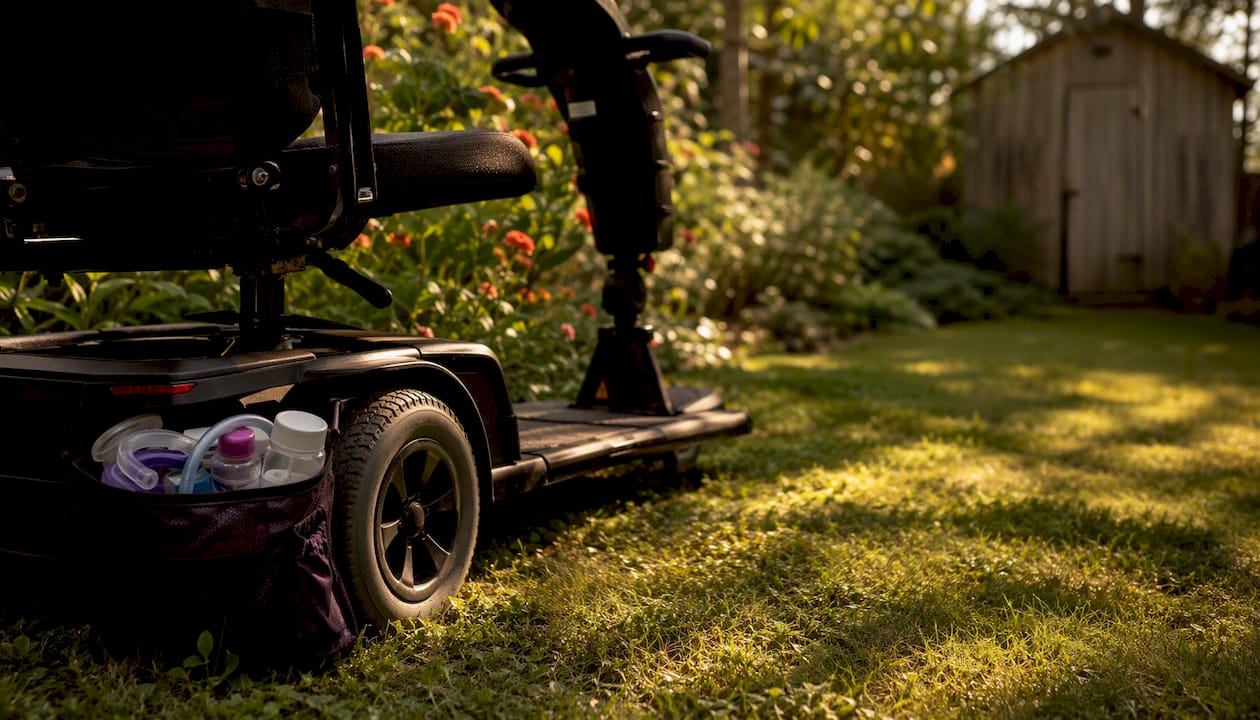
Most mobility scooters are rated between 250 lb and 500+ lb, but the number on the spec sheet is not the number you should plan around. That buffer exists because lab testing happens under controlled conditions, not on rain-slicked Vancouver sidewalks with a winter coat, an oxygen concentrator, and a bag of groceries on board.
Typical capacity bands to know at a glance:
- Travel/compact scooters typically support lower weight capacities.
- Mid-size 3-wheel and 4-wheel scooters offer moderate capacity.
- Heavy-duty and bariatric models are built for higher weight capacities.
Your immediate next steps: weigh the user in typical clothing, add any medical devices and regular cargo, then select a scooter with a capacity higher than your total. If your weight is near a capacity tier boundary, choose the higher tier.
Pro Tip: Store weight low and centred on the frame basket rather than hanging bags from the tiller. Items on the tiller shift the centre of gravity forward and increase tipping risk, especially on slopes.
Key takeaways
| Point | Details |
|---|---|
| Use the 85% rule | Divide total loaded weight by 0.85 to find the minimum rated capacity you need. |
| Total payload, not body weight | Include clothing, medical devices, walking aids, and cargo in every calculation. |
| Choose the next tier up | If your result is close to a category boundary, always round up to the next standard capacity tier. |
| Heavy-duty means different engineering | Reinforced frames, higher-amperage controllers, and stronger brakes, not just a higher number on the label. |
| Seventhchakra for local rentals | Same-day delivery, no deposit, and sanitised scooters across Greater Vancouver, matched to your capacity needs. |
This article is general information, not a substitute for advice from a qualified doctor. Consult a qualified healthcare professional about your own circumstances before acting on anything here.
Table of Contents
- What does a scooter weight limit actually mean?
- Typical capacity ranges by scooter type
- How approaching the limit affects safety and performance
- How to calculate the right capacity for your situation
- Renting versus buying in Greater Vancouver
- How Seventhchakra helps Greater Vancouver families find the right scooter
- What to check when the scooter arrives
- When to choose a bariatric or heavy-duty scooter
- What affects cost and which rental terms to check
- Your action plan: next steps right now
- A local perspective on getting this right
- Seventhchakra mobility scooter rentals in Greater Vancouver
- Sources
- FAQ
What does a scooter weight limit actually mean?
The rated capacity is the maximum total payload a manufacturer has tested the scooter to handle under controlled lab conditions, which include simulated emergency braking, slope navigation, and kerb climbing. Real-world riding adds dynamic forces that lab tests do not fully replicate.
Total payload is not just the rider’s body weight. It includes:
- Clothing and footwear (winter gear in Vancouver can add 5–10 lb)
- Medical devices: oxygen concentrators, portable nebulisers, CPAP equipment
- Walking aids: folding canes, crutches, or a lightweight walker strapped to the frame
- Daily cargo: shopping bags, a backpack, or a camera bag for tourists
- Accessories and their mounting hardware
Operating at or above rated capacity can void the manufacturer’s warranty and may result in an insurance claim being denied. Document your total payload before making any claim.
Safety margin: Manufacturers and specialists recommend keeping loaded weight at or below 80–85% of rated capacity. Using the 85% rule from OzzoCare: divide your total loaded weight by 0.85 to find the minimum rated capacity you need.
Typical capacity ranges by scooter type
Capacity ranges across categories generally fall between 250 lb and 500+ lb. The table below maps common scooter types to their typical ranges.
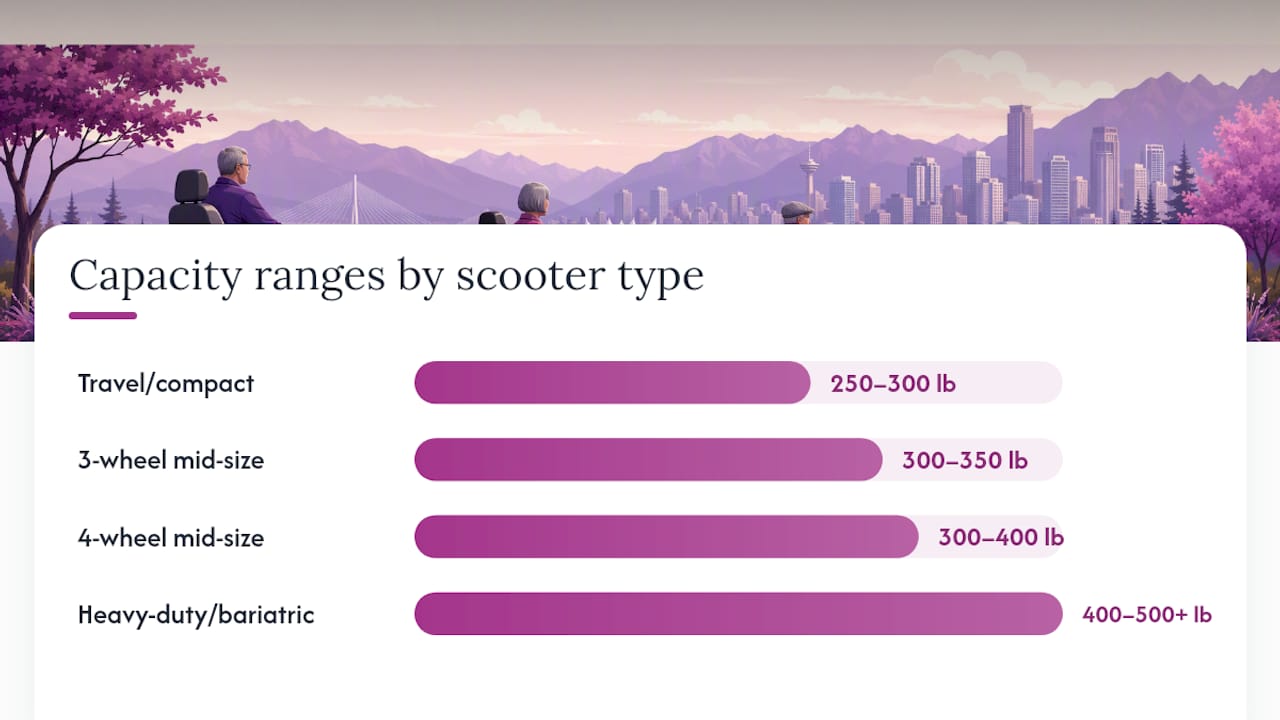
| Scooter type | Typical rated capacity | Approx. in kg |
|---|---|---|
| Travel/compact | 250–300 lb | 250–300 lb |
| 3-wheel mid-size | 300–350 lb | 300–350 lb |
| 4-wheel mid-size | 300–400 lb | 300–400 lb |
| Heavy-duty/bariatric | 400–500+ lb | 400–500+ lb |
Trade-offs to keep in mind:
- Travel/compact: lightest and most portable, but the smallest safety margin; not suited for regular medical-device loads
- 3-wheel mid-size: tighter turning radius, better for indoor use and narrow Vancouver corridors
- 4-wheel mid-size: more stable on uneven pavement; the most common rental choice for recovery and tourism
- Heavy-duty/bariatric: reinforced frames, higher-amperage controllers, and stronger braking; heavier and wider, so check doorway clearance before booking
When your calculation lands near the top of a category, choose the next tier up.
How approaching the limit affects safety and performance
Overloading a mobility scooter triggers a cascade of problems that compound over time:
- Motor and controller overheating: sustained overload causes thermal stress; repeated episodes shorten component life
- Faster battery drain: the motor draws more current to move excess weight, cutting range per charge
- Longer stopping distances: brakes calibrated for rated capacity take more distance to stop an overloaded scooter
- Greater tipping risk: on slopes, kerbs, and uneven pavement, a higher centre of gravity makes the scooter less stable
- Accelerated frame wear: stress fractures and joint failures appear earlier on overloaded frames
Cumulative damage is the hidden cost. Rental providers and insurers can identify overload damage, which affects both warranty claims and liability.
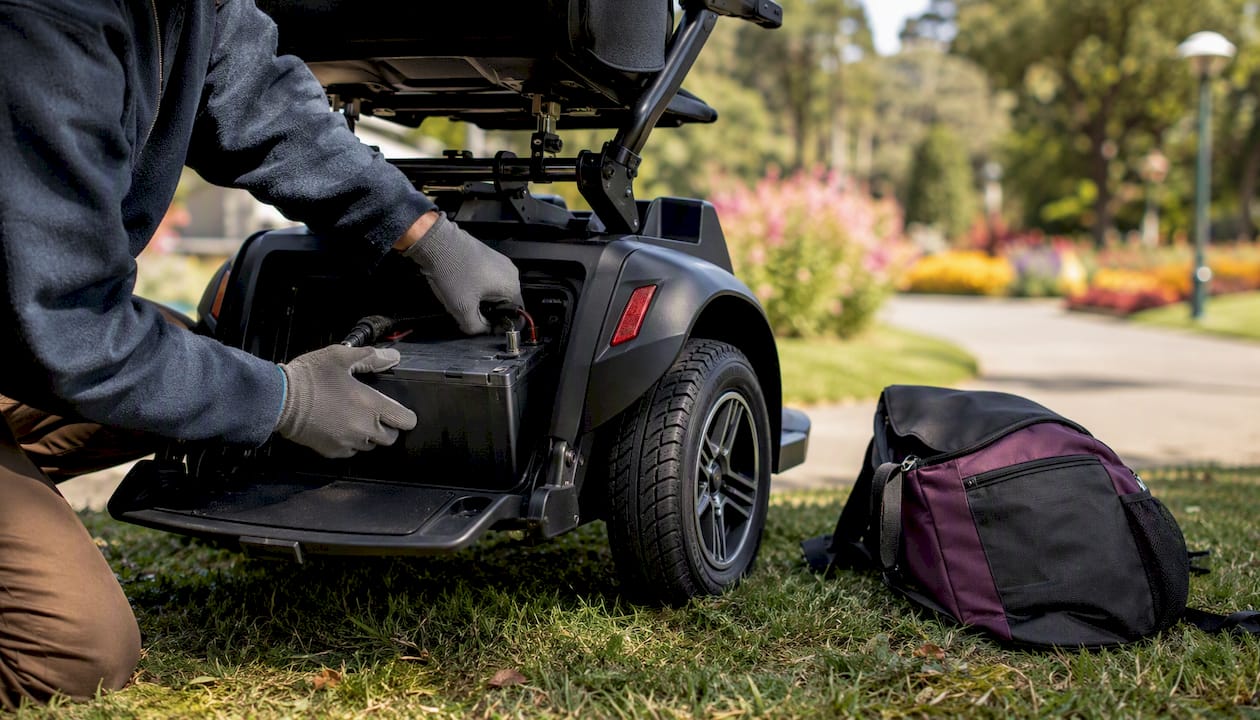
Pro Tip: If considering a larger battery for more range, bear in mind the added weight may increase total payload and necessitate a higher capacity scooter. A higher-rated scooter with a standard battery is often the safer and more cost-effective choice than a lighter scooter with a heavy battery upgrade.
How to calculate the right capacity for your situation
Follow these steps before booking or buying:
- Weigh the user in the clothing they will typically wear, including shoes. In winter, add a realistic estimate for a coat and layers.
- List all carried items: medical devices, walking aids, bags, and any accessories that will travel with the scooter.
- Add seasonal cargo: if the user will shop, carry a camera, or bring luggage on a cruise departure from Vancouver, include those weights.
- Total everything to get your real loaded weight.
- Apply the 85% rule: divide your total loaded weight by 0.85. The result is the minimum rated capacity you need. For a more conservative margin, divide by 0.80.
- Round up to the next standard tier from the table above. Never round down.
Example: a user weighing 220 lb, wearing 8 lb of winter clothing, carrying a 12 lb oxygen concentrator and a 5 lb bag totals 245 lb. Dividing by 0.85 gives a minimum rated capacity of ~288 lb. The nearest standard tier above that is 300 lb (travel/compact), but given how close 288 lb sits to 300 lb, the 3-wheel mid-size at 300–350 lb is the safer choice.
Pro Tip: Always calculate for the heaviest expected configuration, not the average day. A holiday outing or airport transfer with extra luggage is exactly when you need the margin most.
Renting versus buying in Greater Vancouver
Renting makes clear sense for tourists visiting Vancouver, families managing a short post-surgery recovery, or caregivers who need a scooter while a purchased unit is being serviced. Buying becomes the better financial decision when the need extends beyond a few months and the user’s weight and mobility profile are stable.
When renting locally, ask these questions before confirming:
- What is the stated weight capacity of the specific unit being delivered?
- What is the battery’s current condition and realistic range under a full load?
- Are heavy-duty or bariatric models available, and what is the lead time?
- What are the delivery and pickup logistics within Greater Vancouver?
- Is the equipment sanitised before delivery?
Pro Tip: For tourists arriving by cruise ship at Canada Place, same-day delivery to your hotel or ship terminal is available from local rental providers. Confirm the scooter’s travel weight capacity before booking, especially if you plan to carry bags or medical equipment on board.
How Seventhchakra helps Greater Vancouver families find the right scooter
Seventhchakra serves families, caregivers, and healthcare providers across Surrey, Burnaby, Richmond, and the broader Greater Vancouver area with a rental fleet that covers the full range of capacity needs.
Key service features:
- Same-day delivery across Greater Vancouver, including urgent requests
- No upfront deposit required to secure a rental
- Full sanitisation of every unit before delivery
- Tailored rental terms and ongoing support for short-term and long-term needs
- Fleet options spanning 3-wheel scooters, 4-wheel mid-size models, and heavy-duty units for larger payloads
When you call or book, have the user’s total loaded weight ready (calculated using the steps above) and confirm which capacity tier you need. The team can match you to the right unit and arrange delivery to your home, hotel, or care facility.
Pro Tip: If you are also arranging a hospital bed or wheelchair for the same recovery period, ask about bundling rentals. Seventhchakra handles multiple equipment types and can coordinate a single delivery.
What to check when the scooter arrives
Do not sign off on a rental until you have confirmed these items with the user present:
- Seat width and depth: the user should sit with a few centimetres of clearance on each side, not wedged in.
- Armrest clearance: arms should rest naturally without the user leaning to one side.
- Tiller height and angle: the user should reach the controls without hunching or stretching.
- Brake function: test both the hand brake and the automatic park brake on a flat surface.
- Battery charge: confirm the charge level and ask for the realistic range under your expected load.
- Horn and lights: check both, especially if the scooter will be used near traffic.
- Accessory mounting points: confirm baskets or holders are frame-mounted, not tiller-hung.
Then run a brief outdoor trial:
- A short slope test to confirm stability and braking under the user’s actual weight
- A turning-circle check in a realistic space (hallway width, parking lot)
- A weight-distribution check with the user’s regular gear loaded
If anything feels off, contact the rental provider immediately. Reputable local providers will swap the unit or adjust the fit before leaving.
When to choose a bariatric or heavy-duty scooter
A few clear signals point toward a heavy-duty rental:
- Total loaded weight consistently approaches the upper limit of a mid-size category
- The user needs a wider seat for comfort and safe posture
- Medical devices such as oxygen concentrators are carried on every trip
- The scooter will be used on rougher terrain or longer distances regularly
Home and vehicle access deserve attention before a heavy-duty unit arrives. Check:
- Doorway widths: heavy-duty scooters are typically wider; measure before delivery
- Ramp gradient: steeper home ramps may exceed the scooter’s safe climbing angle under full load
- Vehicle lift or hoist capacity: if the scooter travels by car, confirm the lift rating matches the scooter’s weight
- Storage and turning room: larger scooters need more floor space to manoeuvre indoors
True heavy-duty models are engineered differently from standard units with a high capacity label: reinforced frames, higher-amperage motor controllers, and braking systems calibrated for greater loads. That engineering difference is what makes them safe at higher payloads, not just the number on the sticker.
What affects cost and which rental terms to check
Cost drivers for scooter rentals in Greater Vancouver:
- Scooter category: heavy-duty and bariatric units rent at a higher daily or weekly rate than travel or mid-size models
- Rental duration: longer terms typically reduce the effective daily rate
- Delivery and pickup fees: confirm whether same-day delivery carries an additional charge
- Deposit policy: ask explicitly whether a deposit is required and under what conditions it is returned
- Damage and overload clauses: overloading can void warranty coverage and may trigger extra charges under a rental agreement
- Accessory fees: baskets, oxygen-tank holders, and cup holders may be itemised separately
Rental terms to confirm before signing:
- Same-day delivery availability for your specific address in Greater Vancouver
- Sanitisation policy and what it covers
- Support response time if a mechanical issue arises
- Whether bundling with a wheelchair rental or hospital bed rental reduces the overall cost
Your action plan: next steps right now
- Weigh the user in typical clothing, including shoes and any seasonal layers.
- List every item that will travel with the scooter: medical devices, walking aids, bags.
- Add those weights to get your total loaded payload.
- Divide by 0.85 to find your minimum rated capacity, then round up to the next standard tier.
- Contact a local rental provider with that number and confirm they have a matching unit available.
- Arrange same-day delivery if the need is urgent, and confirm the delivery address and access details.
- Run the on-site fit and trial checklist when the scooter arrives.
Have these details ready when you call: the user’s total loaded weight, the delivery address, any access constraints (stairs, narrow doorways), and the expected rental duration.
For urgent requests in Greater Vancouver, Seventhchakra can typically arrange same-day delivery. Having the capacity calculation done before you call speeds the process considerably.
A local perspective on getting this right
The weight capacity question comes up in nearly every rental conversation, and the most common mistake is calculating for the user’s body weight alone. A caregiver books a compact scooter for a parent who weighs 200 lb, then the unit arrives and the oxygen concentrator, winter coat, and shopping bag push the real payload to 240 lb on a scooter rated for 250 lb. That leaves almost no margin, and the scooter’s range and stability suffer for it.
In Greater Vancouver, where sidewalks can be uneven and winter rain adds slippery surfaces, that margin matters more than it might in a flat, dry climate. It is the difference between a scooter that performs reliably for weeks and one that starts showing problems after a few days of real use.
The Pride Mobility consumer safety guide reinforces what local rental experience confirms: total payload, accessory placement, and a proper fit trial at delivery are the three things that prevent the most common problems. Get those right and the scooter will do its job.
Seventhchakra mobility scooter rentals in Greater Vancouver
No deposit, same-day delivery, and fully sanitised equipment: that is what Seventhchakra offers families and caregivers across Greater Vancouver who need a mobility scooter quickly and safely. The fleet covers 3-wheel scooters for indoor and light outdoor use, 4-wheel mid-size models for everyday recovery and tourism, and heavy-duty units for larger payloads. Rental terms are tailored to your timeline, whether that is three days or three months.
Tell the team your total loaded weight and your delivery address. They will match you to the right capacity tier and get the scooter to you the same day. Book your mobility scooter rental now or call to confirm availability for your specific needs in Surrey, Burnaby, Richmond, or Vancouver.
Sources
- What Really Happens When You Overload a Mobility Scooter? A Safety Guide
- Mobility Scooter Weight Limits: Complete Guide
- Wheelchair & Scooter Weight Capacity Guide: The 85% Rule | OzzoCare
- Pride Mobility consumer safety guide
FAQ
What is the typical weight limit for a mobility scooter?
Most mobility scooters are rated between 250 lb and 500+ lb depending on the category. Travel scooters typically support 250–300 lb, mid-size models 300–400 lb, and heavy-duty units 400–500+ lb.
How do I calculate the right scooter capacity for my needs?
Add your body weight, clothing, medical devices, and any cargo to get your total loaded weight, then divide by 0.85. The result is the minimum rated capacity you need; round up to the next standard tier.
What happens if you exceed a scooter’s weight limit?
Exceeding the rated capacity can cause motor overheating, faster battery drain, longer stopping distances, and greater tipping risk. It can also void the manufacturer’s warranty and may result in an insurance claim being denied.
Can Seventhchakra deliver a heavy-duty scooter the same day in Vancouver?
Seventhchakra offers same-day delivery across Greater Vancouver, including heavy-duty and bariatric models, with no upfront deposit required. Contact them with your capacity requirements and delivery address to confirm availability.
Should I store bags on the tiller or the frame basket?
Always use the frame-mounted basket. Items hung on the tiller shift the centre of gravity forward and increase tipping risk, particularly on slopes and uneven pavement.


