
Continuum of care equipment refers to the assistive and home-care devices that move with a patient across settings — hospital, rehabilitation, home, long-term care — so that treatment stays safe and uninterrupted at every handoff. If you or someone you care for is approaching a discharge or transfer, three steps matter right now:
- Ask your clinician or occupational therapist which specific devices are prescribed for your next setting.
- Check your provincial assistive device programme for eligibility (Ontario’s Assistive Devices Program, BC’s Medical Supplies and Equipment programme, and equivalents elsewhere).
- Contact a local rental provider such as Seventhchakra for same-day access while programme approvals are pending.
Table of Contents
- What does the continuum of care mean in Canada’s health system?
- Which devices count as continuum of care equipment?
- Why does equipment matter during care transitions?
- How do you obtain continuum of care equipment in Canada?
- Should you rent or buy continuum of care equipment?
- What is the continuum of care in Canadian healthcare?
- Key takeaways
- What providers prioritise when supporting care transitions
- Same-day rentals in Greater Vancouver from Seventhchakra
- Useful sources
- FAQ
What does the continuum of care mean in Canada’s health system?
Canada’s health system is built around the idea that care should follow the patient, not the institution. The continuum of care rests on two linked concepts: continuity (a coherent series of interventions matched to the patient’s needs) and coordination (proactively bringing providers together across settings so nothing falls through the cracks).
In practice, a patient might move from an acute hospital ward to a rehabilitation unit, then home with community support, and eventually into long-term care. Each move is a transition point where things can go wrong. The College of Physicians and Surgeons of Ontario is explicit: continuity depends on coordinated handoffs and accurate information exchange, not on a single provider being available around the clock. Electronic medical records (EMRs) and patient portals are increasingly central to that exchange, carrying medication lists, equipment prescriptions, and functional assessments from one team to the next.
The RNAO transitions in care guideline reinforces this: safe transitions require collaboration among the full interprofessional team and the person receiving care. Equipment is part of that plan, not an afterthought.
Which devices count as continuum of care equipment?
The core categories are mobility aids, specialised beds, transfer and lift equipment, toileting aids, and monitoring devices. Each one addresses a specific safety gap that opens up when a patient moves between settings.
- Wheelchairs and mobility scooters preserve independent movement and reduce fall risk after discharge.
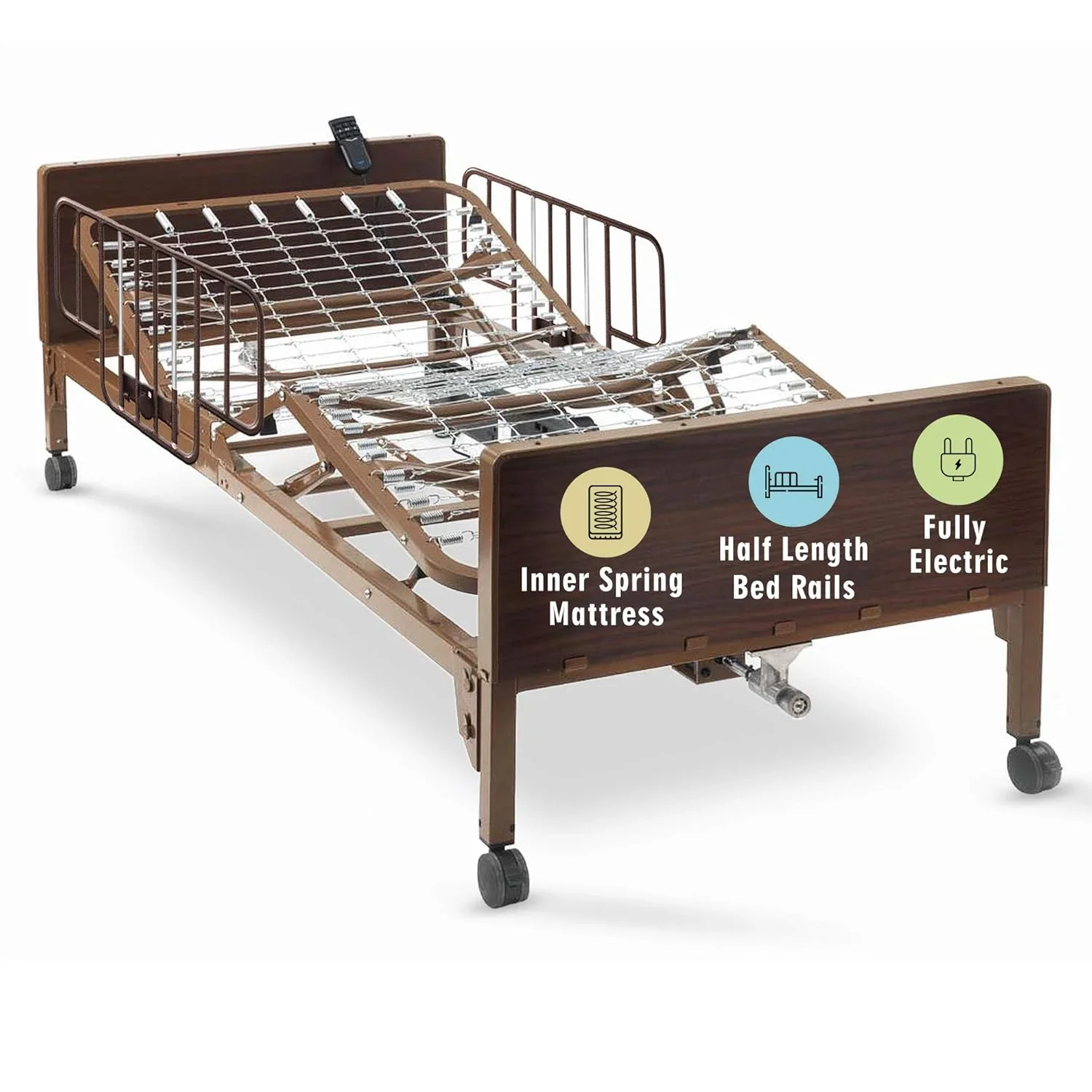
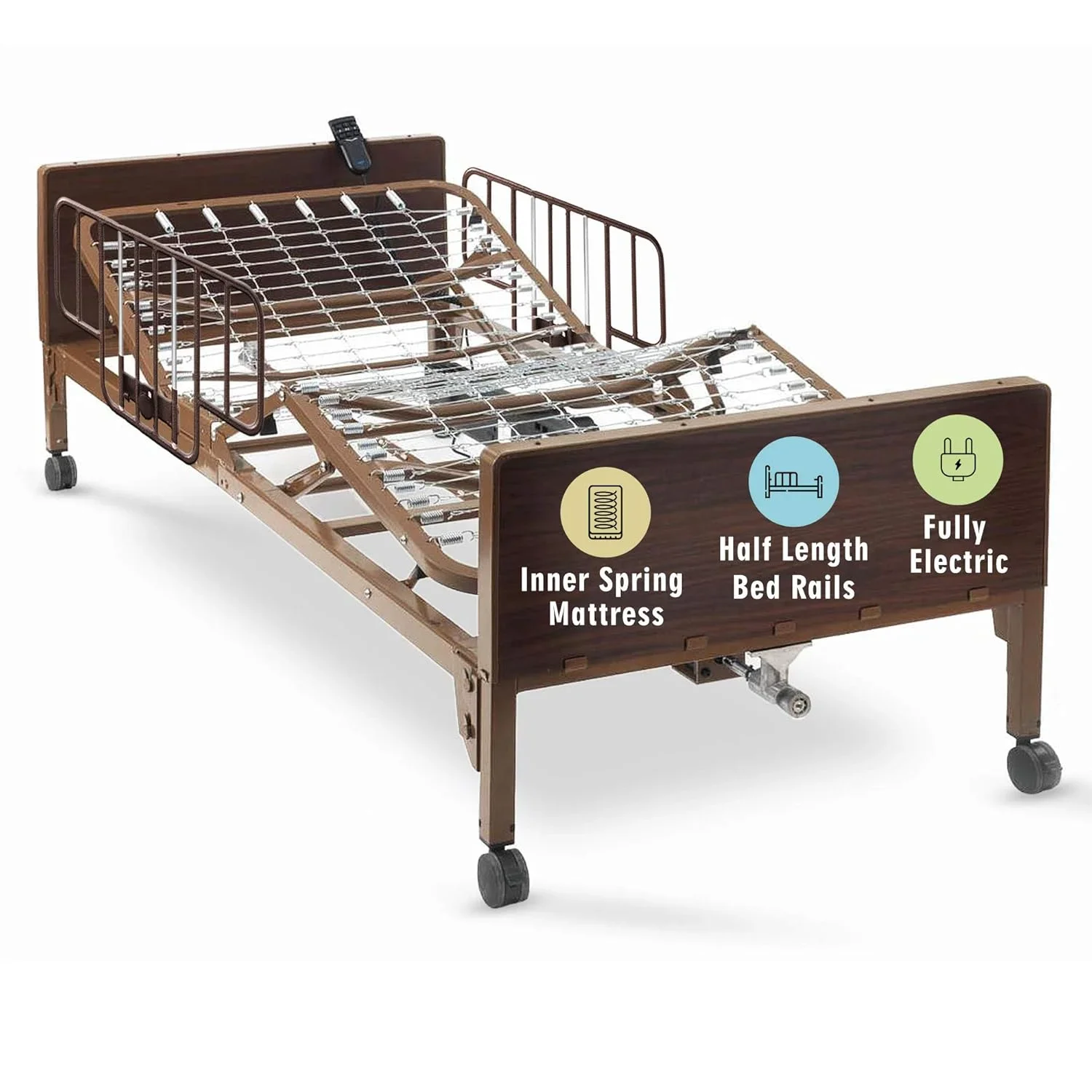
- Hospital-style home beds (electric, adjustable) allow safe post-operative positioning and caregiver access for wound care.
- Walkers and rollators support partial weight-bearing during rehabilitation at home.
- Patient lifts and transfer aids protect both the patient and the caregiver during bed-to-chair or toilet transfers.
- Commodes and shower chairs address toileting safety when bathroom access is limited.
- Monitoring devices (blood pressure cuffs, pulse oximeters, glucose monitors) support chronic disease management across settings.
Mobility aids reduce emergency visits and can delay demand for long-term care by enabling safe ageing at home. Statistics Canada survey data also show that wheeled mobility device users often have unmet needs for home modifications and supplementary devices — ramps, power chairs, grab bars — meaning a single piece of equipment rarely covers every safety need.
| Device category | Typical setting(s) | Primary benefit |
|---|---|---|
| Wheelchair / scooter | Home, rehab, community | Mobility and fall prevention |
| Adjustable hospital bed | Home, LTC | Safe positioning, caregiver access |
| Walker / rollator | Home, rehab | Partial weight-bearing support |
| Patient lift / transfer aid | Home, LTC | Safe transfers, caregiver protection |
| Commode / shower chair | Home, LTC | Toileting safety |
| Monitoring devices | Home, community | Chronic disease management |
Why does equipment matter during care transitions?
The short answer: the right device at the right moment keeps people out of emergency departments and out of long-term care beds they do not yet need.
Ontario’s Assistive Devices Program funded a large number of mobility products in recent years, against a backdrop of long LTC waiting lists across the province. That volume reflects how central assistive devices have become to keeping seniors at home safely. Equipment is not the whole answer, though. The McMaster Health Forum finds that educating patients and caregivers about which assistive technologies are needed measurably improves adherence, reduces anxiety, and makes transitions safer. A hospital bed delivered without a caregiver trained to use the height controls is only half a solution.
Stat to know: Ontario’s ADP funded over 150,000 mobility products in 2021–22, underscoring how assistive devices anchor the province’s strategy for ageing at home.
How do you obtain continuum of care equipment in Canada?
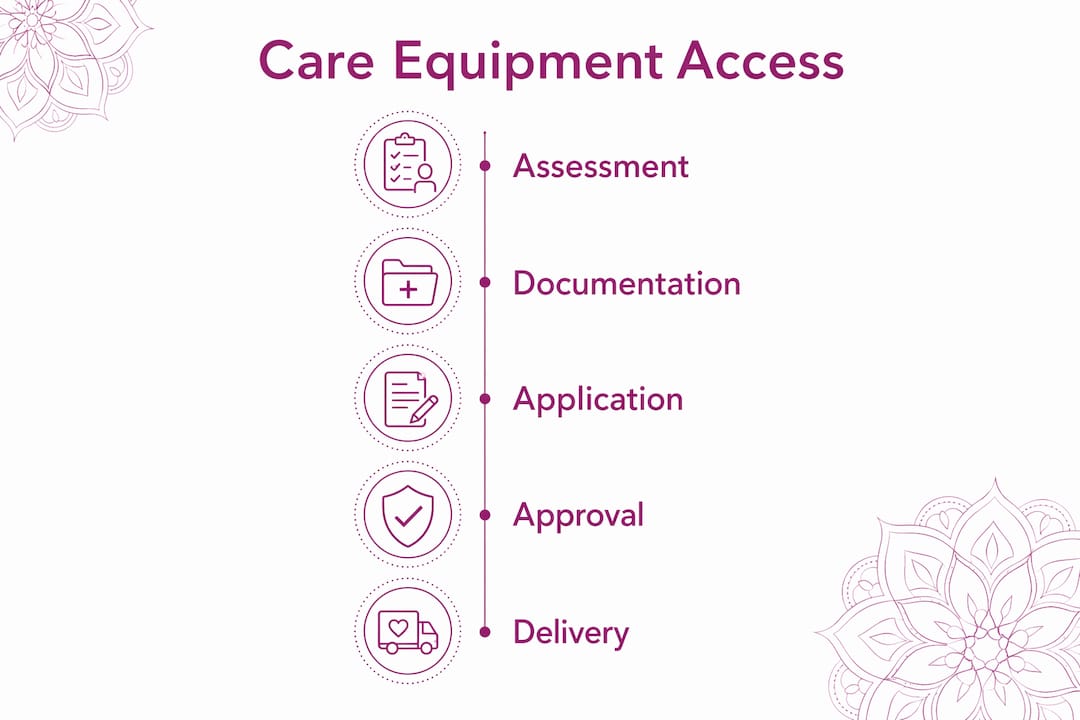
Provincial programmes exist, but they vary considerably. Follow this sequence:
- Assess the need. An occupational therapist or physiotherapist identifies which devices match the patient’s functional level and home environment.
- Get a clinical prescription. Most provincial programmes and private insurers require a physician or OT prescription before approving funding.
- Check private insurance first. Most provinces act as payer of last resort, meaning private coverage must be exhausted before public funding kicks in.
- Apply to your provincial programme. Eligibility, covered devices, and application procedures differ by jurisdiction. BC requires recipients to be on social assistance for wheelchair funding; Ontario’s ADP covers up to 75% of approved device costs for eligible residents.
- Rent locally as a bridge. If approval takes weeks, a local rental provider fills the gap immediately.
Pro Tip: Compile a documentation file before applying: physician notes, OT assessment, mobility trial results, and any private insurance denial letters. The McMaster Health Forum evidence brief on assistive technology access recommends transparent eligibility criteria and thorough documentation to improve approval rates.
Eligibility is often shaped by social and economic policy as much as clinical need, so two patients with identical diagnoses can face very different out-of-pocket costs depending on their province. Check your provincial health authority’s programme page directly for current criteria.
Should you rent or buy continuum of care equipment?
Rent for short-term or uncertain recovery; buy for long-term, customised needs. That rule covers most situations.
| Situation | Recommended approach |
|---|---|
| Post-surgery recovery (weeks to months) | Rent |
| Awaiting provincial programme approval | Rent |
| Permanent mobility limitation | Buy or apply for funded device |
| Travelling or visiting | Rent |
| Custom fit required (power chair, custom seating) | Buy through funded programme |
When you contact a rental provider, ask these questions before committing:
- Is the equipment sanitised and documented before delivery?
- Is same-day or next-day delivery available?
- Are there deposits, and what are the cancellation terms?
- Who handles repairs or replacements if the device fails?
- Can the rental term be extended month-to-month?
Red flags include vague sanitisation answers, large non-refundable deposits, and no clear repair pathway. For readers exploring wheelchair rental options in Vancouver or comparing local providers, Seventhchakra’s pricing and sanitisation process are publicly listed. Long-term care facilities and operators increasingly use integrated platforms like MyLTC Apps to coordinate equipment handoffs and communication between care teams, which is worth knowing if you are managing a transition into a facility.
What is the continuum of care in Canadian healthcare?
The continuum of care is the full spectrum of health and social services a person may need over time, delivered in a coordinated way so that moving between providers or settings does not interrupt treatment. Canada’s model encompasses prevention, primary care, acute hospital care, rehabilitation, home and community care, and long-term care. The goal is that a patient’s information, care plan, and equipment travel with them rather than having to be reconstructed at each new setting. Good communication between care points — whether through shared EMRs, discharge summaries, or direct provider handoffs — is what holds the continuum together.
Key takeaways
Continuum of care equipment is the set of assistive devices that keeps a patient’s care safe and uninterrupted as they move between hospital, rehabilitation, home, and long-term care settings in Canada.
| Point | Details |
|---|---|
| Definition | Assistive devices that support continuity across care settings: wheelchairs, beds, lifts, commodes, and monitoring devices. |
| Provincial variation | Eligibility and covered devices differ by province; most programmes act as payer of last resort after private insurance. |
| Documentation matters | Compile OT assessments, physician notes, and insurance records before applying to provincial programmes to improve approval odds. |
| Rent as a bridge | Renting locally fills the gap while provincial approvals are pending, especially for short-term or uncertain recovery periods. |
| Seventhchakra | Offers same-day wheelchair, scooter, and hospital bed rentals in Greater Vancouver with no deposit required and sanitised equipment. |
What providers prioritise when supporting care transitions
Speed and fit are the two things that actually matter when a family calls during a discharge. A device that arrives two days late, or one that is the wrong size, undoes the entire transition plan.

From a provider standpoint, same-day delivery is not a marketing feature — it is a clinical necessity for families who receive a discharge call on a Friday afternoon. Seventhchakra’s approach centres on exactly that: sanitised equipment delivered the same day, tailored rental terms that flex with recovery timelines, and ongoing support so families are not left troubleshooting alone. Collaborating with the discharging team and the family caregiver during handoffs — confirming bed height, wheelchair width, and transfer technique before the patient arrives home — is what separates a smooth transition from a return trip to the emergency department.
Same-day rentals in Greater Vancouver from Seventhchakra
When a discharge happens faster than a provincial programme can process paperwork, you need equipment today, not next week. Seventhchakra delivers hospital beds, mobility scooters, and wheelchairs across Greater Vancouver the same day, with no upfront deposit and every unit sanitised before it leaves the warehouse.
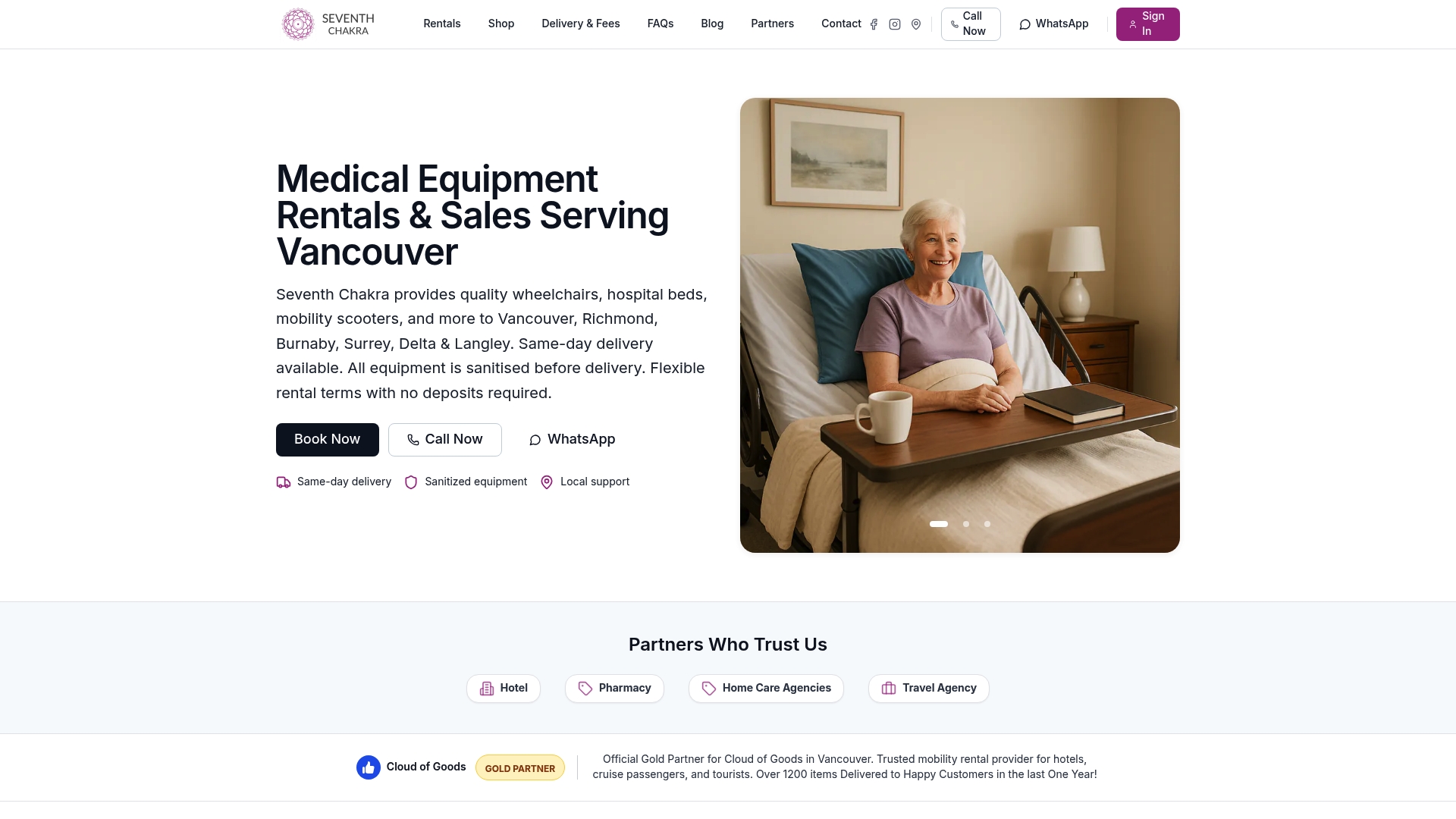
Rental terms are flexible — weekly, monthly, or longer — so you are not locked into a timeline when recovery is unpredictable. Transparent pricing means no surprise fees at return. To check availability or reserve equipment for an upcoming discharge, visit Seventhchakra’s rental pages or call directly. The right device should be waiting when your family member walks through the door.
Useful sources
| Source | Why it’s worth reading |
|---|---|
| CPSO — Continuity of Care | Clinical guidance on handoffs, EMRs, and physician obligations during transitions in Ontario. |
| RNAO Transitions in Care Guideline | Evidence-based best practices for interprofessional teams managing care transitions across all settings. |
| CIHI — Continuum of Care | National data and framing on how Canada measures and reports on care across settings. |
| McMaster Health Forum — Assistive Technologies | Evidence brief on equitable access, public financing, and eligibility criteria for assistive devices in Canada. |
| StrategyCorp — Assistive Devices and Ageing at Home | Ontario-focused analysis of ADP volumes, LTC waiting lists, and the cost-effectiveness of assistive devices. |
| NAO Health Observatory — Public Coverage for Mobility Aids | Rapid review of provincial programme variability and payer-of-last-resort rules across Canada. |
| Statistics Canada — Mobility Device Users | Survey data on unmet needs for home modifications and supplementary devices among Canadians with disabilities. |
Check your provincial health authority’s programme page for current eligibility criteria and application forms, as these change periodically.
FAQ
What is continuum of care equipment, exactly?
It is the set of assistive and home-care devices — wheelchairs, hospital beds, walkers, lifts, commodes, and monitoring tools — that support a patient’s safety and independence as they move between care settings in Canada.
Does provincial insurance cover continuum of care equipment?
Most provinces offer some public funding, but eligibility and covered devices vary widely. Most programmes act as payer of last resort, so private insurance must be used first; check your provincial health authority’s programme page for current criteria.
When should I rent instead of buy?
Rent when recovery is short-term or uncertain, when you are waiting for provincial programme approval, or when you need equipment immediately after a discharge. Buy (or apply for a funded device) when the need is permanent and a custom fit is required.
How does Seventhchakra support care transitions in Greater Vancouver?
Seventhchakra offers same-day delivery of sanitised wheelchairs, mobility scooters, and hospital beds across Greater Vancouver with no deposit required, making it a practical bridge while provincial funding is being arranged.
What questions should I ask a rental provider before booking?
Ask about sanitisation procedures, same-day availability, deposit and cancellation terms, and who handles repairs if the device malfunctions during the rental period.
Recommended
- Hospital Equipment for Home Use in Vancouver: Complete Buying & Rental Guide (2026) | Seventh Chakra
- Complete Guide to Home Medical Equipment in Vancouver: Rentals, Sales & What to Choose | Seventh Chakra
- Medical Equipment Tips & Guides | Seventh Chakra Medical
- Where to Buy the Best Mobility Equipment in Vancouver: Complete 2026 Buyer’s Guide | Seventh Chakra