

A transport wheelchair is defined as a lightweight, caregiver-propelled mobility device designed for short trips rather than independent, full-time use. Unlike a standard manual wheelchair, a transport chair relies entirely on a caregiver or companion to push it. Transport wheelchairs typically weigh between 15 and 26 lbs and support occupants up to 300 lbs, making them one of the most portable options in the mobility aid category. Seventhchakra supplies these chairs across Vancouver, Richmond, and Surrey for caregivers who need reliable, short-term access without the commitment of a full purchase.
What is a transport wheelchair and how does it differ from a standard one?
A transport wheelchair, also called a transit chair, is built around one core principle: the caregiver does the work. The chair has four small wheels, typically 8–12 inches in diameter, and no hand rims on the rear wheels. That last detail matters. Without hand rims, the person sitting in the chair cannot propel themselves forward at all. This is the defining structural difference between a transport chair and a standard manual wheelchair.
Standard manual wheelchairs have large rear wheels, usually 22–24 inches, fitted with hand rims that allow the occupant to push themselves independently. They are built for people who spend significant time in a wheelchair and need that autonomy. Transport chairs sacrifice independence for portability. Transport chairs are approximately 47–49% lighter than standard wheelchairs, which makes loading them into a car boot or storing them in a closet far more practical.

The table below summarises the key differences at a glance.
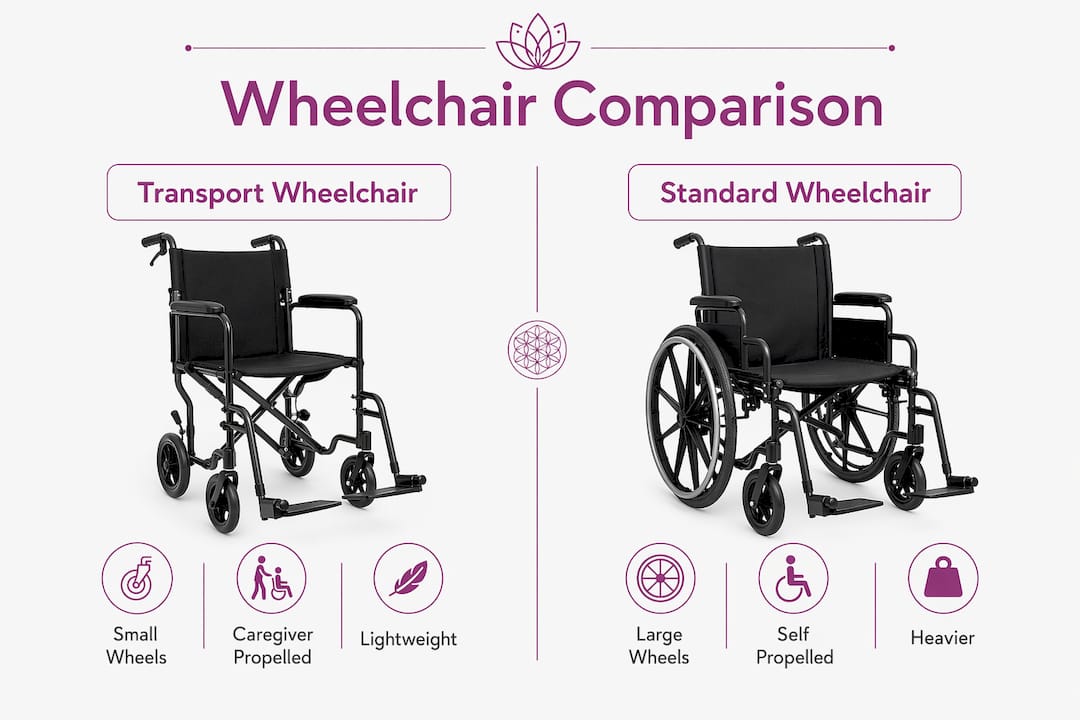
| Feature | Transport wheelchair | Standard manual wheelchair |
|---|---|---|
| Rear wheel size | 8–12 inches | 22–24 inches |
| Hand rims | None | Present |
| Self-propulsion | Not possible | Yes |
| Typical weight | 15–26 lbs | 30–40+ lbs |
| Best use | Short trips, caregiver-assisted | Daily independent use |
| Foldability | Compact, easy fold | Folds, but bulkier |
Pro Tip: If the person you are caring for has any upper body strength and may need to move independently even briefly, a transport chair is the wrong choice. Choose a self-propelled model instead.
What are the benefits of transport wheelchairs?
Transport wheelchairs solve a specific problem: getting someone from point A to point B safely, without the bulk and cost of a full-sized wheelchair. The benefits are clearest when the need is temporary or occasional.
The main advantages include:
- Lighter weight. At 15–26 lbs, most transport chairs fit easily into a standard car boot. Caregivers with limited strength can lift and load them without assistance.
- Compact storage. The folding frame collapses to a slim profile. This matters in small apartments, hospital rooms, or hotel spaces where storage is limited.
- Lower cost. Transport wheelchairs range from about $150 to $500, which is generally less than self-propelled models. That price reflects the simpler design and shorter expected use.
- Reduced user fatigue. The occupant does not need to exert any physical effort. This is particularly valuable after surgery, during illness, or for elderly individuals with limited stamina.
- Ease of manoeuvring indoors. The smaller footprint makes navigating narrow hallways, doorways, and crowded spaces easier than with a full-sized chair.
The ideal use cases for a transport wheelchair are short trips on smooth, even surfaces. Think medical appointments, airport terminals, shopping centres, or accessible attractions like Stanley Park. Smaller wheels limit outdoor use over uneven terrain, so gravel paths, cobblestones, and steep inclines are not suitable environments. Caregivers should plan routes accordingly.
Transport chairs are not designed for full-time daily use. Someone who spends most of their day in a wheelchair needs a self-propelled model with proper postural support. A transport chair fills the gap for recovery periods, travel, and occasional outings.
What safety considerations should caregivers know?
Safety with a transport wheelchair starts before the occupant sits down. The folding backrest on many transport chair models can be a weak point if not properly locked. Half-folding backrests must click firmly into the locked position before any weight is placed on the chair. Skipping this step can cause the backrest to collapse unexpectedly.
Weight capacity is a firm limit, not a guideline. Standard transport wheelchairs support up to 300 lbs, while heavy-duty versions handle up to 400 lbs. Exceeding the rated capacity stresses the frame and increases the risk of structural failure. Always confirm the chair’s weight rating before use.
Key safety checks before every outing:
- Lock the backrest fully before the occupant sits.
- Engage the wheel brakes whenever the chair is stationary.
- Confirm the footrests are in the correct position before moving.
- Check that the folding frame is fully open and latched.
- Assess the terrain ahead and avoid uneven or wet surfaces.
Pro Tip: Caregivers should push from the handles with their back straight and core engaged. Leaning forward while pushing on a slope puts significant strain on the lower back over time.
One critical distinction caregivers often miss: not all transport wheelchairs are safe for use inside a moving vehicle. Only chairs certified under ANSI/RESNA WC19 or ISO 7176/19 have been crash-tested for motor vehicle travel. A standard transport chair should never be used as a vehicle seat. Transfer the occupant to a standard vehicle seat and secure the folded chair separately.
How to choose the right transport wheelchair for your needs
Choosing the right transport chair comes down to matching the chair’s specifications to the occupant’s body, the caregiver’s strength, and the environments where it will be used. Work through these steps before purchasing or renting.
- Confirm the weight capacity. Measure the occupant’s weight and choose a chair rated at least 10–15% above that figure. This provides a safety margin and reduces frame stress over time.
- Measure seat width. Seat widths on transport chairs typically range from 16 to 20 inches. The occupant should be able to sit with a small gap on each side, not squeezed in or sliding around.
- Assess the primary terrain. Smooth indoor floors and paved paths suit standard transport chairs well. If outdoor use on slightly uneven ground is expected, look for models with slightly larger rear wheels for better stability.
- Test the folding mechanism. The chair should fold and unfold in under 30 seconds without requiring significant force. A caregiver who struggles with the fold will avoid using it, which defeats the purpose.
- Consider the caregiver’s height. Handle height affects pushing comfort. Adjustable handles are worth the modest extra cost for caregivers who are significantly taller or shorter than average.
- Consult a healthcare professional. An occupational therapist or physiotherapist can assess the occupant’s posture, skin integrity, and support needs. Matching chair choice to current user capabilities rather than a permanent mobility label leads to better outcomes for both occupant and caregiver.
Renting before buying is a practical strategy for temporary needs. It lets caregivers test a specific model in real conditions before committing to a purchase. Seventhchakra offers flexible rental terms with no upfront deposit, which makes this trial approach accessible for families across the Vancouver region.
Key takeaways
A transport wheelchair is the right choice when the need is temporary, the terrain is smooth, and a caregiver is consistently available to push.
| Point | Details |
|---|---|
| Core definition | A transport wheelchair is caregiver-propelled, with small wheels and no hand rims for self-propulsion. |
| Weight advantage | Transport chairs weigh 15–26 lbs, roughly 47–49% lighter than standard manual wheelchairs. |
| Safety first | Always lock the folding backrest before use and confirm the weight capacity matches the occupant. |
| Terrain limits | Small wheels suit smooth, paved surfaces. Avoid gravel, steep slopes, and wet outdoor terrain. |
| Vehicle travel caution | Only ANSI/RESNA WC19 or ISO 7176/19 certified chairs are safe for use inside a moving vehicle. |
What I have learned from watching caregivers choose the wrong chair
The most common mistake I see is caregivers choosing a transport chair because it is lighter and cheaper, when the person they are caring for actually needs the option to move independently, even occasionally. A transport chair removes that option entirely. Once you take away the hand rims, you take away autonomy. That trade-off is worth it for short-term recovery or travel. It is not worth it for someone who will spend months in a chair and needs to reach for a glass of water without calling for help.
The second mistake is underestimating caregiver strain. Pushing a transport chair on flat ground is easy. Pushing one up a ramp, across a gravel path, or through a crowded venue for two hours is physically demanding. Caregivers who do not account for their own physical limits end up exhausted, which creates risk for the occupant. A lighter chair does not mean an effortless one.
What I find genuinely useful about transport chairs is how well they serve a specific window of need. Post-surgery recovery, a visiting family member with limited mobility, a day trip to Granville Island with an elderly parent. These are exactly the situations where a transport chair earns its place. The problem is when caregivers treat it as a permanent solution because it was the first thing they found and it seemed good enough.
Mobility needs change. A chair that works well in week two of recovery may be completely wrong by week eight. Revisit the choice regularly, and do not hesitate to switch to a self-propelled model when the occupant’s strength and environment call for it.
— Chandan
Transport wheelchair rentals from Seventhchakra
Seventhchakra provides lightweight transport wheelchairs for rent across Vancouver, Richmond, and Surrey, with same-day delivery and no upfront deposit required.

Every chair is sanitised before delivery, so caregivers receive equipment that is ready to use immediately. Rental terms are flexible, whether the need is for a week of post-surgical recovery or a month-long visit from a family member. For caregivers in the Richmond area, medical equipment rental in Richmond is available with transparent pricing and no hidden fees. Contact Seventhchakra directly to discuss which model suits the occupant’s weight, seat size, and daily environment.
FAQ
What is the main difference between a transport and a manual wheelchair?
A transport wheelchair has small wheels and no hand rims, so it must be pushed by a caregiver. A standard manual wheelchair has large rear wheels with hand rims that allow the occupant to propel themselves independently.
Can a transport wheelchair be used inside a vehicle?
Not safely, unless it carries an ANSI/RESNA WC19 or ISO 7176/19 certification. Standard transport chairs are not crash-tested for vehicle travel. The occupant should transfer to a vehicle seat, and the folded chair should be secured separately.
How much does a transport wheelchair weigh?
Most transport wheelchairs weigh between 15 and 26 lbs, which is roughly 47–49% lighter than a standard manual wheelchair. That lighter weight is the primary reason caregivers choose them for short trips and travel.
What weight can a transport wheelchair support?
Standard transport wheelchairs support up to 300 lbs. Heavy-duty models are rated for up to 400 lbs. Always confirm the chair’s rated capacity before use and choose a model with a margin above the occupant’s actual weight.
Are transport wheelchairs suitable for outdoor use?
Transport wheelchairs work well on smooth, paved surfaces such as hospital corridors, shopping centres, and paved paths. Their small wheels make them poorly suited for gravel, grass, cobblestones, or steep inclines, where pushing becomes difficult and the risk of tipping increases.


