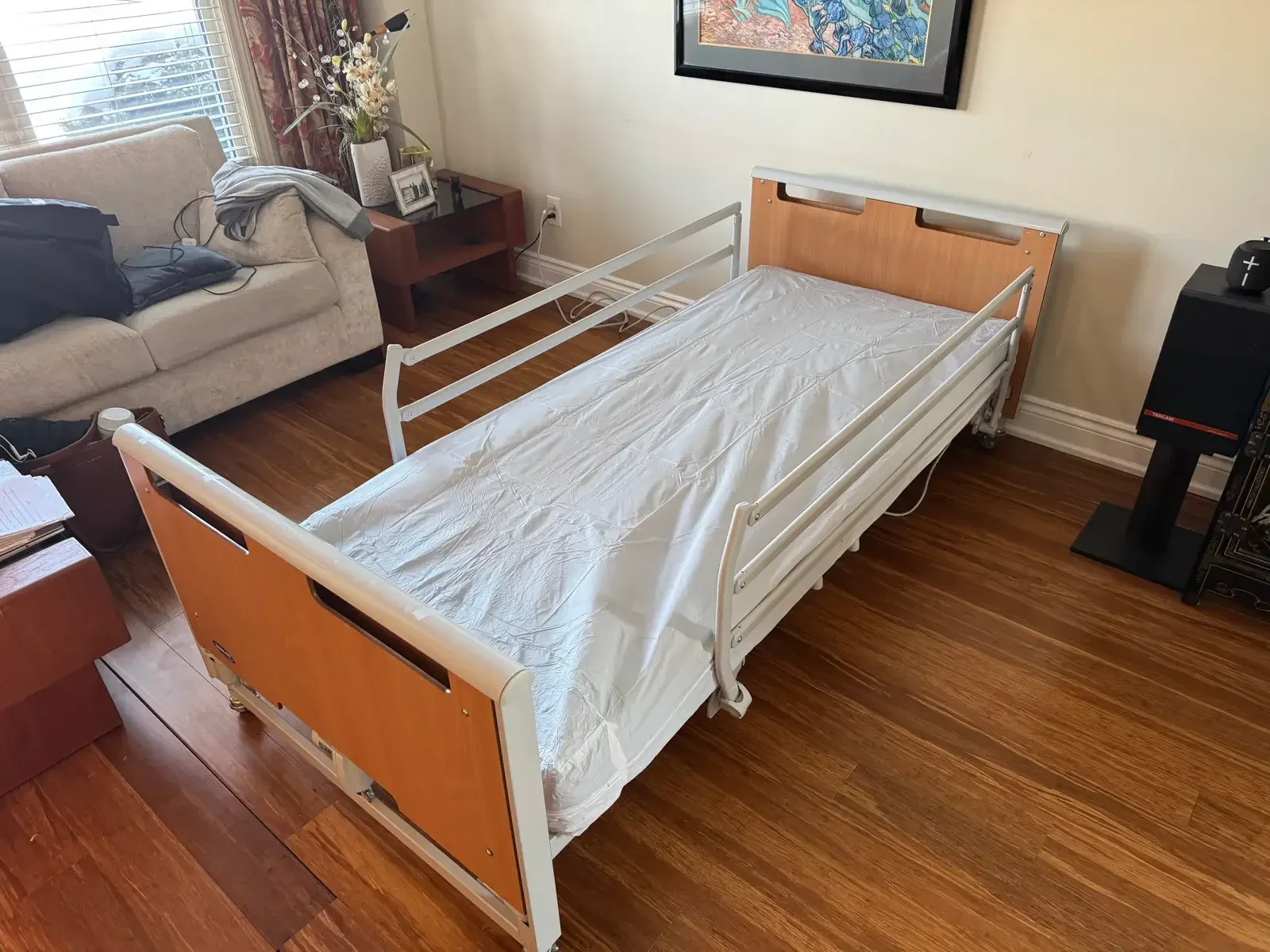
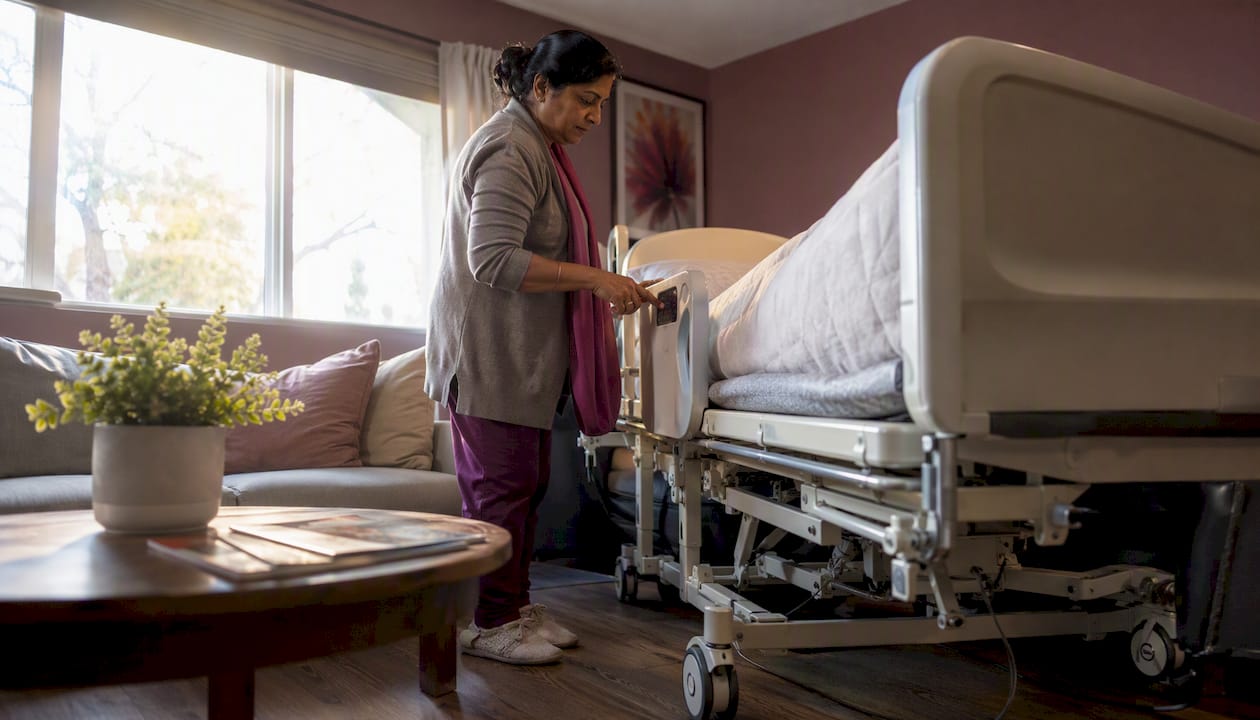
For most Canadian home-care situations, a full-electric low-height hospital bed is the most practical choice. It lets one caregiver adjust the bed height with a button press, which protects their back during transfers and repositioning. The low-height function drops the sleeping surface to a low level from the floor, cutting fall-injury risk for patients with dementia or poor balance.
- Choose full-electric when the patient spends significant time in bed, needs frequent repositioning, or when the caregiver has back concerns. The motor handles height, head, and foot adjustments independently.
- Choose a manual or semi-electric bed for short post-op recoveries (six weeks or less) where cost is the priority and a second person is available to crank height adjustments.
If you need a bed today in Greater Vancouver, Seventhchakra offers same-day hospital bed rental with no deposit and full sanitization before delivery. If you are comparing purchase options, the sections below walk through every decision point.
Table of Contents
- What types of home hospital beds are there?
- What features matter most on any home hospital bed?
- How do you choose the right mattress for a hospital bed?
- How do you choose the best bed for your specific situation?
- What does a home hospital bed cost in Canada?
- What should you insist on at delivery and installation?
- When is a low bed the right clinical choice?
- Seventhchakra: same-day hospital bed rental in Greater Vancouver
- Key takeaways
- The part most guides skip
- Useful sources and provincial funding contacts
- FAQ
What types of home hospital beds are there?
Hospital beds used at home fall into three main power categories, plus two specialty types worth knowing.
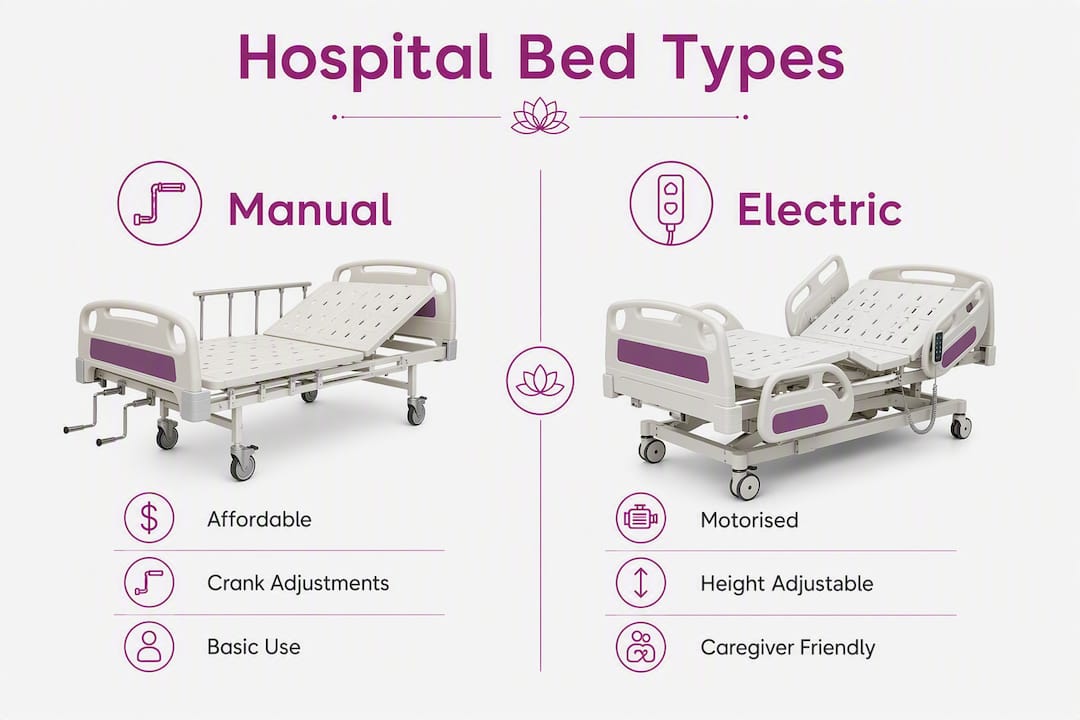
Manual (crank) beds use hand cranks to adjust head, foot, and height positions. They are the most affordable option and work well for short-term post-surgical recovery when a caregiver or family member is always present. The trade-off is physical effort: every adjustment requires someone to turn a crank, which adds up quickly over a long recovery.
Semi-electric beds motorise the head and foot sections but keep height adjustment manual. They suit situations where the patient controls their own comfort (head elevation for reading, foot elevation for swelling) but where height changes happen infrequently. Rental rates for semi-electric models are the most common in Canada.
Full-electric beds motorise everything, including the hi-lo height function. This is the category most occupational therapists and home-care nurses recommend for long-term care because electric height adjustment materially reduces caregiver back strain and speeds safe patient transfers. Advanced models also offer Trendelenburg, reverse Trendelenburg, and cardiac chair positioning, which matter for patients with respiratory or circulatory conditions.
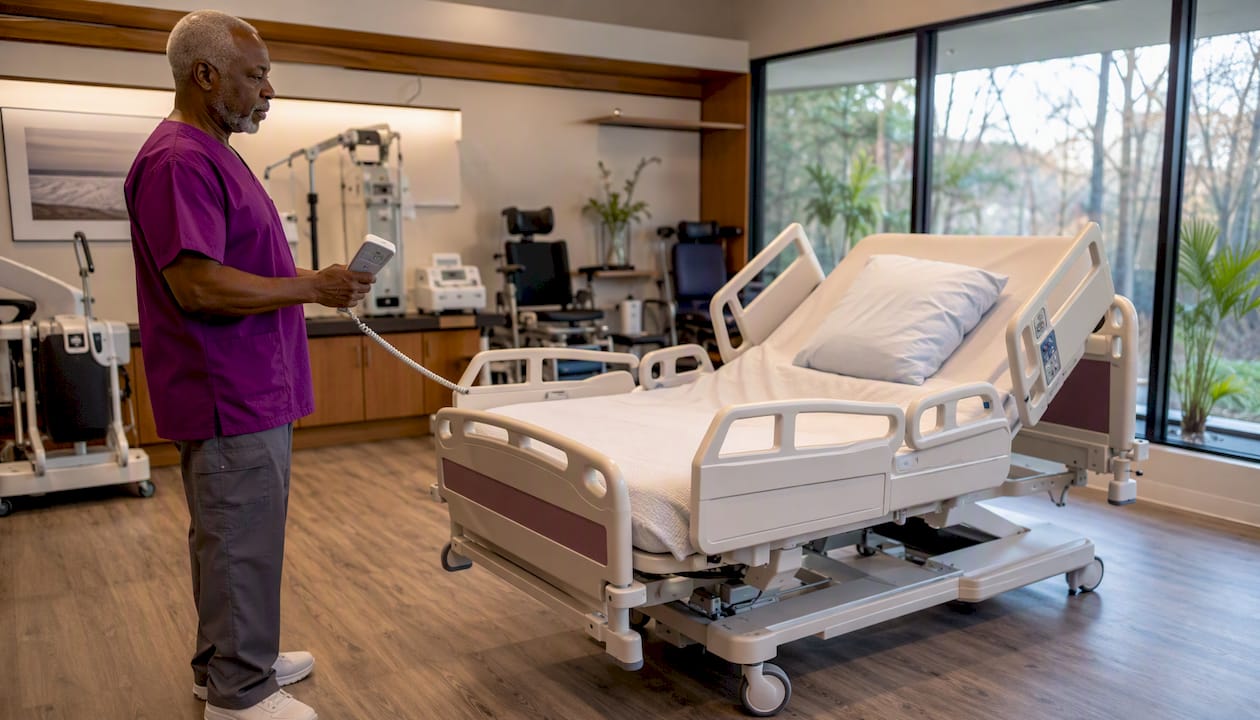
Low hospital beds are a sub-category of full-electric or semi-electric beds that drop to roughly 7–10 inches from the floor. They are specifically designed for patients with dementia, high fall risk, or a history of rolling out of bed. The logic is simple: a fall from a low height causes far less injury than a fall from a typical bed height.
Bariatric beds are reinforced frames with weight capacities of 500 lb or more. Standard hospital beds typically handle moderate weight capacities. If the patient’s weight is near or above the upper range for standard beds, a bariatric frame is recommended.
Pro Tip: Ask the occupational therapist or discharge planner at the hospital which bed type they recommend before you rent or buy. Many provincial home-care programmes will only fund a specific category, and getting the wrong type means starting the paperwork over.
What features matter most on any home hospital bed?
The gap between a consumer adjustable base and a medical-grade hospital bed comes down to three things: permanently mounted side rails, industrial locking wheels, and full-frame height adjustment. Consumer beds have none of those. Here is what to check on any homecare bed before accepting delivery.
Side rails
Side rails come in full-length, half-length, and quarter-length configurations. Full rails run the length of the mattress and are primarily a repositioning aid, not a fall barrier. Half and quarter rails at the head end give the patient something to grip when sitting up. Health Canada’s guidance on adult hospital bed entrapment hazards identifies the gaps between rails, mattress, and frame as the primary entrapment risk. Confirm that rails are securely latched and that there are no gaps wider than the guidance specifies.
Height range and transfer height
The usable height range tells you two things: how low the bed goes (fall safety) and how high it goes (transfer safety for the caregiver). A transfer height that matches the patient’s knee height means they can stand with minimal assistance. For a caregiver, working at a height that keeps their back straight prevents cumulative injury.

Weight capacity and brakes
Check the rated weight capacity against the patient’s actual weight, with a margin. Central locking wheels should engage firmly and release only with deliberate foot pressure. Test the brake on a hard floor before the technician leaves.
Handset and controls
A patient handset should have large, clearly labelled buttons and a lockout function so a confused patient cannot accidentally raise the bed to maximum height. Confirm the lockout works before the technician leaves.
How do you choose the right mattress for a hospital bed?
The mattress is not an afterthought. The wrong one can make a well-chosen bed dangerous or clinically useless.
Foam mattresses are the standard starting point. A high-density foam mattress with a pressure-redistribution profile handles most short-term and moderate long-term needs. They are compatible with virtually every hospital bed frame and are easy to clean.
Alternating-pressure and low-air-loss mattresses are prescribed for patients at moderate to high risk of pressure ulcers. These systems use a pump to cycle air through chambers, redistributing pressure every few minutes. They are effective, but they require a rigid deck frame. Some homecare bed frames use a spring deck that is not suitable for air mattress systems. Before ordering a pressure-redistribution mattress, confirm the bed frame has a solid platform deck.
Mattress height matters more than most people expect. A thick mattress raises the sleeping surface, which reduces the effective height of the side rails. If the rail is 12 inches tall and the mattress is 8 inches thick, you have only 4 inches of rail above the sleeping surface. That is not enough for most patients.
Pro Tip: When renting, ask the supplier how often mattresses are replaced and what their sanitization protocol is between rentals. A mattress that has been through multiple rentals without proper cleaning is a genuine infection risk.
For rental situations specifically, Seventhchakra sanitizes all equipment, including mattresses, before delivery. That is worth confirming with any supplier you consider.
How do you choose the best bed for your specific situation?
Work through these questions in order. Each one narrows the field.
- How many hours per day will the patient spend in bed? More than 12 hours means pressure redistribution and repositioning frequency become clinical priorities, not just comfort ones.
- What is the patient’s fall risk? A history of falls, dementia, or confusion at night points directly to a low-height bed.
- What is the caregiver’s physical capacity? Back problems or a single caregiver working alone makes full-electric height adjustment close to mandatory.
- What are the room dimensions and door widths? Standard hospital bed frames have typical dimensions designed to fit most Canadian home door widths. Measure before ordering.
- How long is the expected recovery? Short post-op needs (under three months) usually favour rental. Longer-term or permanent care usually favours purchase.
- Is provincial funding available? If yes, a physician prescription is almost always required. Ask the prescriber to document repositioning frequency and transfer difficulty in the referral.
Rent vs buy: a quick comparison
| Factor | Renting | Buying |
|---|---|---|
| Upfront cost | Low (often no deposit) | varies depending on type |
| Monthly cost | rental rates vary by type | — |
| Break-even point | rental can be economical for short-term use; buying may be better for long-term use | |
| Delivery and setup | Usually included | May be extra |
| Maintenance | Supplier’s responsibility | Owner’s responsibility |
| Best for | Post-op, short recovery, trial period | Long-term care, permanent need |
| Flexibility | Return when done | Resale or donate when done |
Caregivers who start with a manual or semi-electric bed frequently switch to full-electric within a few months. If there is any doubt about long-term need, renting full-electric from the start avoids that transition cost.
What does a home hospital bed cost in Canada?
Price ranges vary by power type and whether you rent or buy. These are typical Canadian ranges:
| Bed type | Purchase price (CAD) | Rental rate (CAD/month) |
|---|---|---|
| Manual (crank) | under $1,000 | — |
| Semi-electric | $1,200–$3,500 | $120–$250 |
| Full-electric (standard) | $2,000–$6,000 or more for bariatric models | — |
| Bariatric (higher weight capacity) | $2,000–$6,000 or more | — |
Renting for several weeks of post-surgical recovery costs less than buying outright for that period; buying becomes more economical for longer use. The rental math is obvious for short recoveries. Once expected use crosses three months, ownership starts to make financial sense, particularly if provincial funding offsets part of the purchase price.
Provincial funding programmes vary significantly. Ontario’s Assistive Devices Program (ADP), Alberta’s Aids to Daily Living (AADL), and British Columbia’s HELP programme each offer partial funding or equipment loans for medically prescribed hospital beds. All three typically require a physician prescription and documentation of medical necessity. Private extended health benefits through employer plans sometimes cover rental costs as a durable medical equipment benefit. Check your policy’s DME clause specifically.
Suppliers and provincial programmes consistently require the same two documents: a physician prescription and clinical notes documenting why the specific bed type is medically necessary. Getting those in order before you shop saves days.
What should you insist on at delivery and installation?
Delivery day is when most setup errors happen. A rushed installation leaves safety problems that only show up at 2 AM. Here is what to confirm before the technician leaves:
- Same-day availability confirmed in writing when urgency is the reason for renting.
- Full assembly completed on-site, including frame, deck, mattress, and all rail attachments.
- Sanitization certificate or verbal confirmation that the equipment was cleaned before loading.
- Brake test on the actual floor surface of the room where the bed will be used. Hard floors and carpet behave differently.
- Rail gap check: no gaps between rail, mattress, and frame that exceed safe dimensions per Health Canada guidance.
- Handset demonstration: patient and caregiver both operate every function before the technician leaves.
- Handset lockout activated if the patient has cognitive impairment.
- Transfer height set and confirmed: raise the bed to the height that lets the patient stand with minimal effort, and note that setting.
- Emergency lowering procedure explained: know how to manually lower the bed if power fails.
- Warranty and service contact provided: get a direct number for on-site repair, not just a general customer service line.
Same-day delivery, technician assembly, and a post-delivery demonstration are the three service elements that most directly reduce immediate safety risk. If a supplier cannot confirm all three, that is worth factoring into your decision.
When is a low bed the right clinical choice?
The clinical case for low hospital beds is well-established. Beds that lower to roughly 7–10 inches from the floor are consistently recommended for patients with dementia or high fall risk because the injury severity from an unassisted exit drops dramatically at that height.
The caregiver-safety case for full-electric hi-lo beds is equally clear. When a caregiver manually adjusts a bed height repeatedly over months, cumulative back strain is a predictable outcome. Electric height adjustment removes that physical load entirely.
Canada’s home-care system has been tracking this pressure. The Canadian Institute for Health Information (CIHI) monitors home-care populations and consistently identifies fall prevention and caregiver burden as two of the highest-priority safety concerns in home settings. Positioning equipment, including adjustable hospital beds, is part of the clinical response to both.
When to request a physician prescription for funding: If the patient has a documented fall history, pressure ulcer risk, or requires repositioning more than twice per night, ask the prescribing physician to include those specifics in the referral. Provincial programmes use that documentation to determine funding eligibility. A vague prescription (“patient needs hospital bed”) is frequently insufficient.
Seventhchakra: same-day hospital bed rental in Greater Vancouver
When a family member is discharged from hospital on short notice and needs a bed set up that day, the usual retail route does not work. Seventhchakra is built specifically for that situation.
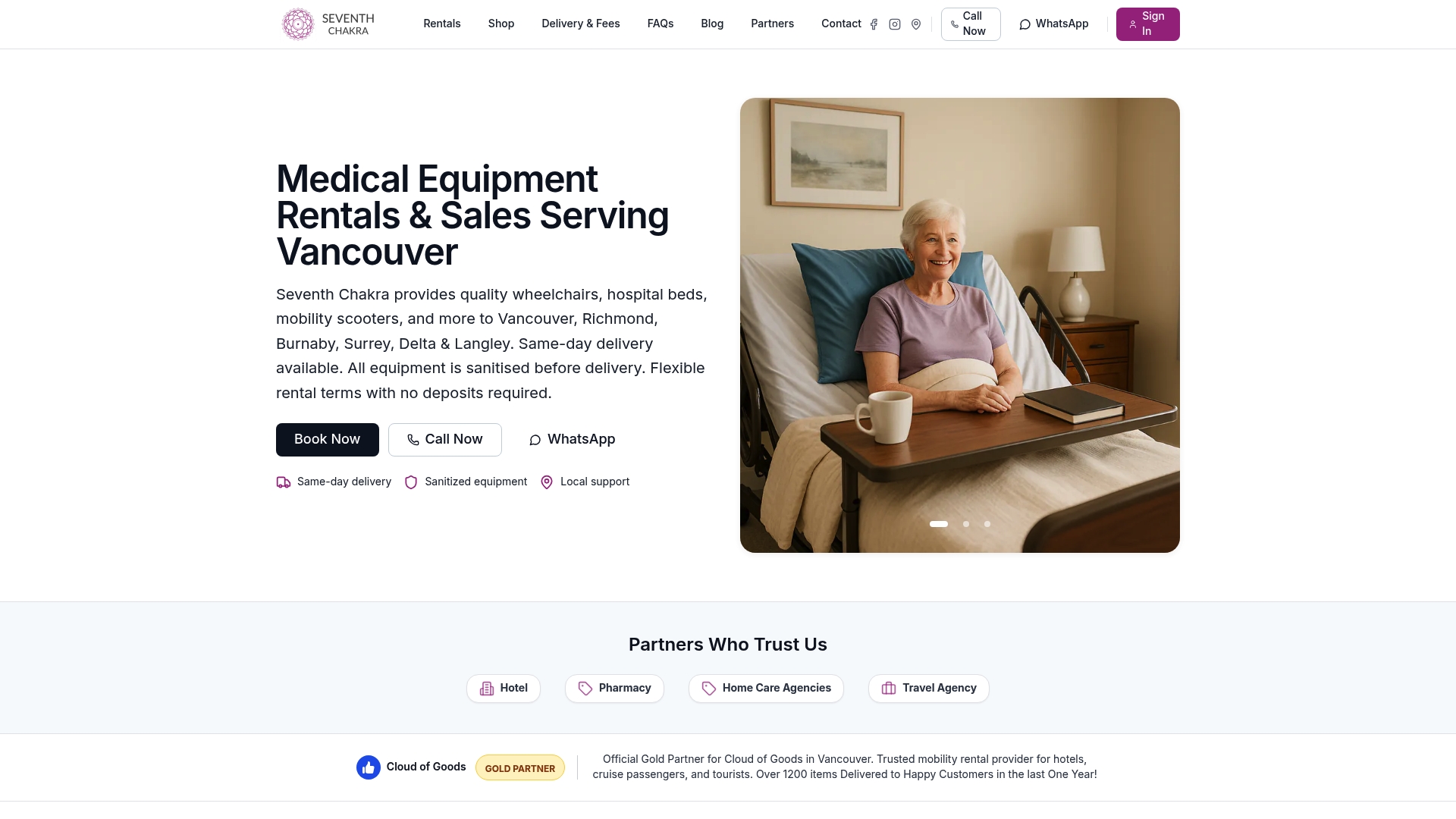
Seventhchakra delivers electric adjustable hospital beds across Greater Vancouver with same-day availability, no upfront deposit, and full sanitization before every delivery. A technician assembles the bed on-site, fits the mattress and rails, and walks both patient and caregiver through every function before leaving. Rental terms are flexible with no long-term lock-in, so you return the equipment when recovery is complete.
Beyond hospital beds, Seventhchakra also rents wheelchairs and mobility scooters to support the full range of home-care mobility needs during recovery.
To reserve a hospital bed rental or ask about same-day availability, visit the hospital bed rental page or call Seventhchakra directly. Same-day delivery is available across the Greater Vancouver area when you book early in the day.
Key takeaways
A full-electric low-height hospital bed is the most practical choice for most Canadian home recoveries, combining caregiver safety, patient fall protection, and clinical positioning in one unit.
| Point | Details |
|---|---|
| Best bed for most situations | A full-electric low-height bed handles repositioning, transfers, and fall prevention in one unit. |
| Rent vs buy threshold | Renting makes sense under three months of use; buying becomes more economical beyond that point. |
| Top safety features at delivery | Confirm rail gaps, brake function, handset lockout, and transfer height before the technician leaves. |
| Provincial funding | Ontario ADP, Alberta AADL, and BC HELP all require a physician prescription and documented medical necessity. |
| Seventhchakra rental option | Same-day delivery, no deposit, and on-site assembly across Greater Vancouver for urgent home-care needs. |
The part most guides skip
Most hospital bed buying guides focus on specs and price. What they underestimate is the caregiver’s physical situation six weeks into a recovery.
A manual bed looks perfectly adequate on paper. It costs less, it adjusts, it has rails. But after two weeks of cranking height adjustments four times a day, the caregiver’s back is the problem. That is when families call looking for an urgent upgrade, often at a worse time than if they had started with full-electric.
The other thing guides miss: the mattress decision is often more consequential than the bed frame decision. A patient who develops a pressure ulcer because the mattress was wrong faces a serious medical complication. A patient on the wrong frame type for an air mattress system gets none of the pressure redistribution benefit they were prescribed. These are not edge cases.
My honest advice: spend the extra $30–$50 per month on a full-electric rental if there is any chance the recovery will extend past six weeks. And before you accept any mattress, confirm the deck type on the frame matches what the mattress system requires. Those two decisions prevent most of the problems I see families encounter after the fact.
Useful sources and provincial funding contacts
These are the primary sources and provincial programme pages worth bookmarking when arranging a home hospital bed in Canada:
- Health Canada — Adult Hospital Beds: Patient Entrapment Hazards and Side Rail Guidance: the federal guidance document on rail safety, entrapment dimensions, and hazard reduction for hospital beds used at home.
- Ontario Assistive Devices Program (ADP): Ontario’s partial-funding programme for medically prescribed equipment, including hospital beds. Requires a physician or authorised prescriber referral.
- Alberta Aids to Daily Living (AADL): Alberta’s benefit programme covering hospital beds and positioning equipment with a prescriber assessment.
- BC HELP Programme (Health Equipment Lending Program): British Columbia’s equipment loan programme for eligible residents requiring home medical equipment.
- MedlinePlus — Home Care Beds: plain-language clinical guidance on setting up and using a hospital bed at home safely.
- Seventhchakra local equipment guide for Vancouver: practical local guidance on finding trusted equipment suppliers in the Greater Vancouver area.
When speaking with a clinician or equipment supplier, bring the Health Canada rail guidance document and your provincial programme’s eligibility criteria. Ask the supplier for the manufacturer’s CSA or UL certification documentation and the exact weight capacity rating for the specific model being delivered.
FAQ
What is the difference between a hospital bed and a regular home bed?
A hospital bed has permanently mounted side rails, industrial locking wheels, and motorised or crank-adjustable height, none of which are available on standard home beds or consumer adjustable bases. These features exist specifically to support safe patient transfers and caregiver repositioning.
How much does a hospital bed cost in Canada?
Manual beds start under $1,000 to purchase; semi-electric models typically run $1,200–$3,500; full-electric beds range from $2,000–$6,000 or more for bariatric models. Rental rates for semi-electric beds run roughly $120–$250 per month across Canada.
Can I rent a hospital bed in Vancouver with same-day delivery?
Yes. Seventhchakra offers same-day hospital bed delivery across Greater Vancouver with no deposit required and full sanitization before delivery, making it a practical option when a patient is discharged on short notice.
What mattress works best with a home hospital bed?
High-density foam mattresses work with most frames and suit short to moderate recovery needs. For pressure ulcer prevention, alternating-pressure or low-air-loss mattresses are clinically preferred, but they require a rigid platform deck frame rather than a spring-based frame.
Does provincial insurance cover a hospital bed at home in Canada?
Ontario’s ADP, Alberta’s AADL, and BC’s HELP programme all offer partial funding or equipment loans for medically prescribed hospital beds. All three require a physician prescription and documentation of medical necessity; private extended health benefits may also cover rental costs under a durable medical equipment clause.