
Yes, you can rent a hospital bed in Canada, and getting one is faster than most caregivers expect. Private providers like Seventhchakra offer same-day or next-day delivery with no deposit required. If you have more time, Ontario Health atHome can coordinate a publicly funded bed through a physician or discharge planner referral, though that process typically takes 3–7 business days. The practical next step: call a local rental provider now if the need is urgent, or ask the discharge planner to start a referral if you have a few days to spare.
Table of Contents
- Why rent a hospital bed rather than buy one
- What types of hospital beds are available to rent?
- What does a rental agreement typically include?
- How does hospital bed rental pricing work in Canada?
- How do you choose the right bed and what should you ask the provider?
- Preparing your home and what to expect on delivery day
- Where can provincial programmes or OHIP help cover the cost?
- Seventhchakra: same-day hospital bed rental in Greater Vancouver
- Key takeaways
- What caregivers get wrong about hospital bed rentals
- Useful sources
- Seventhchakra makes home care setup straightforward in Greater Vancouver
- FAQ
Why rent a hospital bed rather than buy one
Renting is usually the right call for most caregivers, and the reasons go beyond cost. The upfront price of purchasing a full-electric hospital bed runs into the thousands of dollars, whereas rental spreads that cost across weeks or months and keeps your options open as the patient’s condition changes.
The core advantages of renting:
- Lower upfront cost. No large capital outlay; you pay only for the time you need the equipment.
- Flexibility to upgrade. If a standard foam mattress proves inadequate, a reputable provider can swap in a therapeutic pressure-relief mattress without you buying a new bed.
- Professional delivery and setup. Technicians assemble the frame, fit rails, demonstrate the handset, and confirm everything is working before they leave.
- Sanitization included. Beds are cleaned and inspected between rentals; a credible provider documents this.
- Maintenance and repairs covered. If a motor fails or a rail loosens, the provider handles it, usually at no extra charge.
- Pickup when you’re done. No storage problem, no resale hassle.
Buying makes sense in one scenario: a permanent, long-term need where the patient’s condition is stable and a furniture-style adjustable bed fits the home. For post-surgery recovery, palliative care, or any situation where needs may shift, renting protects you from being locked into the wrong equipment.
Pro Tip: When comparing providers, prioritise sanitization documentation, local repair response time, and itemised quotes over the lowest advertised monthly rate. A cheap bed with a two-week repair SLA is a liability.
What types of hospital beds are available to rent?
The main rental categories are manual, semi-electric, full-electric, bariatric, and low/hi-lo beds. Each suits a different clinical picture.
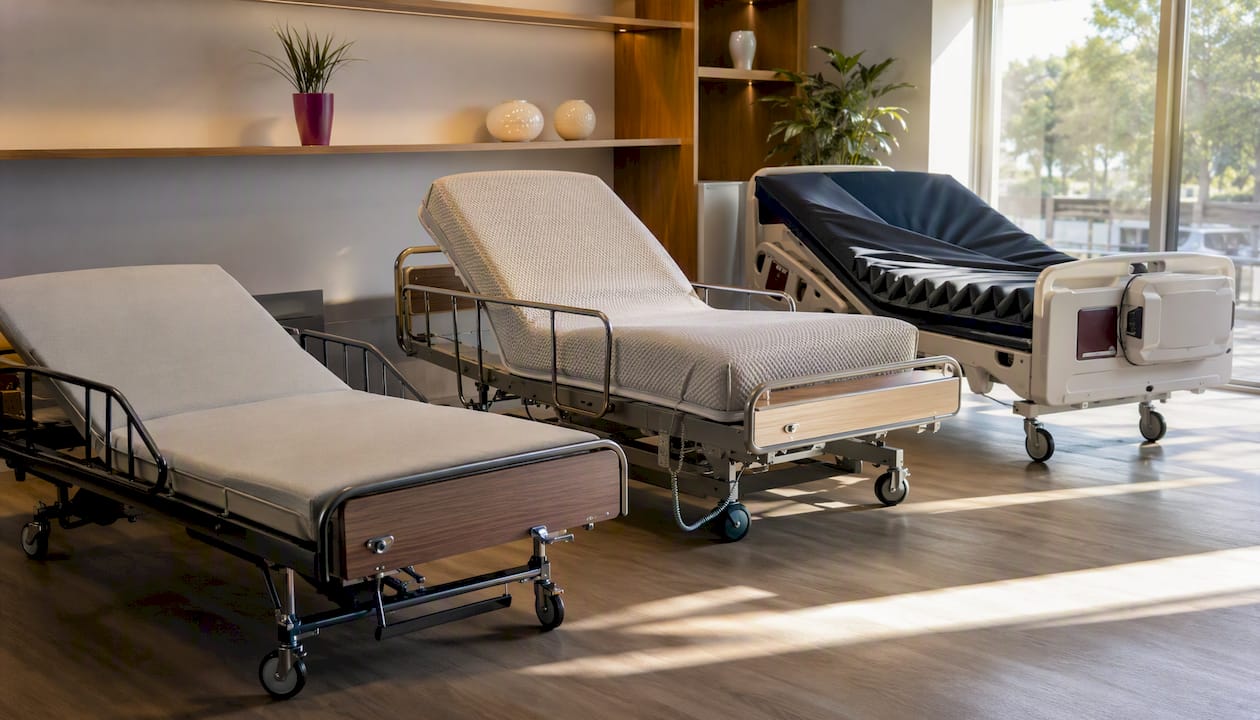
| Bed type | Best for | Key features |
|---|---|---|
| Manual | Short-term recovery, budget-conscious, caregiver-operated | Hand crank height/position adjustment; no power needed |
| Semi-electric | Mixed needs; head/foot adjust by motor, height by crank | Electric head and foot sections; manual height |
| Full-electric / hi-lo | Most home-care situations; caregiver ergonomics critical | Full motor control including height; handset with battery backup |
| Bariatric | Patients over standard weight capacity (typically 250 kg+) | Reinforced frame, wider deck, heavy-duty motors |
| Low / hi-lo | Fall-risk patients; paediatric or neurological care | Lowers close to floor; reduces fall injury risk |
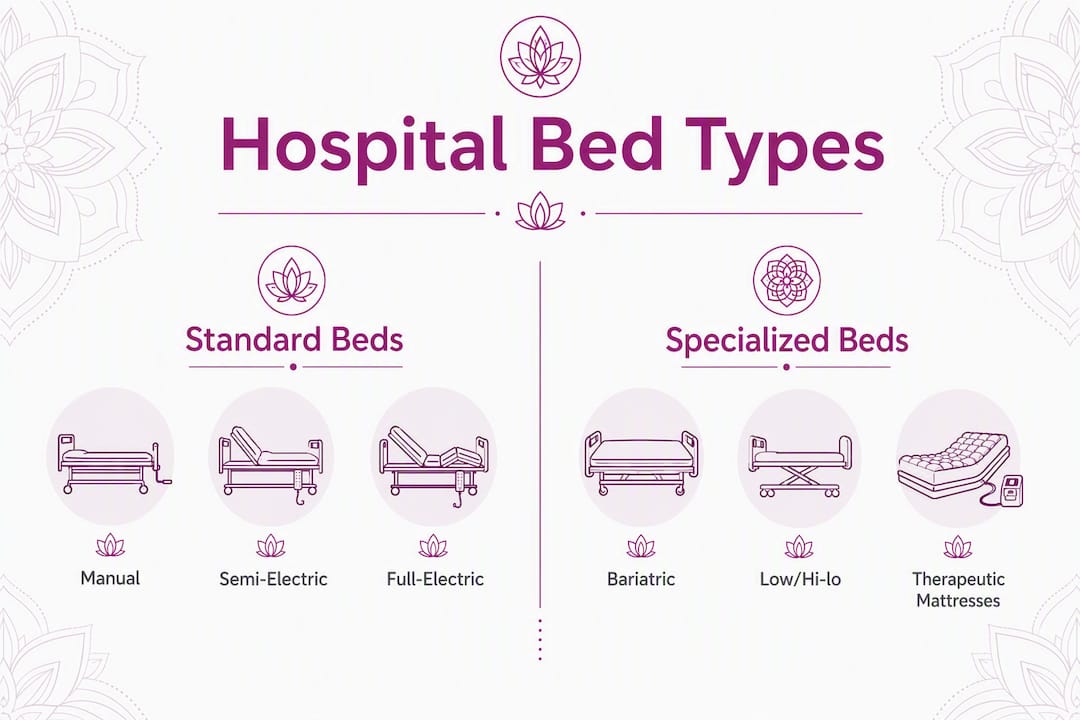
For most home-care situations, a full-electric hi-lo bed is the practical choice. The height adjustment alone reduces caregiver back strain significantly over weeks of daily transfers.
Essential features to confirm before booking:
- Weight capacity. Verify the rated limit matches the patient’s weight with a safety margin.
- Mattress type. Standard foam versus therapeutic alternating-pressure or memory-foam overlay — these are not interchangeable for pressure-injury prevention.
- Side rails. Full-length or half-length; confirm they lock securely and meet the patient’s fall-risk profile.
- Handset and battery backup. Some handsets include a 9-volt battery backup for limited repositioning during power outages — critical for high-repositioning-risk patients.
- Wheel locks and casters. All four wheels should lock independently and roll smoothly on your floor type.
- Height range. Confirm the lowest and highest positions suit both the patient’s transfer needs and the caregiver’s height.
Pro Tip: Always confirm the mattress type in writing before the delivery date. Providers sometimes substitute a standard foam mattress when a therapeutic one was discussed verbally — get it on the quote.
What does a rental agreement typically include?
Most rentals cover the frame, a basic mattress, side rails, and the handset. Delivery, setup, and pickup are sometimes bundled and sometimes charged separately — which is why an itemised quote matters before you sign anything.
Contract items to verify before committing:
- Delivery and setup fee (flat rate or distance-based)
- Mattress type included and upgrade charges if therapeutic is needed
- Minimum rental term (weekly, monthly, or longer)
- Deposit policy — reputable providers like Seventhchakra operate with no deposit
- Pickup scheduling and required notice period
- Damage and liability policy during the rental period
- Maintenance and repair response time (ask for a specific SLA, not “as soon as possible”)
- Sanitization documentation — request a certificate or written confirmation
Documentary checklist before signing:
- Written itemised quote with all fees listed
- Serial or asset number for the specific unit being delivered
- Sanitization certificate or written confirmation of cleaning protocol
- Emergency repair contact number and expected response time
- Pickup notice procedure in writing
Rental packages differ considerably: some providers include therapeutic mattresses and full rails as standard, while others list these as paid upgrades. Getting everything itemised prevents the surprise invoice after delivery.
How does hospital bed rental pricing work in Canada?
Rental pricing varies by bed type, mattress, delivery distance, and service level. Canadian provider listings show monthly starting rates roughly in the range of $140–$300 for standard units, with regional variation and mattress upgrades adding to that figure. Same-day delivery and therapeutic mattress options typically push costs higher.
Common price components:
- Base rental rate (daily, weekly, or monthly)
- Mattress upgrade fee (standard foam is usually included; alternating-pressure or memory-foam overlays cost more)
- Delivery and setup charge
- Pickup fee
- Extended-term discount (monthly rates are almost always cheaper per day than weekly)
- Damage waiver or insurance
- Applicable taxes (GST/HST depending on province)
| Pricing factor | Typical effect |
|---|---|
| Full-electric vs manual bed | Full-electric costs more per month |
| Therapeutic mattress upgrade | Adds to monthly rate; often worth it for long-term use |
| Same-day delivery | May carry a surcharge vs standard next-day |
| Longer rental term | Per-day cost drops on monthly vs weekly plans |
| Bariatric bed | Higher rate due to specialised equipment |
| Delivery distance | Remote areas may incur additional fees |
For hospital bed pricing in Vancouver, Seventhchakra publishes transparent rates with no deposit required. When comparing quotes, convert everything to a per-day rate so you’re comparing apples to apples across daily, weekly, and monthly plans.
How do you choose the right bed and what should you ask the provider?
Start with clinical fit, then work outward to logistics. A bed that doesn’t meet the patient’s pressure-relief or transfer needs is the wrong bed regardless of price.
Selection checklist:
- Confirm the patient’s weight and choose a bed with adequate rated capacity.
- Assess pressure-injury risk — if moderate to high, a therapeutic mattress is not optional.
- Identify the primary caregiver’s height and confirm the bed’s hi-lo range suits their ergonomics.
- Measure the bedroom door clearance and hallway width. A standard hospital bed sleep surface is commonly 36" x 80", and many home doorways are narrower than expected.
- Confirm a grounded power outlet within reach of the bed’s power cord.
- Identify the transfer path from bed to bathroom and check for obstacles.
- Decide on accessories: trapeze bar, overbed table, bed wedge, pressure-relief overlay.
Questions to ask the provider:
- Is this specific bed available for my required dates?
- What is your sanitization process and can you provide written confirmation?
- What mattress is included, and what does a therapeutic upgrade cost?
- What is the minimum rental term and your cancellation policy?
- Do you require a deposit?
- What is your repair response time if something fails?
- How much notice do I need to give for pickup?
- Are delivery and setup included in the quoted price?
Red flags to watch for: vague sanitization claims with no documentation, no written quote, unclear pickup policy, repair response times measured in weeks, and mattress upgrade fees disclosed only after delivery. Families who skip these checks routinely face delays, extra charges, and equipment that doesn’t suit the patient’s actual needs.
Preparing your home and what to expect on delivery day
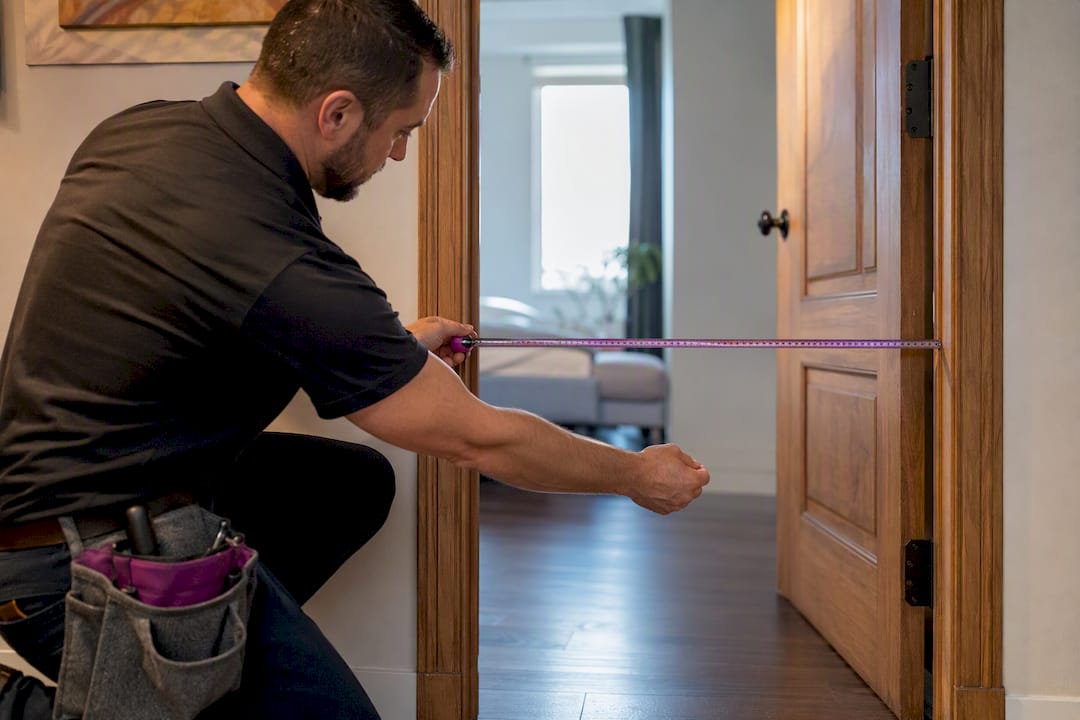
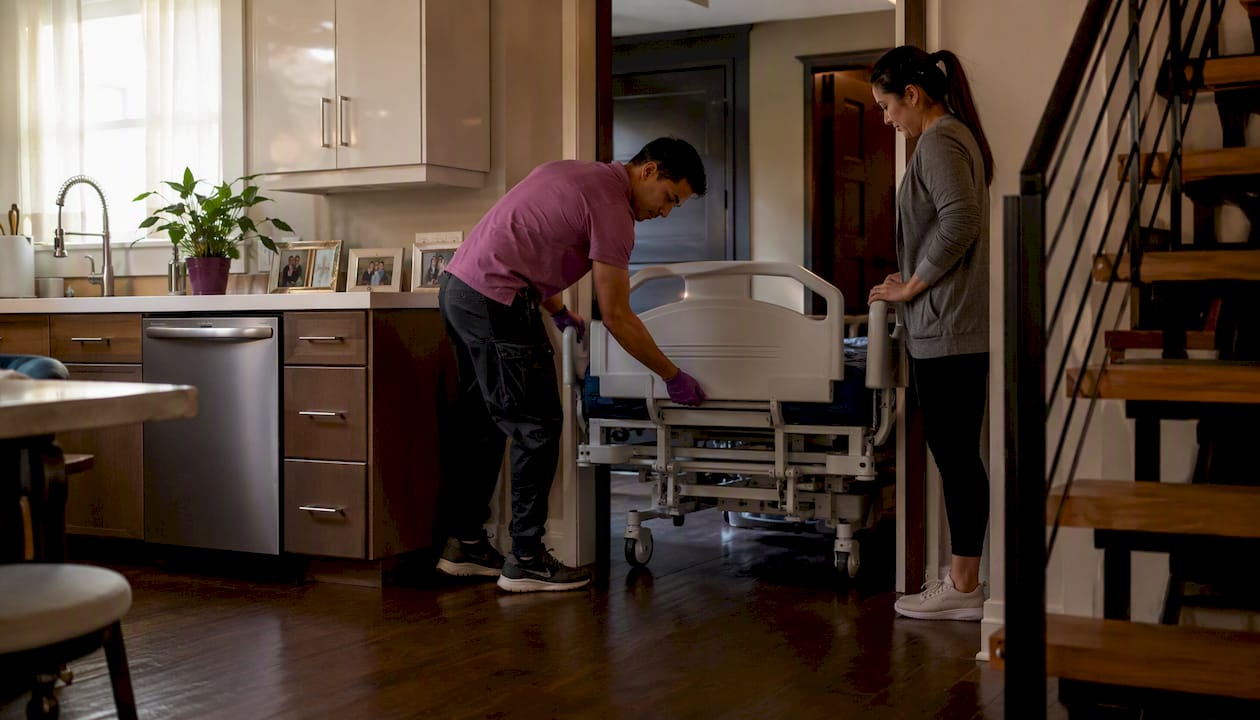
Measure first, then clear the path. A failed delivery because a bed won’t fit through a doorway is one of the most common and entirely avoidable problems in home-care equipment logistics.
Before delivery:
- Measure the actual clear opening of every doorway and hallway the bed must pass through — not the frame width, the clear opening. Building code barrier-free guidance gives minimum widths, but older homes often fall short.
- Move furniture to create a clear turning radius in the bedroom.
- Identify and clear the transfer path from bed to bathroom.
- Locate the nearest grounded power outlet and confirm the cord will reach without crossing a walkway.
- Protect hardwood or laminate floors with a mat or runner where the bed will sit and where the technician will work.
- Arrange for someone to be present who can show the room and receive training on the handset and rails.
What technicians do at setup:
- Assemble the frame and attach the headboard and footboard
- Fit the mattress and side rails
- Demonstrate the handset controls, including height, head, and foot adjustments
- Test the motor and confirm battery backup function if applicable
- Document the serial number and sanitization record
- Walk the caregiver through rail locking, unlocking, and emergency lowering
If the bed cannot pass through interior stairs or a tight elevator, discuss stretcher transport or disassembly options with the provider before the delivery date, not on the day.
Where can provincial programmes or OHIP help cover the cost?
Provincial programmes can cover hospital beds for eligible patients, but timelines and eligibility rules vary. OHIP itself does not pay for home medical equipment directly. Coverage flows through specific programmes, and many families use private rental for immediate needs while a public referral is processed.
Funding sources to check:
- Ontario Health atHome (formerly CCAC): coordinates home equipment for eligible patients; referral to delivery typically takes 3–7 business days
- Provincial Assistive Devices Programme (ADP): covers certain durable medical equipment for eligible residents; eligibility and covered items vary by province
- Veterans Affairs Canada: covers medically necessary home equipment for eligible veterans
- WSIB (Workplace Safety and Insurance Board): covers equipment related to a workplace injury
- Private extended health insurance: many employer plans cover short-term home medical equipment rentals
Action steps:
- Ask the hospital discharge planner or your family doctor to initiate a referral to your provincial home-care programme.
- Gather a physician’s order and, where required, an occupational therapist (OT) assessment — public funders typically require documented medical need before approving equipment.
- Contact your private insurer to confirm coverage limits and pre-approval requirements.
- If the need is urgent and the public timeline doesn’t fit, arrange private rental immediately and pursue reimbursement through your insurer or programme retroactively where permitted.
Short-term recovery equipment is more commonly covered than long-term or premium options. Therapeutic mattress upgrades and furniture-style adjustable beds are usually not covered under public programmes.
Seventhchakra: same-day hospital bed rental in Greater Vancouver
Seventhchakra provides hospital bed rentals in the Greater Vancouver area with same-day delivery, no deposit, and full sanitization before every delivery.
What’s included:
- Electric adjustable hospital beds with hi-lo function
- Therapeutic mattress options available
- Side rails and handset with battery backup
- Caregiver training at delivery on controls, rails, and safety
- Flexible rental terms with no long-term commitment required
Trust signals:
- Documented sanitization protocols before every delivery
- Local support team with fast repair response
- Transparent itemised quotes with no hidden fees
- Clinical and OT referral support for families navigating public funding
For caregivers in Vancouver who need a bed quickly, Seventhchakra removes the two biggest friction points: the deposit and the wait. You can also explore hospital bed rental options in Vancouver or check the full range of home medical equipment, including wheelchair rentals and mobility scooters, for a complete home-care setup.
Pro Tip: Book delivery for the morning of the patient’s discharge day. That gives the technician time to set up and train the caregiver before the patient arrives home.
Key takeaways
Renting a hospital bed in Canada requires measuring your home, confirming the mattress type in writing, and getting a fully itemised quote before delivery day.
| Point | Details |
|---|---|
| Measure before booking | Confirm door clearance and hallway width; a standard bed surface is 36" x 80". |
| Confirm mattress type in writing | Therapeutic pressure-relief mattresses prevent pressure injuries and are often an upgrade cost. |
| Get an itemised quote | Delivery, setup, mattress upgrades, and pickup fees vary widely between providers. |
| Verify sanitization and repair contact | Ask for written sanitization confirmation and a specific repair response time before signing. |
| Seventhchakra for Vancouver | Offers same-day delivery, no deposit, and documented sanitization for Greater Vancouver caregivers. |
What caregivers get wrong about hospital bed rentals
The biggest mistake families make is treating a hospital bed rental like renting a piece of furniture. It isn’t. The mattress choice alone can determine whether a patient develops a pressure injury during a two-week recovery. That’s a clinical decision, not an aesthetic one, and most families don’t know to ask about it until after delivery.
The second thing providers wish families understood: the logistics matter as much as the equipment. A full-electric bed that can’t fit through a 28-inch doorway is useless on delivery day. Measuring takes five minutes. A failed delivery costs everyone a day.
There’s also a tendency to over-focus on the monthly rate and under-focus on repair response time. A $20-per-month saving means nothing if a motor fails on a Friday night and the provider’s next available technician is Tuesday. Ask for a specific SLA in writing, not a reassuring verbal promise.
Seventhchakra’s approach to this is straightforward: no deposit removes the financial friction, same-day delivery removes the wait, and local technicians handle repairs without the multi-day queue that national chains often carry. For caregivers in Greater Vancouver, that combination is the practical difference between a stressful discharge day and a smooth one.
Useful sources
These are the primary sources to check for funding eligibility, programme details, and discharge coordination in Canada:
- Ontario Health atHome: the starting point for publicly funded home equipment in Ontario; contact through your hospital discharge planner or family doctor.
- Hospital discharge home bed setup guide: practical guidance on measuring, building code dimensions, and preparing a home for delivery.
- Common mistakes when renting home care equipment: a checklist of the errors families most often make and how to avoid them.
- Veterans Affairs Canada (veterans.gc.ca): covers medically necessary home equipment for eligible veterans; contact your VAC case manager.
- WSIB (wsib.ca): covers equipment related to a workplace injury claim; contact your WSIB case worker directly.
- Your provincial Assistive Devices Programme: eligibility and covered items vary; search “[your province] assistive devices programme” for the relevant ministry page.
Who to call first: start with the hospital discharge planner or your family doctor to initiate a referral. If the timeline is urgent, contact a private rental provider like Seventhchakra directly for same-day service while the public referral is processed.
Seventhchakra makes home care setup straightforward in Greater Vancouver
When a family member is coming home from hospital and you need a bed today, not in a week, Seventhchakra is the practical answer for Greater Vancouver caregivers. No deposit, same-day delivery when available, full sanitization before every rental, and a local team that trains you on the equipment before they leave.
Beyond hospital beds, Seventhchakra carries the full range of home-care mobility equipment: wheelchair rentals, mobility scooter rentals, and accessories that complete a home recovery setup. If you’re coordinating care for someone returning home, it’s worth checking what else you might need at the same time.
Book your hospital bed rental in Vancouver directly on the Seventhchakra site, or call to confirm same-day availability for your area.
FAQ
How much does it cost to rent a hospital bed in Canada?
Monthly rental rates for Canadian providers typically start in the range of $140–$300 depending on bed type, included mattress, and region. Therapeutic mattress upgrades, same-day delivery, and bariatric models add to that base rate.
Is a hospital bed covered by OHIP?
OHIP does not directly cover home medical equipment. Coverage for eligible patients flows through provincial programmes like Ontario Health atHome, the Assistive Devices Programme, Veterans Affairs, or WSIB, and typically requires a physician’s order or OT assessment.
What are the main types of hospital beds available to rent?
The four main rental categories are manual, semi-electric, full-electric (including hi-lo), and bariatric beds. Low/hi-lo beds are also available for fall-risk patients.
How long does it take to get a hospital bed delivered in Canada?
Private providers like Seventhchakra offer same-day or next-day delivery in their service area. Public referrals through Ontario Health atHome typically take 3–7 business days from referral to delivery.
What should I confirm before signing a hospital bed rental agreement?
Confirm the mattress type included, delivery and pickup fees, minimum rental term, deposit policy, sanitization documentation, and the provider’s repair response time, all in writing before signing.