
Yes, you can fly with a mobility scooter. Under Canadian federal regulations, airlines operating flights to, from, or within Canada must accept mobility aids as priority baggage when you notify them in advance. The catch is that “in advance” means at least 48 hours before departure, and the airline needs specific technical details about your device before they can confirm carriage.
Three things to do right now:
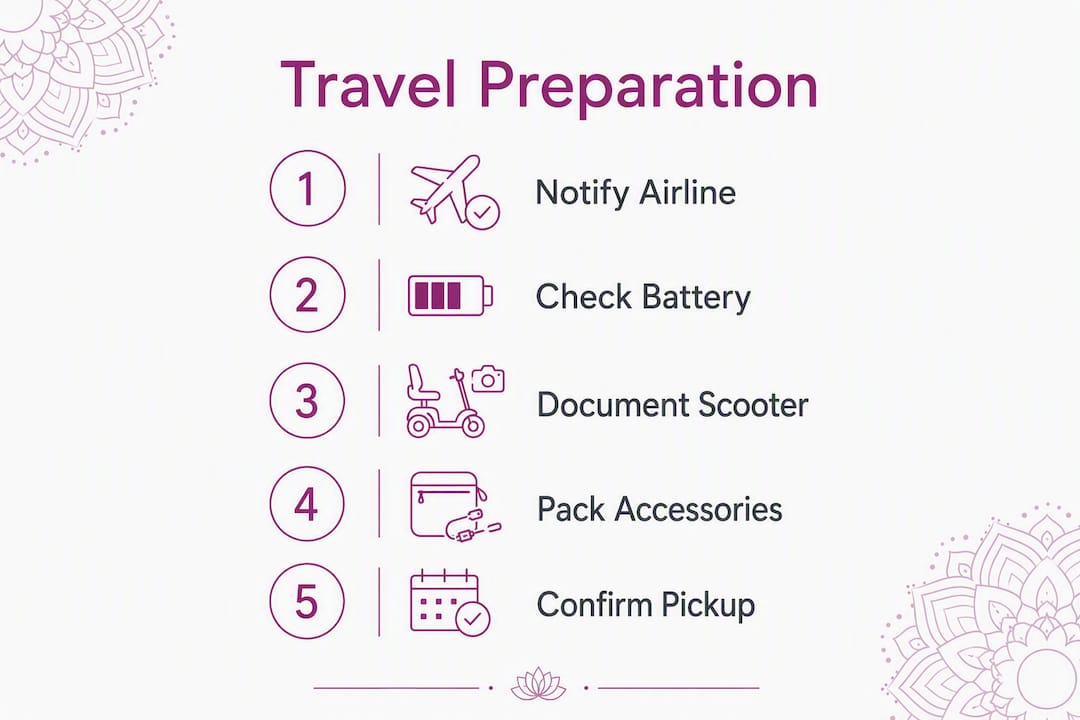
- Call your airline and declare your mobility scooter at least 48 hours before your flight. Ask for meet-and-assist service and gate-side handling.
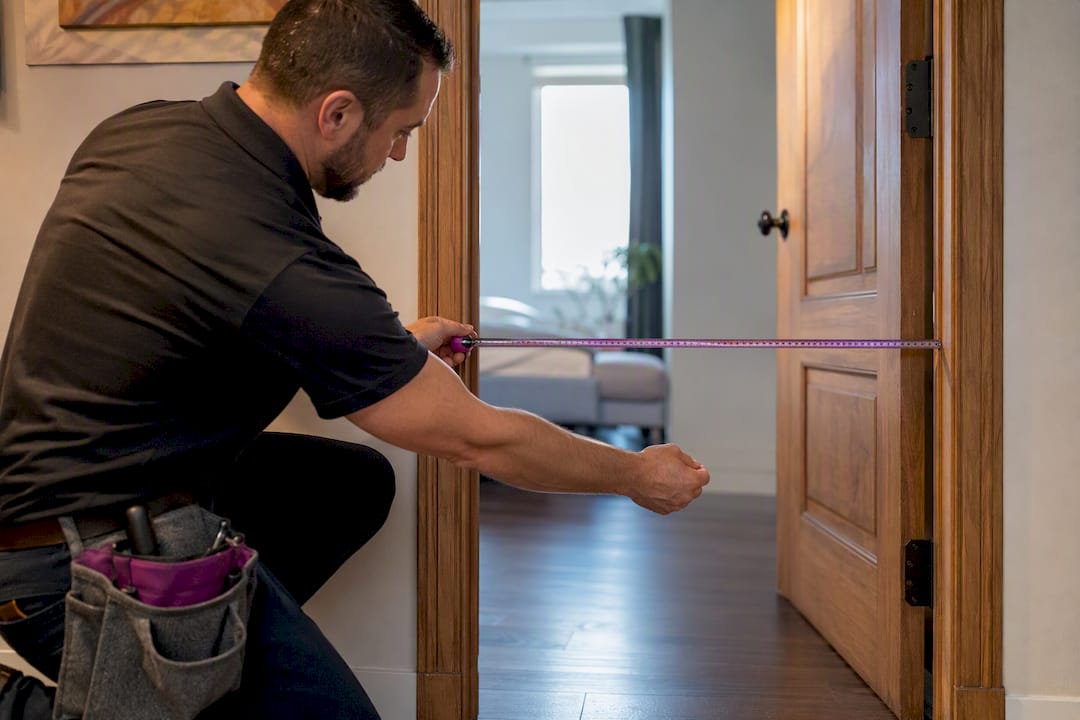
- Gather your scooter’s measurements and battery details (length, width, height, unoccupied weight, battery chemistry, and watt-hours). Airlines need these to confirm the device will fit and comply with safety rules.
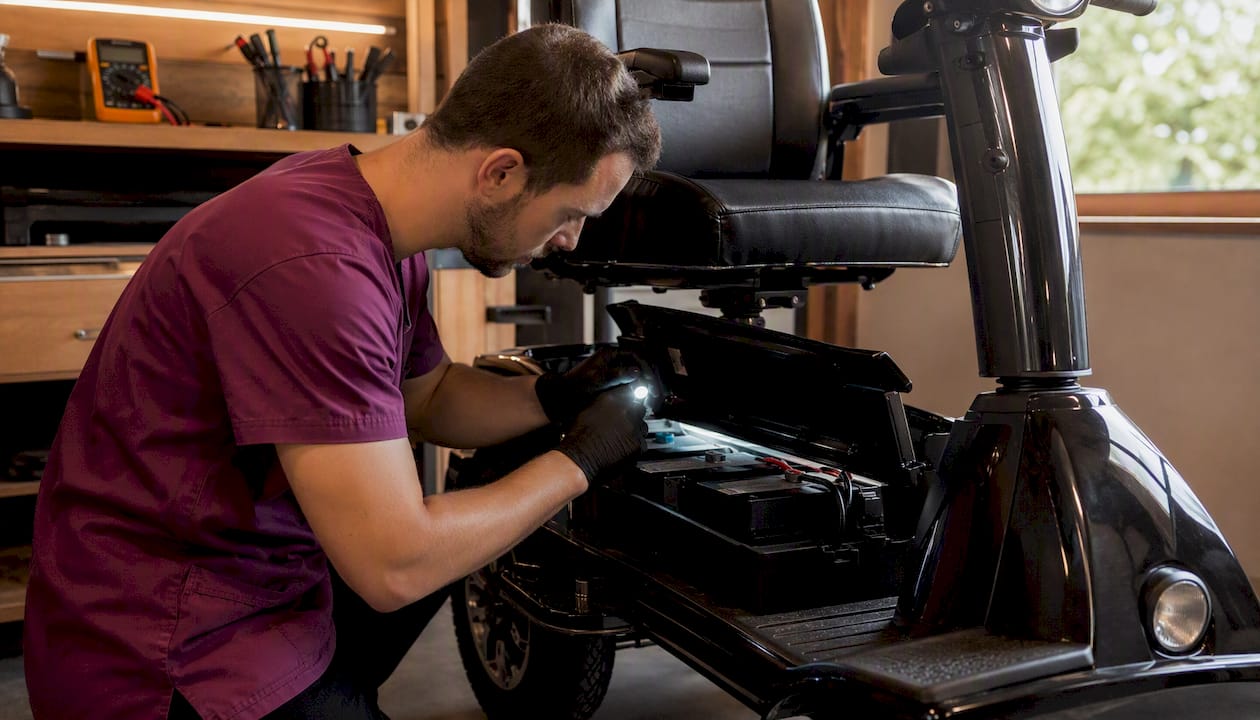
- Photograph your scooter from every angle, including the battery compartment, serial number plate, and any tie-down points. These photos protect you if the device is damaged in transit.
The two Canadian authorities that govern this process are the Canadian Transportation Agency (CTA), which sets passenger rights and airline obligations, and the Canadian Air Transport Security Authority (CATSA), which controls what goes through the security checkpoint. If flying with your own scooter feels like too much to manage, renting one at your destination is a practical option. Seventhchakra delivers sanitized, deposit-free scooters the same day across Greater Vancouver.
Table of Contents
- What do you need to do before your flight with a mobility scooter?
- What are the battery rules for mobility scooters in Canada?
- What happens at CATSA security screening with a mobility scooter?
- How do airlines handle your scooter once you check in?
- Which scooter designs travel best by air?
- Day-of-travel checklist
- What to do if your scooter is delayed, damaged, or lost
- Should you rent a scooter at your destination instead?
- Key takeaways
- The part most travellers get wrong
- Seventhchakra makes Vancouver arrivals easier for scooter users
- Useful sources
- FAQ
What do you need to do before your flight with a mobility scooter?
The CTA frames advance notice as a logistics and safety tool, not a courtesy. When you call, the airline uses your measurements to determine whether disassembly, crating, or special handling is required. Skipping this step is the single most common reason scooters get refused at the gate.
Call the airline at least 48 hours before departure. When you reach the accessibility desk, have the following ready:
- Scooter make, model, and manufacturer name
- Total unoccupied weight (kilograms)
- Dimensions: length × width × height (centimetres)
- Battery type (lead-acid or lithium-ion) and watt-hour (Wh) rating
- Whether the battery is removable or sealed
- Whether the scooter disassembles and, if so, the heaviest single piece
Ask for a reference number and the agent’s name. Write both down. Operational policies vary by fleet and route, so what Air Canada permits on a wide-body international flight may differ from what WestJet allows on a regional turboprop. Confirming the specific policy for your flight number matters.
Measurements and documentation to prepare:
| Item | Why the airline needs it |
|---|---|
| Length × width (base footprint) | Confirms fit through cargo door |
| Height (seated and folded) | Determines stowage position |
| Unoccupied weight | Confirms lift/ramp capacity |
| Battery chemistry and Wh | Determines battery handling rules |
| Disassembly instructions | Guides ground crew reassembly |
| Manufacturer spec sheet | Backs up your verbal information |
Photograph checklist: shoot the scooter from the front, rear, both sides, and above. Get close-up shots of the serial number, battery compartment label, and any tie-down points or loops. These photos form the core of your Mobility Aid Passport, a one-page document the CTA recommends that includes photos, disassembly steps, and manufacturer specs.
For international travel, ask the airline about making a special declaration of interest under the Montreal Convention. This documents the scooter’s monetary value and identifying features. Airlines on international routes are required to advise you of this option, and it significantly strengthens any damage or loss claim.
Pro Tip: Print your Mobility Aid Passport on a single laminated page and attach one copy to the scooter frame before check-in. Keep a second copy in your carry-on. Ground handlers who can read disassembly steps directly off the device make far fewer errors.
What are the battery rules for mobility scooters in Canada?
Battery type determines almost everything about how your scooter travels. Get this wrong and the device may be refused at check-in, regardless of size or weight.
The short answer: an installed lithium battery powering your scooter is permitted through the CATSA checkpoint. You may also bring one spare lithium battery of up to 300 Wh in your carry-on, provided the terminals are protected.
| Battery type | Installed in device | Spare in carry-on | Spare in checked baggage |
|---|---|---|---|
| Lithium-ion (≤300 Wh) | Permitted | 1 spare, terminals protected | Not permitted |
| Lead-acid (sealed/gel) | Permitted (device upright) | Not permitted | Not permitted as loose spare |
| Lead-acid (spillable) | Subject to airline approval | Not permitted | Not permitted |
How to identify your battery chemistry: check the label on the battery itself or the manufacturer spec sheet. Lithium-ion batteries are marked “Li-ion” or “LiPo.” Lead-acid batteries are heavier and often marked “SLA,” “VRLA,” or “GEL.” If you cannot find the label, contact the manufacturer before you book.
Packing spare batteries correctly:
- Place each spare in its original retail packaging, or tape over both terminals with electrical tape and put it in a separate protective bag
- Never pack a loose spare battery in checked luggage
- Carry spare batteries in your carry-on where they can be monitored
If the airline requires the battery to be disconnected and removed before stowage, confirm this during your 48-hour call. Some carriers will handle disconnection themselves; others expect you to do it at the gate. Know which applies to your flight.
CATSA’s rule in plain terms: one lithium battery installed in your mobility device plus one spare of up to 300 Wh in carry-on with terminals protected. Anything beyond that requires advance airline approval and may be refused. Confirm the exact Wh rating of your battery before you travel.
Source: CATSA battery guidelines
What happens at CATSA security screening with a mobility scooter?
Screening will happen. There is no bypass for mobility aids. What CATSA does is make reasonable efforts to screen you and your scooter together, so you do not have to separate from your device for longer than necessary.
Here is how the process typically unfolds:
- Arrive at the checkpoint early. Screening a mobility scooter takes longer than a standard bag check. Add extra time to your security buffer to accommodate screening procedures.
- Declare your needs immediately. Tell the officer at the start that you use a mobility aid and describe any limitations (cannot stand, cannot transfer, pain with certain movements). Officers are trained to accommodate these.
- The officer will attempt to screen you and the scooter together using a combination of X-ray, physical inspection, and explosive trace detection swabs on the device.
- If simultaneous screening is not possible, CATSA offers alternative screening methods and private screening rooms. You can request a private area at any point.
- Tools for disassembly (Allen keys, wrenches needed to remove the battery) are permitted through screening when they are medically necessary for your device.
- Spare batteries must come out of your bag and be presented separately, just like a laptop.
If you cannot stand or step away from your scooter at any point, say so clearly. Officers will not ask you to do something physically unsafe. If you feel a screening procedure is inappropriate, you can ask for a supervisor.
Pro Tip: Write a brief note on a card that describes your device, your physical limitations, and your screening preferences. Something like: “I use a power scooter. I cannot stand or transfer. I prefer private screening. Battery is lithium-ion, 150 Wh, installed.” Hand it to the officer at the start. It speeds the process and removes ambiguity.
How do airlines handle your scooter once you check in?
Most carriers treat mobility scooters as priority baggage, which means the device is loaded last and unloaded first. In practice, the handling chain looks like this:
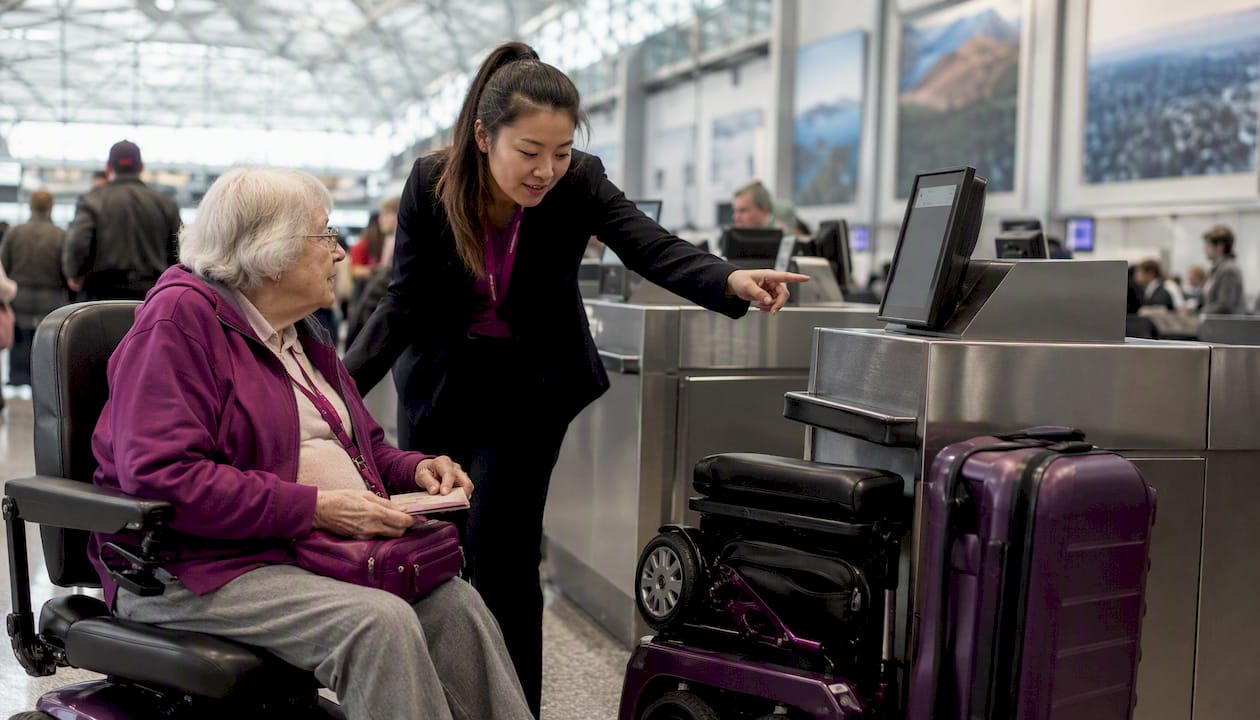
- At check-in or the gate, you hand over the scooter and confirm disassembly instructions with the agent
- Ground crew disconnect the battery (or you do it, depending on the airline’s policy)
- The device is wrapped or crated and loaded into the cargo hold
- At your destination, the scooter is returned to you at the gate or the aircraft door before you reach baggage claim
The CTA’s Final Report on Mobility Aids and Air Travel highlights a commonly referenced cargo stowage height of 31 inches (0.78 m) as an operational reference point for single-aisle aircraft. Many mid-size and heavy-duty scooters exceed this height in their assembled position, which is why measuring your device before you call the airline matters.
Common reasons a scooter may be refused:
- The base footprint or height exceeds the cargo door dimensions for that aircraft type
- The unoccupied weight exceeds the lift or ramp capacity at a particular airport
- The aircraft has fewer than 60 seats and the design physically precludes carrying the aid
- The battery cannot be safely disconnected or is a spillable lead-acid type
Small airlines operating aircraft with fewer than 60 seats are not required to carry mobility aids if the aircraft design makes it impossible. If your itinerary includes a regional connection, check that leg separately.
When you arrive: inspect the scooter before you leave the gate area. Check the frame, joystick, seat, armrests, and battery connections. If anything is damaged, photograph it immediately and ask airline staff for a written damage report before you exit the secured area.
Which scooter designs travel best by air?
Not every scooter is built for air travel. The features that matter most are the ones that make the device easier to measure, disassemble, and stow without exceeding cargo limits.
Travel-friendly features to look for:
- Foldable or disassembling frame (reduces footprint for cargo stowage)
- Quick-disconnect lithium battery (avoids lead-acid complications)
- Low unoccupied weight, ideally under 30 kg for the heaviest single piece
- Small base footprint that fits within typical cargo door dimensions
- Removable seat, armrests, and tiller to reduce height
- Clearly marked tie-down points and protected battery terminals
When to bring your own scooter: if you rely on custom seating, a specific joystick configuration, or positioning supports that cannot be replicated in a rental, travelling with your own device makes sense. The preparation work is significant, but it is manageable with the right documentation.
When to rent instead: short trips, unfamiliar aircraft types, battery non-compliance, or a previous bad experience with cargo damage are all strong signals to leave your scooter at home. Renting a travel-ready scooter at your destination removes the battery question entirely and eliminates the risk of arriving without your device.
Whichever path you choose, create a one-page spec sheet from your manufacturer’s manual. Include the model name, dimensions, weight, battery chemistry and Wh rating, and a numbered disassembly sequence. Give a copy to the airline when you call and attach one to the device at check-in. Mobility aid sizing details matter more than most travellers expect, and having the numbers ready prevents the most common refusal scenario.
Day-of-travel checklist
Arrive at the airport earlier than you normally would. Checking in a mobility scooter takes more time than standard baggage, and meeting your assist team at the gate requires coordination.
Documents to carry in your bag:
- Manufacturer spec sheet (dimensions, weight, battery details)
- Mobility Aid Passport (photos, disassembly steps, tie-down diagram)
- Special declaration of interest receipt (international flights)
- Airline reference number from your 48-hour call
- Battery purchase receipt or spec label showing Wh rating
Label and secure the device before you hand it over:
- Tape over battery terminals if the battery is being removed
- Attach a luggage tag with your name, phone number, and destination
- Add a “Fragile” or “Priority” tag if the airline provides one
- Mark tie-down points with bright tape or a sticker so handlers can find them quickly
At the airport:
- Check in at least 2.5–3 hours before departure for international flights, 2 hours for domestic
- Ask at check-in to confirm gate-side return of the scooter at your destination
- Identify yourself to the gate agent when you board and confirm the handling plan
Keep with you in your carry-on:
- Any medications or medical supplies you need during the flight
- Spare lithium battery (terminals protected, under 300 Wh)
- Disassembly tools if required
- A copy of your Mobility Aid Passport
What to do if your scooter is delayed, damaged, or lost
Act at the airport, not after you get home. The moment you notice damage or a missing device, your next steps determine whether you recover the cost.
Immediate steps:
- Photograph all damage before moving the scooter
- Ask airline or ground-handling staff for a written Property Irregularity Report (PIR) before leaving the baggage area
- Keep every receipt related to the scooter (purchase, repairs, rental replacement)
- Note the names and employee numbers of anyone you speak to
Filing a claim with the airline:
Include your Mobility Aid Passport, the PIR, all photos, your special declaration of interest (if filed), and the manufacturer’s replacement cost. Submit in writing and keep a copy. Airlines typically have a 7-day window for damage claims on checked items, though this varies by carrier.
Escalating to the CTA:
If the airline does not respond within a reasonable time or disputes your claim, the Canadian Transportation Agency accepts formal complaints from passengers. The CTA can order compensation and require the airline to cover the cost of a replacement or rental device while yours is being repaired.
Know your rights before you fly: under Canadian regulations, airlines must accept mobility aids as priority baggage and are responsible for damage caused during handling. Filing a special declaration of interest before an international flight documents the device’s value and strengthens your position if a claim becomes necessary.
Source: CTA Guide — Travelling with Mobility Aids and Other Assistive Devices
For international travel, the Montreal Convention governs liability limits. A special declaration of interest raises those limits and is worth the small administrative effort before departure.
Should you rent a scooter at your destination instead?
For many travellers, the answer is yes. Renting a scooter at your destination sidesteps the battery compliance question, eliminates cargo damage risk, and removes the stress of coordinating gate-side handling on both ends of the trip.
Seventhchakra offers mobility scooter rentals in Vancouver with same-day delivery, no deposit, and full sanitisation before every rental. For travellers flying into Vancouver, the rental can be waiting at your hotel or accommodation when you arrive.
How renting solves the most common flying problems:
- No battery compliance issues: the rental unit is already configured for ground use
- No cargo damage risk: your own scooter stays safely at home
- No airline refusal: nothing to declare, nothing to measure, nothing to stow
- Flexible terms: rent for a day, a week, or longer depending on your stay
How to book with Seventhchakra:
- Contact Seventhchakra by phone or through the website to confirm availability and your required dates
- Specify your delivery address (hotel, Airbnb, family home, or terminal)
- Confirm the scooter type that fits your needs (3-wheel, 4-wheel, mid-size, or heavy-duty)
- Seventhchakra delivers, sanitises, and sets up the device before you arrive
Seventhchakra also delivers to major Vancouver destinations. If you are arriving by cruise ship, scooter delivery to Canada Place is available. For travellers who want to compare local rental options before booking, the blog covers the full range of available devices and terms.
Key takeaways
Flying with a mobility scooter in Canada is manageable when you notify your airline at least 48 hours in advance, supply exact technical details, and follow CATSA battery rules for lithium and lead-acid devices.
| Point | Details |
|---|---|
| 48-hour advance notice | Call your airline at least 48 hours before departure and provide dimensions, weight, and battery details. |
| Battery rules (CATSA) | One installed lithium battery plus one spare up to 300 Wh in carry-on with terminals protected; no spare batteries in checked bags. |
| Mobility Aid Passport | Bring photos, disassembly steps, and specs on one laminated page; attach a copy to the scooter frame. |
| Small aircraft exception | Some smaller aircraft may not be able to carry certain mobility aids due to design limitations; passengers should check regional legs separately. |
| Seventhchakra rental option | Seventhchakra delivers sanitised, deposit-free scooters same-day across Greater Vancouver, removing battery and cargo risk entirely. |
The part most travellers get wrong
Most of the anxiety around flying with a mobility scooter comes from treating it as a luggage problem. It is not. It is a logistics coordination problem, and the difference matters.
Luggage problems get solved at check-in. Logistics problems get solved 48 hours before you leave the house, on the phone with an accessibility agent who has the authority to confirm your device will actually fit on your specific aircraft. By the time you reach the airport, the decision should already be made. If you are still figuring out your battery Wh rating at the check-in counter, you have already lost the window where the airline could have helped you.
The Mobility Aid Passport concept is the clearest example of this. The CTA and stakeholders developed it specifically because ground handlers were damaging devices not out of carelessness, but because they had no instructions. A laminated page attached to the frame with a numbered disassembly sequence and a photo of the tie-down points costs almost nothing to produce. It changes the outcome.
The other thing worth saying plainly: for short trips, renting at your destination is often the smarter call, not the fallback. Travelling without your scooter means no cargo risk, no battery paperwork, and no waiting at the gate on arrival. Seventhchakra’s same-day delivery model exists precisely for this situation. The scooter is there when you land. You travel lighter, and the device you use is clean, charged, and ready.
Seventhchakra makes Vancouver arrivals easier for scooter users
Flying into Vancouver and worrying about whether your scooter will arrive in one piece is a real problem with a straightforward local solution. Seventhchakra delivers fully sanitised mobility scooters directly to your hotel, home, or terminal across Greater Vancouver, with no deposit required and same-day delivery available.
The rental fleet includes 3-wheel lightweight scooters for indoor and outdoor use, mid-size 4-wheel models for added stability, and heavy-duty options for users who need more capacity. Every unit is cleaned and inspected before delivery. Rental terms are flexible, there is no long-term commitment, and the booking process takes minutes.
To reserve a scooter for your Vancouver visit, call Seventhchakra directly or book through the mobility scooter rental page. Specify your arrival date, delivery address, and preferred scooter type, and Seventhchakra will confirm availability and arrange delivery to meet your schedule.
Useful sources
- Travelling with a mobility aid — Canadian Transportation Agency
- Travelling with Mobility Aids and Other Assistive Devices: A Guide — Canadian Transportation Agency
- Mobility Aids and Air Travel Final Report — Canadian Transportation Agency
- Helpful tips — accessible transportation of large wheelchairs and mobility aids — Canadian Transportation Agency
- Batteries for wheelchairs — CATSA
- Guidelines: Batteries — CATSA
- Accessibility and medical needs — CATSA
- Medication and medical items — CATSA
- SOR-88-58, section 148 — Canadian federal regulations
- Accessible Transportation for Persons with Disabilities Regulations — Government of Canada
FAQ
Do airlines charge extra for mobility scooters in Canada?
No. Under Canadian federal regulations, airlines must carry mobility aids as priority baggage at no additional charge, provided you notify them in advance. Standard checked-baggage fees do not apply to mobility aids.
How do I know if my mobility scooter battery is airline-approved?
Check the battery label for the watt-hour (Wh) rating. CATSA permits one installed lithium battery in your device plus one spare of up to 300 Wh in carry-on with terminals protected. Lead-acid batteries have different rules depending on whether they are sealed or spillable; confirm with your airline before travel.
Which mobility scooters are best suited for air travel?
Lightweight, foldable scooters with quick-disconnect lithium batteries and a small base footprint travel most easily. Devices that disassemble into pieces under 30 kg each are easier for ground crews to handle and less likely to exceed cargo door or lift limits.
Can I rent a mobility scooter when I arrive in Vancouver instead of flying with mine?
Yes. Seventhchakra delivers sanitised mobility scooters same-day across Greater Vancouver with no deposit required, making it a practical alternative to checking your own device. You can book by phone or online and specify your hotel or arrival address for delivery.
What should I do if my scooter is damaged during a flight?
Photograph the damage before leaving the baggage area, obtain a written Property Irregularity Report from airline staff, and submit a formal claim with your photos, Mobility Aid Passport, and any receipts. If the airline does not resolve the claim, you can escalate to the Canadian Transportation Agency.