Get Medical Equipment Fast in BC: MSP Coverage and 6 Steps

MSP does not pay for wheelchairs, mobility scooters, hospital beds, or any other home medical equipment. Coverage for those items comes from other places: Island Health’s MEPP program for short-term loans, ministry disability or income assistance for longer-term needs, or a private rental if you need something today. The fastest path forward is usually a prescription or occupational therapist assessment, followed by either a funding application or an immediate rental while that application moves through the system.
TL;DR:
- Short-term rental programs like MEPP cover equipment for up to three months but are designed as bridges, not long-term solutions.
- Ministry-funded equipment requires prior approval, detailed medical justification, and usually covers only basic, necessary items like manual wheelchairs or grab bars.
- Private rental companies can provide same-day equipment delivery for urgent needs, typically with flexible terms and no deposit, making them ideal for immediate situations.
- Public funding is a last resort after exhausting private insurance, ICBC, WorkSafeBC, and Veterans Affairs, which must be checked first before applying to government programs.
- Proper application involves a medical provider confirming the need, followed by an occupational therapist or physical therapist assessment, with delays often caused by form errors rather than program complexity.
Table of Contents
- What does MSP cover, and why doesn’t it include equipment?
- Which public programs pay for medical equipment in BC?
- How do you apply for equipment funding in BC?
- Which equipment usually qualifies, and which doesn’t?
- What if you need equipment right now?
- How can Seventh Chakra help with immediate access?
- Book a rental: where to start with Seventh Chakra
- A practical perspective on chasing public funding while staying mobile
- Sources
- FAQ
What does MSP cover, and why doesn’t it include equipment?
MSP is British Columbia’s insurer for medical services, not medical hardware. It pays physicians for consultations, surgeries, and diagnostic work, along with select services from other practitioners. That mandate has never extended to physical items you use at home, and the Province’s own list of services covered by MSP confirms the boundary clearly: it is built around clinical services, not durable equipment.
This surprises a lot of people, especially those coming out of hospital who assume “medical” coverage means everything tied to their recovery. It doesn’t work that way in BC. Here’s what MSP actually pays for:
- Visits to family doctors and specialists deemed medically necessary
- Most surgical procedures performed in a hospital or approved clinic
- Diagnostic services like lab tests, X-rays, and some other imaging
- A limited set of services from other health practitioners under specific criteria
- Basic maternity care and some mental health services
Equipment funding lives in a completely separate system. PharmaCare, for example, covers certain prosthetic and orthotic devices, but under its own rules and pre-approval process, entirely distinct from MSP and from the equipment programs discussed below. That distinction trips people up constantly: PharmaCare handles some devices, MSP handles clinical services, and neither one touches your wheelchair or hospital bed. Knowing which silo you’re dealing with saves a lot of wasted phone calls.
Which public programs pay for medical equipment in BC?
Three main systems fund equipment in this province, and each one serves a different situation. None of them work like a simple reimbursement claim, so knowing which door to knock on first matters.
MEPP, run through Island Health, offers short-term rentals, generally capped around three months, for residents facing financial hardship who already have MSP coverage and no other resource available to them. It’s designed as a bridge, not a permanent solution. If you’re recovering from surgery and need a hospital bed for six weeks while your strength returns, MEPP is built for exactly that. Its own program description is explicit that this is urgent, temporary help, not an ongoing equipment supply.
Ministry-funded equipment, through Employment and Assistance or disability assistance programs, is the route for longer-term needs. Approval requires pre-authorization, and the ministry insists on the least expensive item that still meets your medical need. Contracted suppliers usually handle delivery and fitting, though non-contracted suppliers can be accepted when a contracted one isn’t available. Co-funding is also possible: if another resource covers part of the cost, the ministry can pick up the remainder under specific regulations for income and disability assistance clients.
Other payers fill in the gaps. If your need stems from a workplace injury, WorkSafeBC is the first stop, not the ministry. A car accident points you toward ICBC. Veterans have access to Veterans Affairs Canada programs that can cover certain equipment for eligible individuals. Private extended health benefits through an employer plan often sit ahead of all of these in the eligibility order.
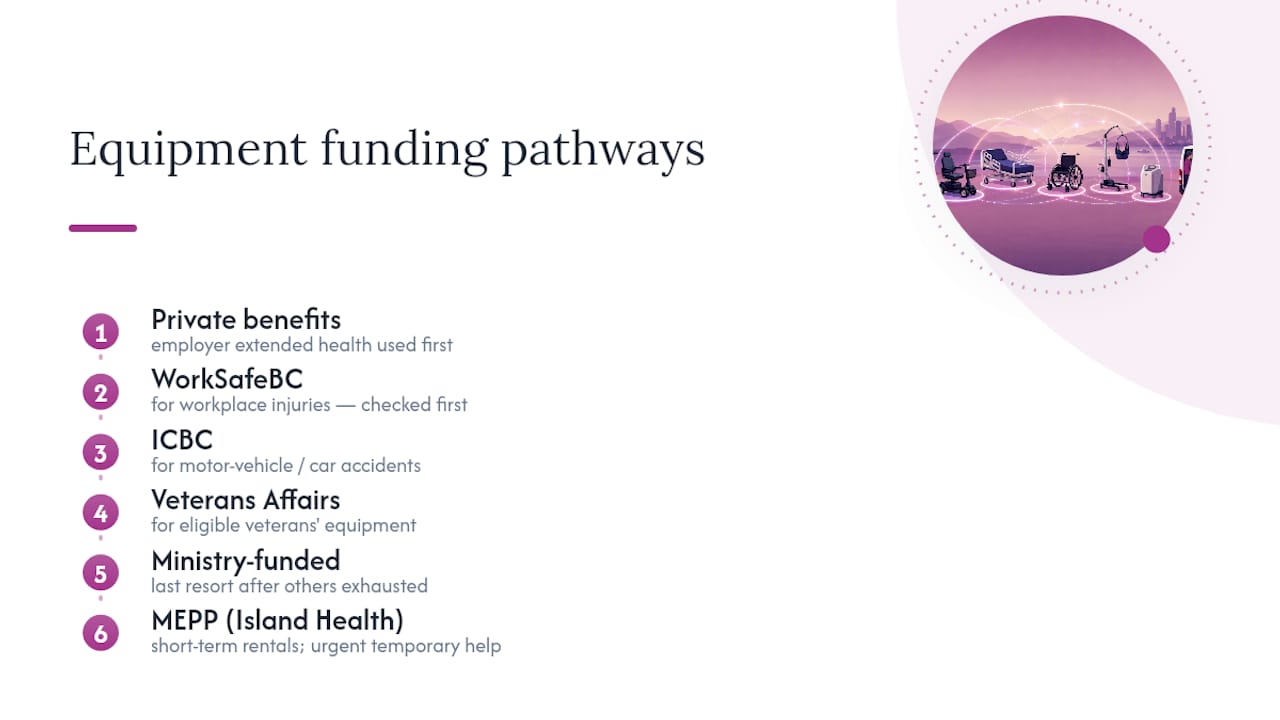
That order matters more than most people realize. Government policy is explicit that ministry funding is a last resort. It only kicks in once you’ve exhausted private insurance, ICBC, WorkSafeBC, and Veterans Affairs. If you have workplace health coverage, that gets checked and used first, every time, before a ministry application even gets considered.
How do you apply for equipment funding in BC?
Getting equipment funded starts with paperwork, and the order you do things in determines whether the process takes two weeks or two months.
A medical practitioner or nurse practitioner has to confirm the medical need in writing first. From there, most programs also want confirmation from an occupational therapist or physical therapist that the specific item, not just the general category, matches your situation. A generic doctor’s note saying “patient needs a wheelchair” usually isn’t enough on its own; assessors want details on why this chair, at this height, with these features.
Here’s the sequence that tends to work:
- Book an appointment with your family doctor or a nurse practitioner and get a written statement of medical need.
- Arrange an OT or PT assessment if the program requires one (MEPP and most ministry equipment claims do).
- Confirm which program you qualify for. Check MSP coverage status, financial situation, and whether other resources (insurance, WorkSafeBC, ICBC) apply first.
- Submit the application with the medical justification letter and any required ministry forms, referencing the program’s own documentation where the assessor is unfamiliar with it.
- Wait for pre-approval before buying or committing to anything. Purchasing ahead of approval can disqualify the claim entirely.
- Once approved, work with a contracted supplier where possible, since this typically speeds up delivery and warranty coverage.
The most common source of delay isn’t complexity. It’s an assessor who fills out ministry-specific forms incorrectly because they don’t normally deal with this paperwork, a pattern the ministry’s own guidance flags directly. An OT who handles these applications regularly will know exactly which HR forms to attach and how to phrase the justification so it doesn’t bounce back for clarification.
Pro Tip: Ask your OT or assessing clinician directly whether they’ve submitted ministry equipment applications before. If they haven’t, ask them to reference the ministry’s own policy manual while filling out the forms. It’s a small step that prevents most of the back-and-forth that stalls approvals for weeks.
Which equipment usually qualifies, and which doesn’t?
Funding decisions come down to medical necessity and cost. Programs lean toward practical, no-frills items over premium versions, and some categories of equipment simply sit outside their scope no matter how badly you need them.
Items that generally have a reasonable shot at approval:
- Basic manual wheelchairs and transport chairs
- Ambulatory aids like walkers, canes, and crutches
- Short-term hospital bed rentals through MEPP for post-surgical recovery
- Bath and toilet safety aids, such as grab bars or raised toilet seats
- Certain surgical supplies tied directly to a documented medical need
Items that typically fall outside these programs:
- Hearing aids, which run through separate provincial hearing programs, not MSP or ministry equipment funding
- Dentures, generally excluded unless a very specific medical exception applies
- Many CPAP machines, where funding usually comes through extended health benefits or direct purchase rather than ministry channels
- Non-medical convenience items, even when they’d genuinely make daily life easier
The “least expensive, appropriate” rule shapes almost every approval. If a basic manual wheelchair meets your clinical need, the ministry won’t fund a power chair just because it’s more comfortable. Contracted suppliers know this rule well and will usually steer your application toward the option most likely to clear, which sometimes means accepting a less deluxe product than you’d hoped for.
What if you need equipment right now?
Waiting weeks for an assessment and approval isn’t realistic when you’re being discharged from hospital on Friday and need a bed at home by Saturday. This is where rentals matter more than any funding program.
MEPP has return requirements and firm rental limits, generally around three months, so it’s not meant to cover you indefinitely even once approved. A private rental fills the gap while you sort out longer-term funding, and it also works if your MEPP or ministry application gets declined or takes longer than expected.
Before calling a rental company, have a few things ready:
- A copy of your prescription or medical letter, if you have one
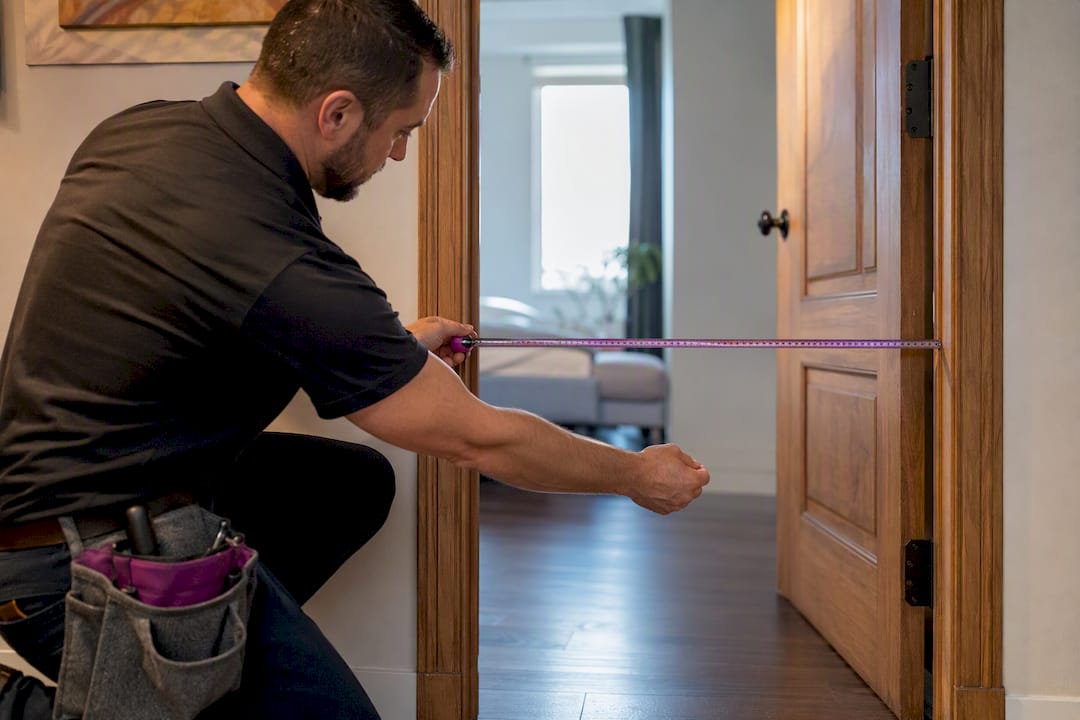
- Measurements of doorways, hallways, and the room where the equipment will go
- Notes on stairs, tight corners, or anything that affects delivery access
- A rough timeline for how long you’ll likely need the item
Pro Tip: Keep every receipt, delivery confirmation, and email tied to a private rental. If your ministry or MEPP application is later approved, documented rental costs can sometimes support a co-funding or reimbursement claim, but only if you can prove exactly what you paid and when.
How can Seventh Chakra help with immediate access?
When a funding decision is still weeks away and someone needs a hospital bed, wheelchair, or scooter tonight, a private rental is often the only realistic option. Rental companies can provide same-day delivery of wheelchairs, scooters, and hospital beds with no deposit required upfront, which matters when you’re already managing hospital discharge instructions and don’t have spare cash tied up in a security hold.
Every piece of equipment is sanitized before it leaves the warehouse. Rental terms are flexible rather than locked into a rigid contract, so a two-week bridge rental while you wait on a MEPP decision works the same as a longer-term arrangement if your situation changes.
Before calling, it helps to have the same details ready that any rental company would ask for:
- A copy of your medical letter or prescription, if one exists
- Basic measurements of your home entryway and the room the equipment will go in
- Any stairs, narrow hallways, or access issues the delivery team should know about
Roughly 900,000 people in Metro Vancouver are over the age of 55, a population whose mobility equipment needs spike fast and rarely on a convenient schedule. Same-day rental exists for exactly that reality, not as a substitute for pursuing MSP-adjacent funding, but as the practical way to stay safe and mobile while that paperwork works its way through the system.
Book a rental: where to start with Seventh Chakra
If you need a hospital bed, wheelchair, or scooter this week rather than next month, the hospital bed rental page is the place to start for post-surgical or home recovery setups, with electric adjustable beds delivered the same day starting from a weekly rental rate. For mobility around the house or outdoors, the standard wheelchair rental page starts from $75 per week, and the mobility scooter rental page starts from $200 per week for outdoor-capable models.
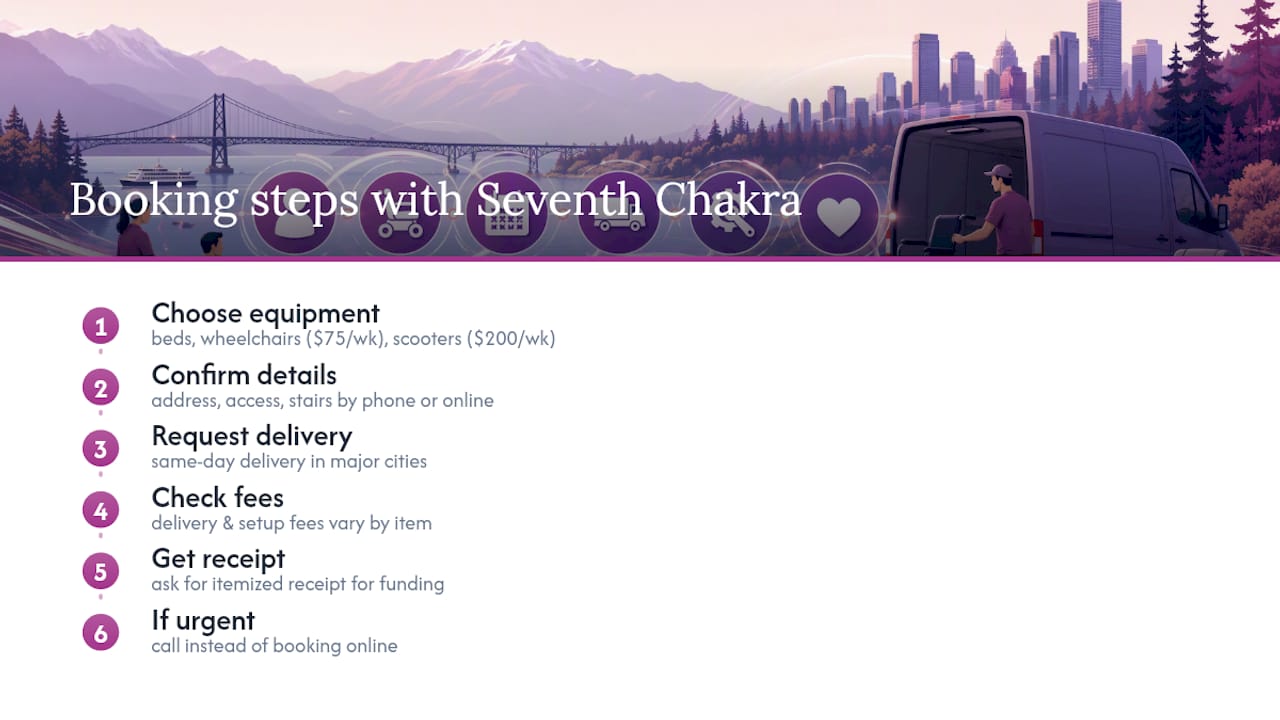
Booking is straightforward: pick the equipment, confirm your address and access details over the phone or online, and delivery happens the same day in most cases across Vancouver, Surrey, Burnaby, and Richmond. Delivery and setup fees vary depending on the item, and the delivery fees page lays out the exact costs so there are no surprises when the invoice arrives. If you’re pursuing MEPP or ministry co-funding, ask for an itemized receipt at delivery. It’s the kind of documentation that later supports a reimbursement claim.
If your need is urgent, call rather than book online. Same-day delivery works best when the team knows the full picture, including any stairs, tight doorways, or care needs at the destination.
A practical perspective on chasing public funding while staying mobile
The frustration here is real, and it’s not really about the money. It’s the waiting. Public programs exist for good reason, but “pre-approval before purchase” and “exhaust other resources first” can mean weeks pass before anyone tells you yes or no, and mobility problems don’t pause for that.
My honest read: pursue the public routes because MEPP and ministry funding genuinely help people who qualify, but never let an application timeline dictate whether someone is safe getting to the bathroom this week. Get the assessment moving, apply where you’re eligible, and rent in the meantime if the wait outlasts the need. Keep every receipt. Some of that rental cost may come back to you later through co-funding, but only if you can prove what you spent.
— Chandan
FAQ
What does MSP cover in British Columbia?
MSP covers medically necessary physician services, most surgeries, diagnostic testing, and select services from other practitioners. It does not cover home medical equipment like wheelchairs, hospital beds, or mobility scooters.
How do I get a CPAP machine for free in BC?
MSP and most ministry equipment programs generally don’t fund CPAP machines directly. Coverage more often comes through private extended health benefits, employer insurance plans, or in some cases specific ministry health supplement provisions, so check your insurance policy and ask your doctor which route applies to your situation.
What is not covered by MSP in BC?
Beyond home equipment, MSP typically excludes hearing aids, most dental work including dentures, and many elective procedures. These fall under separate provincial programs, PharmaCare rules, or private insurance rather than MSP itself.
Does MSP cover medical expenses outside the province?
MSP provides limited coverage for medically necessary services received outside BC, and coverage is generally far more restricted outside Canada entirely. It’s worth contacting Health Insurance BC directly before travelling if you have ongoing medical needs, since equipment funding programs like MEPP and ministry assistance are BC-specific and don’t travel with you.
Can Seventh Chakra help while I wait for MEPP or ministry approval?
Yes. Some companies offer same-day rental of wheelchairs, mobility scooters, and hospital beds with no deposit required, which can work well as a bridge while a funding application is pending. Current rental pricing is listed on each product page, including the wheelchair rental page.