
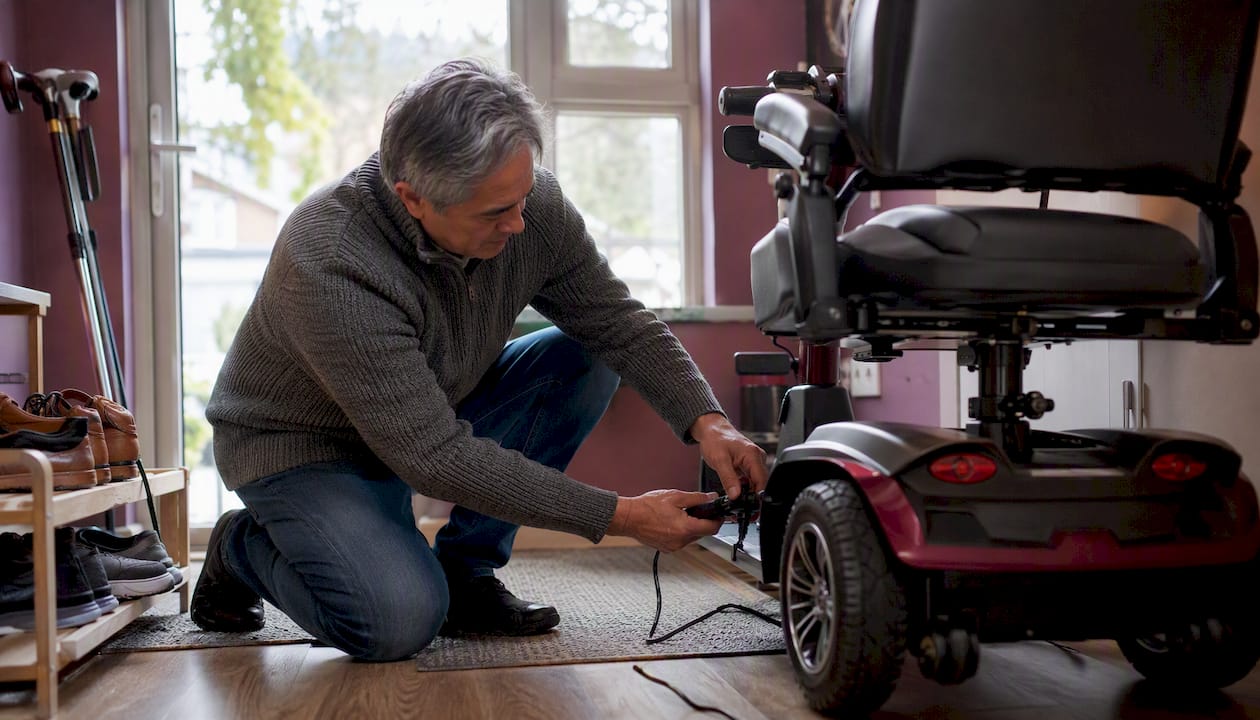
Plan for a moderate real-world range on a full charge, and only book a scooter whose advertised range is at least double your estimated trip distance. That single rule keeps you from getting stranded on a Vancouver hillside or halfway along the seawall.
Before you leave, run through three quick checks:
- Battery charge: confirm it reads full (or close to it) at pickup or delivery
- Charger present: verify the correct charger is included, especially on multi-day rentals
- Tyre pressure: soft tyres alone can shave meaningful distance off your trip
Pro Tip: If your planned outing is 10 km return, look for a scooter advertised at 20 km or more. That 2× buffer accounts for hills, weight, and the natural fade of a battery that isn’t brand new.
Advertised range figures come from controlled lab tests, not Vancouver streets. Real-world factors like rider weight, terrain, and surface type consistently pull actual distance well below what the spec sheet promises.
Key takeaways
A rental mobility scooter in Greater Vancouver realistically covers 15–20 km per charge under normal conditions, so always choose a model whose advertised range is at least double your planned trip distance.
| Point | Details |
|---|---|
| Safe planning rule | Choose a scooter with advertised range at least 2× your estimated trip distance. |
| Main range factors | Weight, hills, surface type, and cold weather all reduce real-world distance below the spec. |
| Battery chemistry matters | LiFePO4 lasts 5–10 years and handles cold best; SLA lasts 12–18 months and fades fastest in winter. |
| Charge after every use | Plug in with the supplied charger after each outing and store the scooter indoors overnight in cold weather. |
| Seventhchakra rental | Same-day delivery across Greater Vancouver, no deposit, sanitized equipment, and charger included. |
Table of Contents
- 1. Which external factors most change your scooter’s real-world range?
- 2. How battery chemistry affects lifespan and cold-weather performance
- 3. How to estimate a safe trip distance from an advertised range
- 4. Charging and maintenance practices that protect your rental battery
- 5. Signs a battery needs replacing and what it costs in Canada
- 6. Pre-rental checklist for Greater Vancouver bookings
- What most renters get wrong about scooter battery range
- Seventhchakra delivers rental scooters across Greater Vancouver, same day, no deposit
- Sources
- FAQ
1. Which external factors most change your scooter’s real-world range?
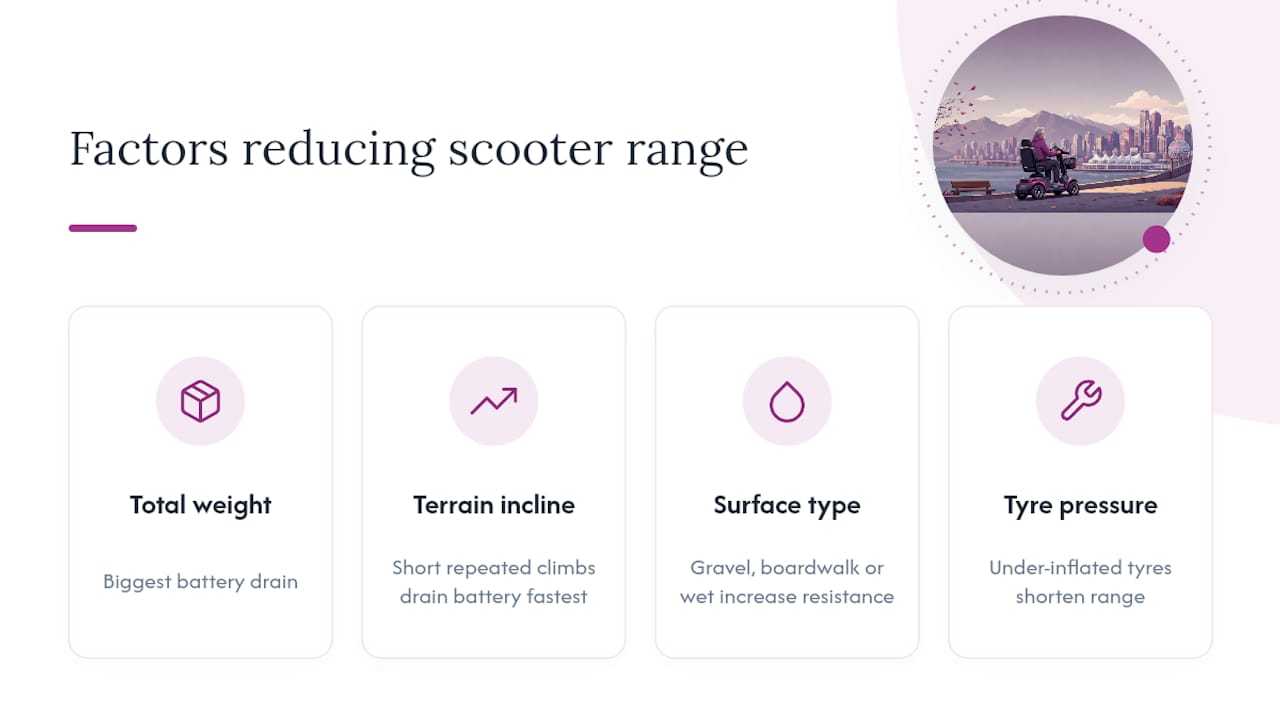
Four variables do most of the damage to battery performance for scooters, and three of them are things you can actually control.
Total weight is the biggest draw on the battery. A heavier rider, a loaded backpack, or a caregiver adding cargo all increase motor effort on every metre of the trip. Hill climbing and heavier loads can markedly cut maximum range, so travelling light genuinely extends how far you go.
Terrain incline hits hard in Vancouver. The Stanley Park seawall is relatively flat and forgiving on battery life. Steep neighbourhood streets in areas like Commercial Drive or the West End are a different story — short climbs that repeat across a trip drain the pack faster than any other single factor.
Surface type matters more than most renters expect. Smooth pavement rolls easily; gravel paths, wooden boardwalks, and wet surfaces all increase rolling resistance and battery draw.
Tyre pressure is the easiest fix. Under-inflated tyres create more contact with the ground, which means more resistance and shorter range.
Cold-weather note: Canadian battery guidance warns that battery capacity can drop substantially as temperatures fall, with meaningful losses per 10°C drop. On a cold Vancouver morning in January or February, expect noticeably less range than the same scooter delivers in July.
Pro Tip: Planning a flatter route can extend usable range more than upgrading to a higher-capacity battery, especially when terrain is the main constraint.
2. How battery chemistry affects lifespan and cold-weather performance
Three battery types appear in rental mobility scooters, and they behave very differently in Canadian conditions. A Canada-focused battery guide confirms that winter conditions and improper charging shorten battery life across all chemistries, but the gap between them is significant.
| Battery type | Typical lifespan | Cold-weather performance | Weight |
|---|---|---|---|
| SLA (sealed lead-acid) | 12–18 months | Loses capacity quickly below 10°C | Heaviest |
| Gel | 18–24 months | Moderate cold tolerance | Heavy |
| LiFePO4 (lithium) | 5–10 years | Best cold retention of the three | Lightest |
What this means for renters in practical terms:
- An older SLA battery on a cold January morning may deliver significantly less range than its advertised figure
- Gel batteries are a step up but still degrade faster than lithium in repeated cold cycles
- LiFePO4 batteries hold their capacity better year-round and are the best choice for frequent or winter use in Greater Vancouver
- Always ask the rental provider how old the battery is — a 14-month-old SLA is near the end of its useful life
3. How to estimate a safe trip distance from an advertised range
The safe planning rule: take the advertised range, apply a realistic-conditions factor to account for weight, terrain, and surface, then halve that figure to leave a return-trip buffer.
Here is the arithmetic for a typical rental scooter advertised at 25 km:
- Start with advertised range: a typical figure
- Apply real-world factor: adjust for realistic single-charge distance
- Apply a safety margin: halve it for a safe one-way planning distance
So a scooter advertised at 25 km gets you roughly 8 km from your starting point before you should turn back. That covers a comfortable loop of the seawall from the West End, but not a round trip to Granville Island and back with hills in between.
“Manufacturer range figures are produced under ideal testing conditions. Real-world performance varies with rider weight, terrain, wind, and surface — plan your trip distance around the realistic figure, not the spec sheet.” — medmobility.ca
Before you calculate, check these four things on the scooter itself:
- Advertised amp-hour (Ah) and voltage (V) rating on the battery label
- Battery age (ask the provider — this affects how close to rated capacity it actually holds)
- Tyre condition and pressure
- Whether the battery was fully charged before delivery
4. Charging and maintenance practices that protect your rental battery
Pride Mobility’s manufacturer guidance is clear: plug in after each day of use, always use the original charger, and store batteries at suitable room temperatures. For renters, that translates into a short daily routine.
Daily charging checklist:
- Plug in the scooter after every outing, even short ones
- Use only the charger supplied with the rental — incompatible chargers are a leading cause of premature battery failure
- Charge in a warm indoor location when possible, not in a cold garage or on a balcony overnight
- Bring the scooter inside overnight during cold weather to protect capacity
For multi-day rentals, ask the provider these questions before you take delivery:
- Is the charger included, and is it the correct model for this battery?
- Where should the scooter be stored overnight — indoors only, or is a heated garage acceptable?
- Is there a backup battery or swap option if range drops unexpectedly?
- What is the charging time from flat to full?
Pro Tip: SLA batteries benefit from a full charge cycle rather than repeated short top-ups. Lithium batteries are more tolerant of partial charges. Ask the provider which chemistry your rental uses so you charge it correctly.
5. Signs a battery needs replacing and what it costs in Canada
A battery that needs replacing will usually tell you before it fails completely. Watch for these warning signs:
- Range drops noticeably compared to earlier in the rental period
- The charge indicator falls faster than expected after a full overnight charge
- Charging takes longer than the manufacturer specifies
- The battery or casing shows swelling, corrosion, or unusual heat
Older batteries deliver less range because repeated charge cycles, cold exposure, and age all reduce the amount of energy the cells can hold. For rental scooters, this means a unit that sat unused through a cold winter may perform well below its advertised figure even after a full charge.
Canadian replacement price ranges vary by chemistry:
| Battery type | Typical Canadian replacement cost |
|---|---|
| SLA (per pair, most scooters use two) | $80–$180 CAD |
| Gel (per pair) | $120–$250 CAD |
| LiFePO4 (lithium) | $400–$900 CAD |
For renters, the practical takeaway is simple: if you notice a sharp drop in range mid-rental, contact the provider immediately and ask for a battery swap or a replacement unit.
6. Pre-rental checklist for Greater Vancouver bookings
Use this list when you call or receive delivery from a local rental provider. It takes five minutes and can prevent a trip cut short.
At booking, confirm:
- Advertised range of the specific scooter model being sent
- Battery chemistry and approximate age
- Whether the charger is included in the delivery
- Sanitization policy (all equipment should be cleaned before delivery)
- Same-day delivery availability for your neighbourhood
At delivery, check:
- Battery reads full on the indicator
- Charger is present and matches the scooter model
- Tyres look firm (press with your thumb — they should not compress easily)
- The scooter powers on and drives smoothly before the driver leaves
- You have a contact number for same-day support if something changes
Questions specific to Vancouver routes:
- Does the scooter handle moderate inclines (ask about the motor wattage)?
- Is there a swap or backup option if range is insufficient for your planned route?
- For tourists: can the scooter be delivered directly to your hotel?
Pro Tip: For a trip along the seawall or through Stanley Park, a mid-size 4-wheel scooter typically offers a better range-to-stability balance than a compact 3-wheel model.
What most renters get wrong about scooter battery range
The number on the spec sheet is not a promise. It is a best-case scenario measured in a lab with a light rider, flat ground, and a brand-new battery at room temperature. None of those conditions describe a real trip in Vancouver in November.
What I see consistently is renters planning right up to the advertised figure, then wondering why the scooter slowed down on the return leg. The 2× safety margin is not conservative — it is the minimum buffer that accounts for battery age, hills, and the simple fact that a rental unit has been used before you got it.
The other thing worth saying plainly: route choice matters more than battery size. A scooter with a 30 km advertised range on a hilly route may deliver less usable distance than a 20 km model on a flat one. Choosing flatter routes can increase usable distance more reliably than chasing a higher spec number.
Cold weather is the variable most people underestimate until it catches them. Bringing the scooter indoors overnight is not optional in a Vancouver winter — it is the single most effective thing a renter can do to protect next-day range.
Seventhchakra delivers rental scooters across Greater Vancouver, same day, no deposit
When you need a mobility scooter rental in Vancouver today, Seventhchakra removes the two friction points that slow most rentals down: the upfront deposit and the wait. Every scooter arrives sanitized, with the correct charger included, and a team you can call if range or equipment questions come up mid-rental.

Rental options available for same-day delivery across Greater Vancouver:
- 3-wheel lightweight scooter — compact and manoeuvrable for indoor use and shorter flat trips
- Mid-size 4-wheel scooter — better stability and range for parks, seawall routes, and hillier neighbourhoods
- Heavy-duty scooter — suited to higher weight capacities and longer daily distances
Flexible rental terms, no deposit required, and same-day delivery to homes, hotels, and care facilities across the region. Check availability and book your scooter rental directly online.
Sources
- Best Mobility Scooter Batteries for Canadian Weather
- Understanding Mobility Scooter Performance | Batteries, Tires & Range
- Best Practices for Battery Life | Pride Mobility Experience
- How Far Can a Mobility Scooter Go: A Complete Range Guide – GYROOR
FAQ
How far can a mobility scooter realistically go on one charge?
Plan for 15–20 km of real-world range on a full charge under typical Vancouver conditions. Advertised figures are higher because manufacturers test under ideal lab conditions, not on hills or with a loaded rider.
How does cold weather affect scooter battery range in Vancouver?
Cold temperatures reduce battery capacity, with meaningful losses per 10°C drop. Bringing the scooter indoors overnight and charging in a warm location helps preserve next-day range during Vancouver’s winter months.
What battery type lasts longest in a rental mobility scooter?
LiFePO4 (lithium iron phosphate) batteries last 5–10 years and retain capacity better in cold weather than SLA (12–18 months) or gel (18–24 months) options, making them the strongest choice for year-round Canadian use.
What should I ask a Greater Vancouver rental provider before booking?
Ask for the scooter’s advertised range, the battery type and age, whether the charger is included, and whether same-day delivery and a backup swap option are available if range falls short.
How do I calculate a safe one-way trip distance from the advertised range?
A scooter advertised at 25 km gives you roughly 8 km of safe one-way travel after accounting for real-world factors and safety margin.