
Vancouver Sidewalk Rules: Burnaby Mobility Use, Rentals From $75/Week

Yes, mobility scooters, powered wheelchairs and manual wheelchairs may generally use sidewalks in Burnaby and Vancouver, provided the device is used for its intended purpose and stays within pedestrian speed and behaviour. Under British Columbia’s Motor Vehicle Act, a mechanically propelled invalid’s chair used as designed is exempt from the Act’s normal vehicle rules, which is why these devices are treated like pedestrians on sidewalks, curb ramps and multi-use paths rather than like road vehicles.
TL;DR:
- Mobility devices used as designed are exempt from BC vehicle laws and are generally allowed on sidewalks at pedestrian speeds.
- Devices with pedals, excessive motor power, or higher speeds may fall outside the pedestrian category and require road use or special registration.
- Renting providers in Burnaby offer same-day delivery with options to confirm device fit, safety, and sanitization before use.
- Sidewalk conditions such as construction, uneven pavement, or missing ramps are common barriers, and reporting hazards helps ensure repairs.
- Standard mobility scooters and wheelchairs do not require permits or licenses for sidewalk use, but documentation may be needed for certain rentals.
Table of Contents
- What the BC Motor Vehicle Act says about mobility devices
- Comparing local rental providers in Burnaby
- Renting the right device: a caregiver’s checklist
- How Vancouver and Burnaby treat sidewalks under municipal rules
- When a sidewalk is blocked, broken or unsafe
- Sharing the sidewalk: rights, courtesy and conflict resolution
- Permits and registration: what you actually need
- Where to find local support and advocacy resources
- Keeping your device safe and sidewalk-ready
- A caregiver’s routine for predictable sidewalk trips
- Same-day mobility rentals from Seventh Chakra in Burnaby
- Sources
- FAQ
What the BC Motor Vehicle Act says about mobility devices
The Motor Vehicle Act states that its rules do not apply to the operation of a mechanically propelled invalid’s chair when it is used only for the purpose it was designed for. In plain terms, a mobility scooter or powered wheelchair used to get around a sidewalk or crosswalk is not treated as a motor vehicle, so a caregiver pushing or operating one does not need a driver’s licence, plates or vehicle insurance for that use.
Classification still matters. BC’s statutory definitions separate a “pedestrian,” a “designated personal mobility device” and a “motor assisted cycle,” and where a device fits changes where it may legally travel. A device with pedals, a motor exceeding the prescribed power output, or a top speed above what regulations allow can fall outside the pedestrian category and get treated more like a cycle or motor vehicle, which usually means it belongs on the road, not the sidewalk. These distinctions come from BC’s Motor Vehicle Act definitions and regulations.
If there is ever doubt about how a device is classified, a peace officer has the authority to inspect it and, in some cases, temporarily seize it if there are reasonable grounds to believe it is being used against the Act. Sticking to a standard mobility scooter or wheelchair, used for mobility rather than modified for speed, keeps you clearly inside the pedestrian exemption.
Comparing local rental providers in Burnaby
Two names come up often for Burnaby residents looking to rent rather than buy: Seventh Chakra Healing Ltd and Motion, formerly known as Motion Specialties. Both serve the area, but their focus and depth differ enough to matter when you are booking on short notice.
Seventh Chakra operates as a local medical equipment supplier offering wheelchair and mobility scooter rentals with same-day delivery and sanitization, which suits a family who needs a device quickly. Its rental model supports caregivers needing quick access to mobility equipment after a hospital discharge.
Motion brings a longer institutional history and a wider retail footprint, including stairlifts and a broader catalogue of mobility equipment beyond short-term rentals. It suits someone comparing permanent equipment purchases or wanting a showroom visit, though availability of scooters or hospital beds for short-term rental is worth confirming directly by phone before you plan around it.
Before booking with either provider, it helps to check a short list:
- Confirm the device’s width and turning radius against your home’s doorways and your usual sidewalk route.
- Ask whether delivery includes setup and a brief fit check, not just drop-off.
- Verify sanitization is standard practice, not an optional add-on.
- Ask about pickup timing and what happens if you need to extend the rental.
Renting the right device: a caregiver’s checklist
Getting the right device matters more than getting a device quickly, though in Burnaby you can often get both. Before you book, run through this list:
- Check the device’s width and turning radius against your home’s doorways, elevators and the curb ramps on your regular route.
- Confirm the weight capacity matches the user’s needs, including any added weight from bags or oxygen equipment.
- Ask about battery range for scooters and powered wheelchairs, especially if the route includes hills or longer outdoor stretches.
- Test the brakes and any speed limiter before the delivery technician leaves.
- Check seat and arm support for comfort on multi-block trips, not just short indoor use.
- Ask if the device folds or disassembles easily for transport in a car or transit.
When you call a rental provider, a few direct questions cut through the guesswork: Do you offer same-day delivery? Can I request a short test roll on my actual route before committing? Is sanitization included in the rental price? What is your pickup policy if my needs change? Do you offer on-call technical support if something needs adjusting mid-rental?
Some providers may also ask about a prescription or documentation, particularly for power-based mobility equipment. A blog post on prescriptions for wheelchairs in BC walks through when that paperwork is actually required and when same-day rental is possible without it.
How Vancouver and Burnaby treat sidewalks under municipal rules
Sidewalks in both cities are built and governed as shared pedestrian space, and mobility devices used as intended fall under that pedestrian umbrella rather than under bylaws written for wheeled micromobility. Vancouver’s walking and accessibility guidance treats sidewalks as essential transportation corridors and prioritizes curb ramps and tactile warning strips specifically to improve access for wheelchair and mobility-aid users, which tells you these devices are the intended users of that infrastructure, not an exception to it.
Local bylaws that restrict devices like e-scooters or certain wheeled cycles from sidewalks are aimed at that category of micromobility, not at devices legally defined as pedestrian mobility devices under the Motor Vehicle Act. That distinction matters because it means a mobility scooter or wheelchair is not swept up in restrictions written for a different kind of device, even though both might look similar at a glance.
In practice, this means you can generally expect to use sidewalks the way any pedestrian would: travelling at a walking pace, yielding at crosswalks, and using the same curb ramps built into the city’s accessibility upgrades. Where a municipality’s design standards call for wider clearances, such as sidewalk passing widths intended to let a wheelchair user and another pedestrian move side by side, those same measurements tend to make routes friendlier for scooters too. The practical challenge is rarely legality. It is finding sidewalks that are actually wide enough, level enough and free of obstructions to use comfortably.
When a sidewalk is blocked, broken or unsafe
Construction, uneven pavement and missing curb ramps are the most common problems Burnaby and Vancouver mobility device users run into, more so than any legal restriction. When a sidewalk is obstructed by construction with no posted detour, the right move is to look for accessible path of travel signage before assuming a detour into the roadway is safe or permitted. Stepping into traffic lanes without a signed route is not a reliable workaround, even when the sidewalk closure feels temporary.
Both cities take hazard reports seriously, and reporting a blocked or damaged sidewalk through the municipal contact channels is the fastest way to get it flagged for repair or a proper detour. Burnaby’s Accessibility Plan points to wide, smooth park trails as safer alternative routes where sidewalks are uneven or incomplete, which is worth remembering if your regular path has a rough stretch you already know about.
Older curb ramps built before current design standards are sometimes steeper than what newer guidance recommends, and a ramp that looks fine on foot can be a real problem for a scooter or powered wheelchair. If you are new to a route, or renting a device for the first time, a short test roll on the actual sidewalk you plan to use is the simplest way to catch a curb ramp that will not work before you are relying on it daily. This is also why choosing a rental provider that offers a fit check at delivery, rather than a pure drop-off, makes a practical difference. A technician who can see the ramp in question can flag a mismatch on the spot rather than after a return trip proves the point.

Sharing the sidewalk: rights, courtesy and conflict resolution
Mobility device users have the same right to sidewalk space as any other pedestrian, and that includes right-of-way at crosswalks and priority on curb ramps built for accessible access. Cyclists are generally required to stay off sidewalks in built-up areas under municipal bylaws, which means a wheelchair or scooter user encountering a cyclist on a sidewalk is dealing with someone who, in most cases, should not be there in the first place.
In practice, most sidewalk friction comes down to space and awareness rather than any real dispute over rights. Pedestrians walking two or three across, dog leashes stretched wall to wall, or someone stopped to check a phone can all narrow a sidewalk that was already tight. A clear, calm request to pass, or a moment’s pause at a pinch point, resolves the overwhelming majority of these situations without needing to invoke any rule at all.
When a genuine conflict happens, such as a cyclist refusing to yield a shared path or a blocked curb ramp with no alternative, documenting the location and reporting it to the municipality is more productive than confronting the other party directly. Both Vancouver and Burnaby track these reports as part of ongoing accessibility upgrades, and specific, repeated complaints about the same intersection or block tend to get prioritized faster than one-off comments. Keeping a short note of the date, location and issue makes that report more useful if you ever need to follow up.
Permits and registration: what you actually need
For a standard mobility scooter, powered wheelchair or manual wheelchair used as designed, there is no permit, licence or registration required to use it on a Burnaby or Vancouver sidewalk. The Motor Vehicle Act’s exemption for mechanically propelled invalid’s chairs used for their intended purpose covers this directly, which means the paperwork burden that applies to motor vehicles simply does not apply here.
Where documentation sometimes enters the picture is on the rental or purchase side, not the sidewalk-use side. Some rental providers ask for a prescription or a healthcare provider’s note before renting certain powered equipment, particularly for longer-term rentals or higher-power devices. That requirement varies by provider and by device, so it is worth asking directly when you call rather than assuming either way.
If a device’s specifications push it outside the pedestrian mobility device definition, such as unusually high power output or a top speed beyond what the definitions allow, it may need to be treated as a different class of vehicle entirely, which can bring in registration and insurance requirements similar to a motor vehicle. This is uncommon for standard rental scooters and wheelchairs, but it is a reason to stick with mainstream rental equipment rather than a modified or unusually powerful device if your main use is sidewalk travel.
Where to find local support and advocacy resources
Burnaby and Vancouver both fold mobility device access into broader civic accessibility work rather than treating it as a separate program, which means the most useful resources are often the same ones covering accessible design generally. Burnaby’s Accessibility Plan outlines the city’s approach to removing barriers in public spaces and civic facilities, and it is a reasonable starting point if you want to understand what upgrades are planned near your neighbourhood.
On the parks side, Burnaby has been building out wider, smooth-surfaced trails and barrier-free entries at civic facilities, which can offer a more predictable route than an older residential sidewalk when the goal is simply a reliable walk or roll outdoors. Vancouver’s accessible street design technical guide serves a similar function for anyone who wants to understand the actual measurements behind curb ramp grades and sidewalk clearances before choosing a regular route.
Beyond municipal planning documents, local caregiver networks and healthcare providers are often the most practical source of day-to-day advice, since they tend to know which specific blocks or intersections cause the most trouble for wheelchair and scooter users. If you are new to the area or new to using a mobility device, asking a discharge planner, occupational therapist or rental provider for route suggestions is often faster than working through planning documents alone.
Keeping your device safe and sidewalk-ready
A mobility device that is well maintained is also a device that is easier to keep inside the pedestrian mobility category, since worn brakes, a failing speed limiter or a modified motor can push a device outside its designed specifications. A basic weekly check covers most of what matters: brakes responding evenly, tires or wheels free of cracks or flat spots, and the speed limiter working as intended rather than bypassed.

Battery care matters just as much for outdoor sidewalk use as performance does. A scooter or powered wheelchair that loses charge mid-route on a longer Burnaby sidewalk stretch, particularly one with hills, is more than an inconvenience: it can leave someone stranded well short of a curb ramp or crossing. Charging fully before any trip longer than a short errand, and knowing the device’s realistic range rather than its rated maximum, avoids most of these situations.
For rented equipment, this maintenance responsibility is shared. A provider that sanitizes and inspects a device before delivery is doing part of that work for you, but a quick check at drop-off, brakes, tires, battery level, still catches anything missed. If something feels off mid-rental, calling for on-call technical support before continuing to use the device on sidewalks is the safer call than pushing through.
A caregiver’s routine for predictable sidewalk trips
Before heading out, I run through the basics: battery charged, brakes checked, and a route planned around known curb ramps rather than guessed at. Packing a high-visibility vest and a charged phone takes thirty seconds and matters more than it seems on a grey Burnaby afternoon.
If a route feels wrong on paper, a short test roll or a quick call to the rental provider for a technician check settles it faster than trial and error. Sticking to known accessible routes, and reporting a hazard the moment you spot one, keeps the next trip easier than this one.
— Chandan
Same-day mobility rentals from Seventh Chakra in Burnaby
If you need a mobility scooter, wheelchair or hospital bed promptly, some providers offer delivery with no deposit required and sanitization before it reaches your door.
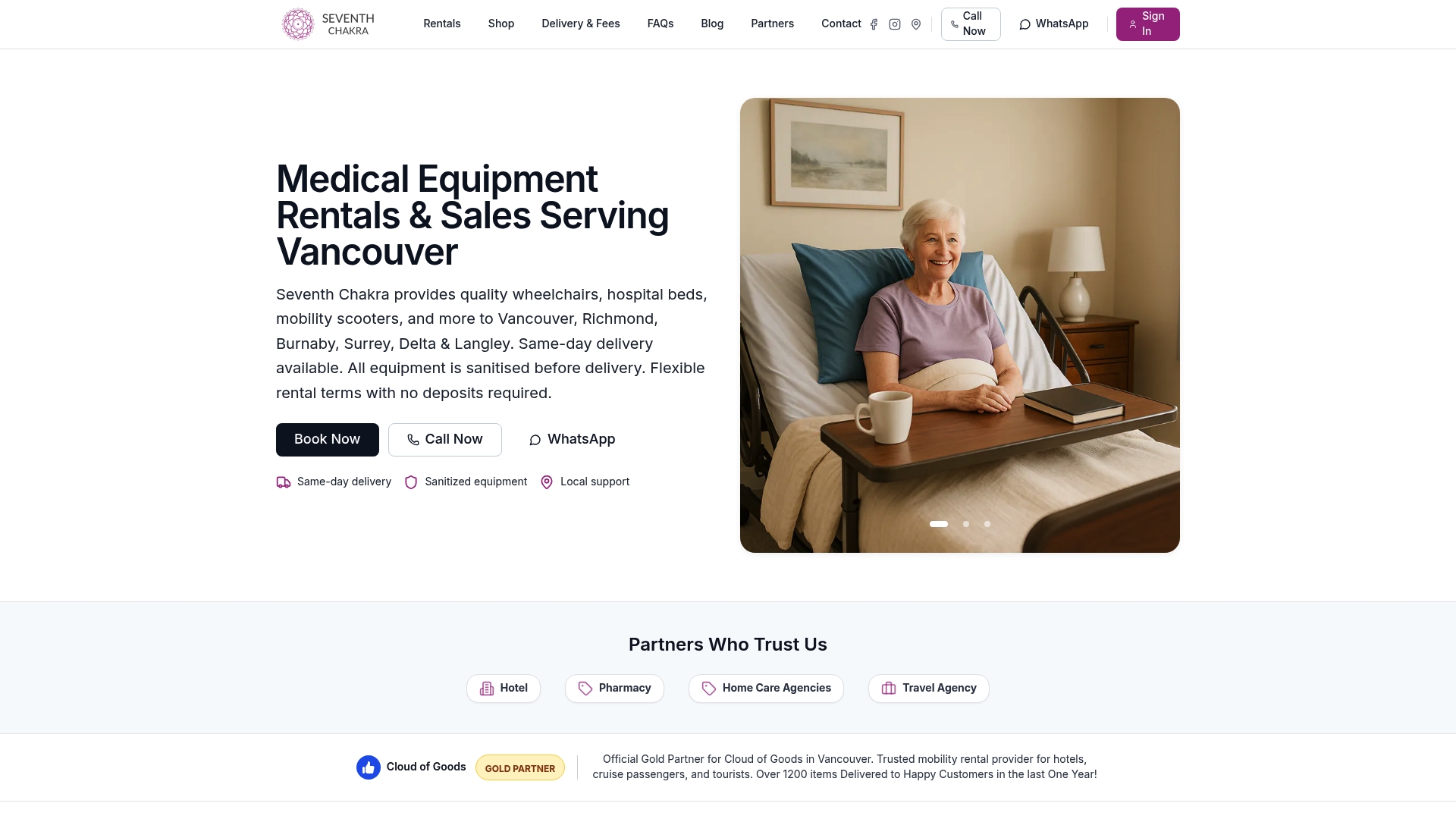
- Mobility scooter rentals start from $200 per week, with same-day delivery available.
- Standard wheelchair rentals start from $75 per week for short-term or extended use.
- Hospital bed rentals start from $175 per week, delivered and set up the same day.
- Browse the full rental catalogue for transport chairs, bariatric wheelchairs and other equipment.
Before booking, confirm that the device fits your route and home access points. Some providers offer technician support on delivery to ensure proper fit and usability.
Sources
- Motor Vehicle Act (consolidated) — BC Laws
- Walking and accessibility | City of Vancouver
- Burnaby Accessibility Plan
FAQ
Can I ride a mobility scooter on the sidewalk in Vancouver or Burnaby?
Yes, a mobility scooter used for its intended purpose is treated as a pedestrian device under BC’s Motor Vehicle Act, so it may travel on sidewalks the way a pedestrian would. It should stay at a walking pace and follow the same crosswalk and yielding rules as anyone else on foot.
Do I need insurance or a licence to use a powered wheelchair outside?
No, a mechanically propelled invalid’s chair used as designed is exempt from the Motor Vehicle Act’s normal licensing and insurance rules according to BC’s legislation. A device pushed beyond its designed power or speed limits could be classified differently, so sticking with standard rental equipment keeps you inside that exemption.
What should I do if a sidewalk is blocked by construction?
Look first for posted accessible path of travel signage rather than assuming it is safe to move into the roadway. If no detour is marked, reporting the block to the municipality helps get it flagged, and Burnaby’s Accessibility Plan also points to wide park trails as an alternative route where sidewalks are uneven or incomplete.
Can I rent a wheelchair or scooter the same day in Burnaby?
Yes, Seventh Chakra offers same-day delivery for wheelchair and mobility scooter rentals across Burnaby and the surrounding Greater Vancouver area, with no deposit required. Other local providers such as Motion offer broader mobility equipment ranges, though same-day availability for short-term rentals is worth confirming directly.
Do I need a doctor’s note to rent a mobility device in BC?
Not always. Some providers request a prescription for certain powered equipment or longer-term rentals, while others offer same-day rental without documentation, so it depends on the device and provider. A guide to wheelchair prescriptions in BC explains when paperwork is typically required.


