
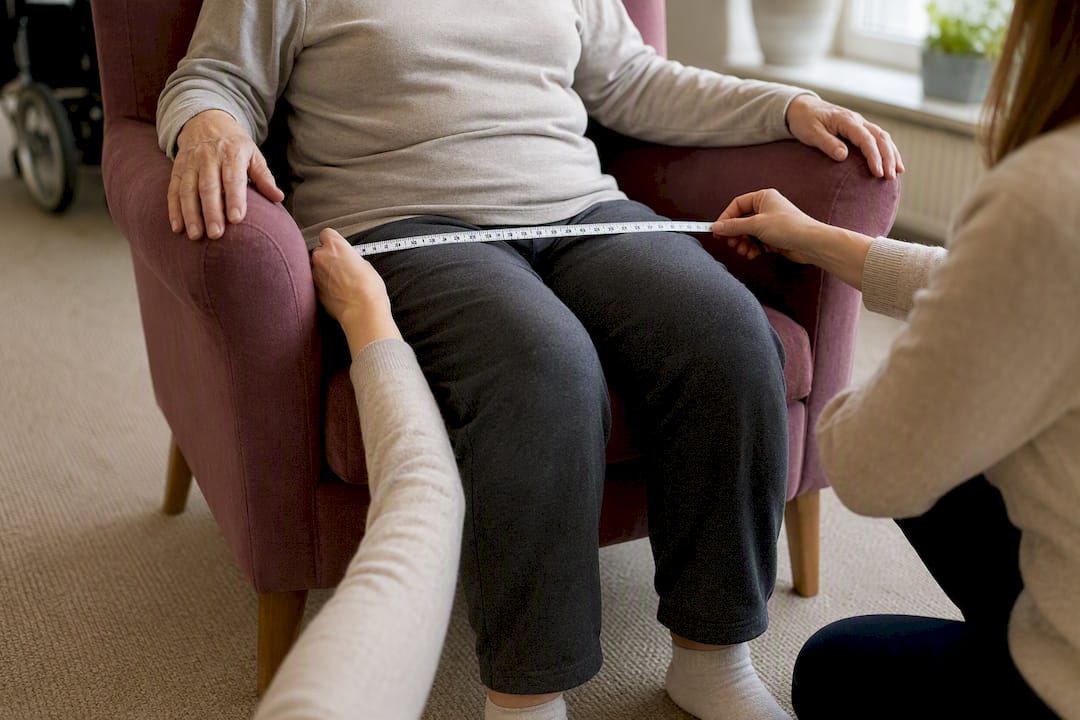
Measure the widest seated hip or thigh point and add roughly 2 inches for clearance. Measure seat depth from the back of the buttocks to the popliteal fossa (the crease behind the knee) and subtract 1 to 2 inches. Then confirm the frame’s rated weight capacity clears the user’s actual weight with a real safety margin, not a razor-thin one.
Five numbers matter before you buy or rent anything: seated hip/thigh width, seat depth, knee-to-floor height, back height, and body weight. Write them down together, not from memory a week later.
- Seated hip/thigh width (widest point, seated, not standing)
- Seat depth (buttock to popliteal fossa, minus 1 to 2 in.)
- Knee-to-floor height (heel-to-popliteal, with foot supported)
- Back height (measured in functional seated posture)
- Total body weight, including any recent changes
Pro Tip: A tape measure gets you close, but soft tissue shifts under load. Book a short rental of an extra-wide chair and sit in it for 30 to 60 minutes before committing. That single trial catches sizing errors no chart will.
Key Takeaways
Accurate bariatric wheelchair sizing depends on measuring seated hip width, seat depth, and body shape correctly, then confirming fit with a real trial before purchase.
| Point | Details |
|---|---|
| Seat width formula | Measure the widest seated hip or thigh point and add about 2 in. for clearance. |
| Seat depth formula | Measure buttock to popliteal fossa, then subtract 1 to 2 in. to protect the knee. |
| Capacity margin matters | Choose a frame rated well above current weight, accounting for cushion weight too. |
| Body shape changes the seat | Pannus, gluteal shelf, and apple/pear builds each call for different pan and back configurations. |
| Trial before you buy | Seventhchakra’s same-day, no-deposit bariatric wheelchair rentals let you confirm fit in real conditions first. |
Table of Contents
- How do you measure for a bariatric wheelchair?
- Weight capacity and chassis details: how to pick a base that will last
- Why body shape changes seat dimensions
- Cushion selection and pressure-relief considerations
- Manual, heavy-duty manual, or power: which base fits?
- Testing fit before you buy: a practical trial checklist
- Where to check clinical measurement standards
- Test the fit before you commit to it
- What I’d tell a family member sizing a chair for the first time
- Sources
- FAQ
How do you measure for a bariatric wheelchair?
Get positioning right before you touch a tape measure. Seat the person upright on a firm, flat surface, hips and knees at roughly 90 degrees, feet flat and supported. Slouching or a soft cushion under the sit bones will throw off every number that follows, so fix posture first and measure second.
1. Seat width. With the person seated, measure across the widest point of the hips or thighs. This is often not at the very back of the seat. Add about 2 inches total, giving roughly 1 inch of clearance on each side for clothing and movement. The Wheelchair Seating and Positioning Guide from a provincial health association uses this exact formula, and it holds up whether you’re fitting a standard frame or an extra-wide bariatric base.
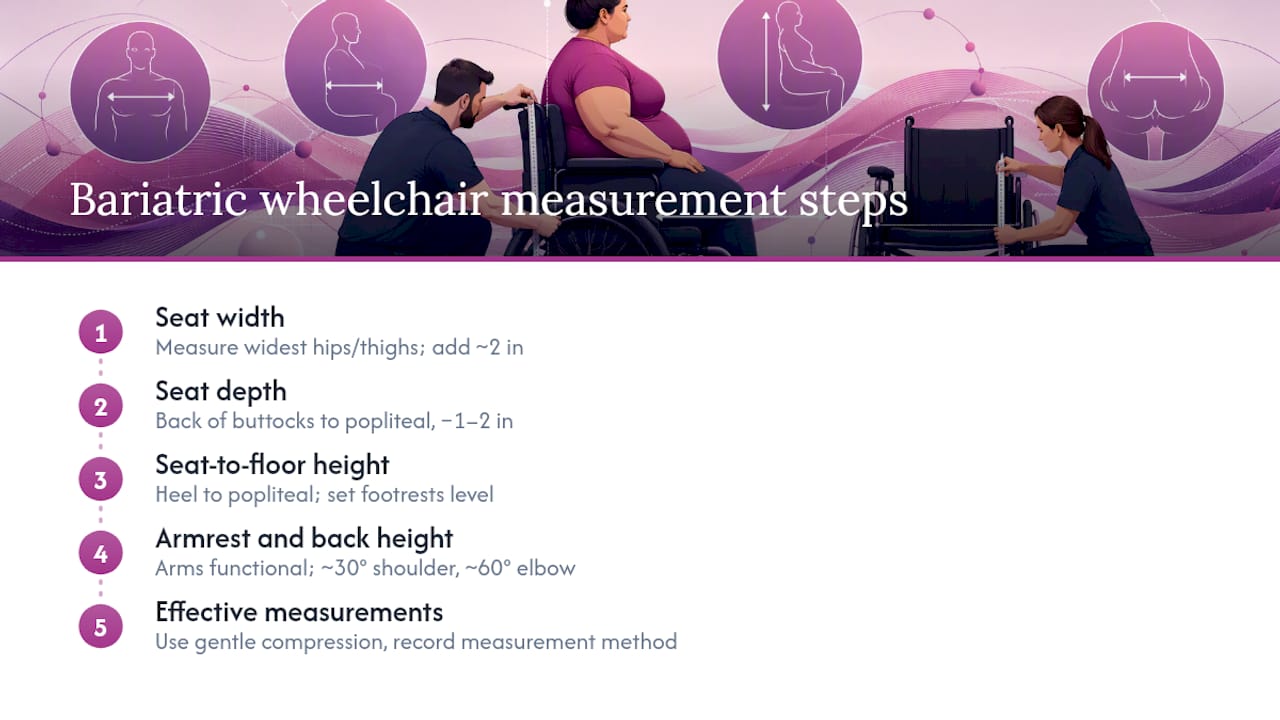
2. Seat depth. Measure from the back of the buttocks straight along the thigh to the popliteal fossa. Subtract 1 to 2 inches from that number. Skip the subtraction and the front edge of the seat digs into the back of the knee every time the person sits down, which restricts circulation and wrecks comfort over a full day.
3. Seat-to-floor height. Measure heel to popliteal fossa with the foot resting flat, then set footrests so feet land level or slightly elevated. Feet dangling or jammed too high both create pressure problems down the line.
4. Armrest and back height. Measure with the arms in a natural, functional position. Clinical reference points call for roughly 30 degrees of shoulder flexion and 60 degrees of elbow flexion, with about 1 inch of clearance between the thighs and the armrest uprights so nothing pinches.
5. When landmarks disappear under soft tissue. This is where most home measurements go wrong. Bariatric assessments frequently rely on what’s called Level 2 measurements, covering maximum lower-body width, ischial depth, waist depth, and individual knee width, and fall back on “effective” measurements whenever adipose tissue hides the actual bony landmark, according to Sunrise Medical’s bariatric assessment guide. In practice, that means using gentle compression with a flat measuring stick or calipers, and writing down exactly how you took the number so a prescriber can interpret it later.
One more detail worth checking during measurement: have the person let an arm hang naturally at the side of the target chair. If the fingertips land at or near the axle, that axle sits close to shoulder height, which is the reference point for efficient manual propulsion.
Weight capacity and chassis details: how to pick a base that will last
The rated capacity on a spec sheet is a ceiling, not a target. Choose a frame rated meaningfully above the user’s current weight, and build in margin for weight fluctuation and for the added weight of a bariatric cushion, which can run several pounds heavier than a standard foam pad.
Capacity bands vary widely across the bariatric category, and the number alone tells you little about comfort. A 300 to 400 lb rated chair suits a different build than a 400 to 600 lb-plus heavy-duty frame, and seat widths across bariatric product lines commonly run from around 22 inches up to 30-plus inches, based on manufacturer sizing ranges. That spread is exactly why weight alone never determines the right chair. You measure the person.
Beyond the capacity number, look at the chassis itself:
- Reinforced cross-braces and heavier-gauge tubing at stress points
- Axle placement built for stability under a shifted centre of gravity
- Larger casters rated to carry load without excess drag or premature wear
- Wheelbase width matched to the seat, not just bolted onto a standard frame
Prescription guidance for bariatric users flags centre-of-gravity shifts as a real engineering problem, not a footnote. A wider, heavier user changes where the chair’s balance point sits, which can demand different axle placement or push a decision toward a power base rather than a manual one, according to rehab industry guidance on bariatric wheelchair prescription. If you notice caster flutter, uneven tire wear, or a frame that flexes visibly under load, the base is underspecified for the person in it.
Why body shape changes seat dimensions
Two people at the same weight can need completely different seats. What matters is where the mass sits.
If the widest point is at the front of the seat, often from a pannus or abdominal apron, the seat pan may need to be wider at the front than at the back, with a shorter depth to leave room for the mass to hang without pressing into the thighs. If the width is concentrated toward the back, a gluteal shelf can push the pelvis forward on a flat seat pan, and that usually calls for measuring gluteal depth separately and considering a bi-angular back support or a modified back mount that actually holds the pelvis in place instead of letting it slide.

Apple-shaped bodies, where the mass sits mostly through the abdomen, often do better with a more open seat-to-back angle and a shorter seat depth, which reduces anterior pressure and keeps posture upright rather than pitched forward. Pear-shaped bodies, widest through the hips and thighs, may need that wider front pan mentioned above to allow the legs to abduct naturally.
When palpation can’t find the bony landmarks reliably, document the effective measurement and how you took it.
Pro Tip: Don’t trust a single seated measurement for anyone with significant soft tissue. Seating specialists often trial a contoured pan against a flat one during assessment because the difference in pressure distribution can be dramatic, and you won’t know which suits a given body shape until you sit in both.
Cushion selection and pressure-relief considerations
The cushion is part of the sizing equation, not an accessory you pick afterward. Foam, gel, air, and hybrid cushions each compress differently, and that compression changes the effective width and depth of the seat once someone actually sits down.
- Foam: affordable, moderate contouring, compresses over time
- Gel: good pressure distribution, heavier, holds shape longer
- Air-filled: excellent pressure relief when set up correctly, needs regular maintenance
- Contoured or hybrid: blends materials for shape support plus pressure relief
Measure the person with the intended cushion already in the seat whenever that’s possible. A 3-inch gel cushion narrows the usable width and shortens the usable depth compared to a thin foam pad, and skipping this step is one of the most common reasons a “correctly sized” chair still feels wrong on delivery day.
Cushion base and cover materials also need a weight rating that matches the chair. A standard cushion under a 500-pound user tends to bottom out fast, losing pressure relief exactly when it matters most. Clinical guidance is direct on this point: nobody should sit straight on a sling without a properly rated cushion, since seating systems need to distribute pressure and hold posture together, not one without the other, according to the NCBI clinical review on bariatric seating and mobility. Seat depth clearance should land around 1.5 to 2 inches between the seat edge and the popliteal fossa once the cushion is factored in. When pressure relief is a clinical necessity rather than a comfort preference, get a professional assessment. Pressure mapping and a longer trial period catch problems a quick sit-test never will.
Manual, heavy-duty manual, or power: which base fits?
Match the base to how the person actually moves, not to what looks sturdiest in a catalogue.
If someone can self-propel and needs to move between rooms or in and out of a vehicle, a reinforced manual bariatric frame often works, provided you check wheel access and armrest clearance carefully. If propulsion strength is limited, or the person covers real distance daily, a power base rated for bariatric weight is usually the better call. Check the turning circle and how the unit breaks down for transport before assuming it fits the home.
Door width and vehicle clearance decide more real-world outcomes than any spec sheet. A chair that’s perfect on paper but three inches too wide for the bathroom door solves nothing. Measure doorways, hallway turns, and the vehicle trunk or ramp before finalizing anything.
When the decision isn’t obvious, trial both. A short-term rental lets you test actual propulsion effort, transfer ease, and comfort in the person’s own home rather than guessing from a showroom floor.
Testing fit before you buy: a practical trial checklist
A measurement on paper and a chair that actually works aren’t always the same thing. Run a real trial before committing.
- Sit in the chair for 30 to 60 minutes doing normal activities, not just sitting still.
- Practice at least two real transfers, bed to chair and chair to another surface.
- Check armrest clearance, aiming for roughly 1 inch of space at the thigh.
- Confirm footrest height gives full foot contact, not toes barely touching.
- Push or drive the chair along the actual route used at home, including doorways and turns.
- Check the skin at pressure points after the trial for redness that doesn’t fade quickly.
Write down anything that needed adjusting during the trial, including footrest height changes or cushion swaps, so a prescriber or supplier has real data instead of a guess.
This is the exact gap a rental fills. Extra-wide bariatric wheelchair rentals through Seventhchakra come with same-day delivery, no upfront deposit, and fully sanitized equipment, which means the trial above can happen this week instead of after a six-week order lead time. Booking is simple: delivery is arranged, the chair is set up and basic fit guidance is provided, and return happens once you’ve confirmed sizing or moved on to a purchase.
- Same-day delivery across the Greater Vancouver area
- No deposit required to start a rental
- Sanitized equipment before every delivery
- Local support if adjustments are needed mid-rental
Where to check clinical measurement standards
Two references anchor most of the measurement technique above. The NCBI clinical review on seating and mobility for bariatric individuals covers pressure distribution and seating system design in depth. RESNA sets broader industry standards for wheelchair seating and mobility equipment that clinicians reference regularly. For hands-on assessment technique, including Level 1 and Level 2 measurement protocols, the Sunrise Medical bariatric assessment guide is worth reading directly.
Test the fit before you commit to it
Seventhchakra is the practical alternative to guessing from a size chart or waiting weeks on a custom order. Renting an extra-wide bariatric chair means you sit in the actual seat, test the actual cushion, and try the actual transfer before any money changes hands on a purchase.

Delivery happens same-day across Surrey, Burnaby, Richmond, and the wider Vancouver area, with no deposit required to get started. Every chair is sanitized before it reaches your door, and if the fit needs tweaking mid-rental, local support is a call away rather than a shipping return. Start with the bariatric wheelchair rental page to check availability, or if portability matters more than extra width, the standard wheelchair rental option may be the better fit. If a hospital bed or mobility scooter is also part of the recovery setup, those rentals run under the same no-deposit, same-day terms. Book online or call to arrange delivery and get a proper fitting done this week, not next month.
What I’d tell a family member sizing a chair for the first time
Most sizing mistakes I see come from trusting a chart over a body. Two people can weigh the same and need completely different seats, because the chart can’t see where the mass sits or how the pelvis shifts on a flat pan versus a contoured one. That’s not a knock on measurement guides. It’s a reason to treat every number as a starting point, not a final answer.
The single biggest lever most people skip is the trial. A tape measure tells you what should fit. Thirty minutes sitting in the actual chair tells you what does fit, and those two things disagree more often than anyone expects. If you’re fitting for yourself or a family member, measure carefully using the clinical guidance above, then get into a real chair before buying anything. And plan on checking fit again if weight or mobility changes.
Sources
FAQ
What size is considered a bariatric wheelchair?
There’s no single cutoff, but bariatric chairs typically start around a 22-inch seat width and extend past 30 inches, with frames rated for higher weight capacities than standard models. The right size still comes from measuring the individual seated hip/thigh width, not from a generic size label.
Is a 20-inch wheelchair bariatric?
Generally, no. Bariatric models usually begin closer to 22 inches and go wider, paired with a reinforced frame and higher weight rating.
What is the difference between a bariatric wheelchair and a regular wheelchair?
A bariatric wheelchair has a wider seat, a reinforced chassis with a higher rated weight capacity, larger casters, and often a different axle placement to handle a shifted centre of gravity. A standard wheelchair isn’t built to carry that added structural load safely over time.
What size wheelchair does a 200-pound person need?
Weight alone doesn’t determine seat width. The correct seat width comes from measuring seated hip/thigh width and adding roughly 2 inches, while the frame simply needs a rated capacity comfortably above the user’s actual weight with margin to spare.


