Tall users, generally people over 6 feet, can absolutely get a comfortable, well-fitted wheelchair. The catch is that most stock models are built around average dimensions, so a tall body usually needs a taller seat-to-floor height, a deeper seat, and a longer backrest than what’s sitting on a showroom floor. The fix isn’t complicated. It starts with three measurements and one decision.
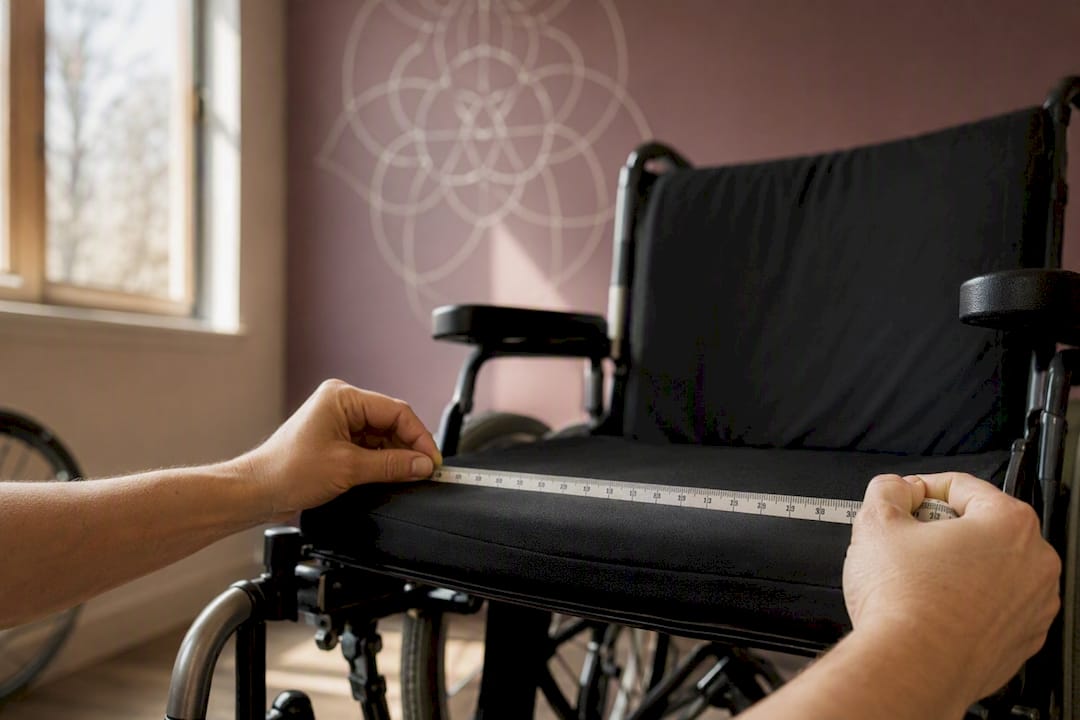
Grab a tape measure or book a clinician appointment, and capture these before you shop, rent, or buy anything:
- Knee-to-heel length, measured in the shoes you’ll actually wear
- Seat depth, from the back of the pelvis to just behind the knee
- Seat-to-floor height, factoring in your cushion thickness
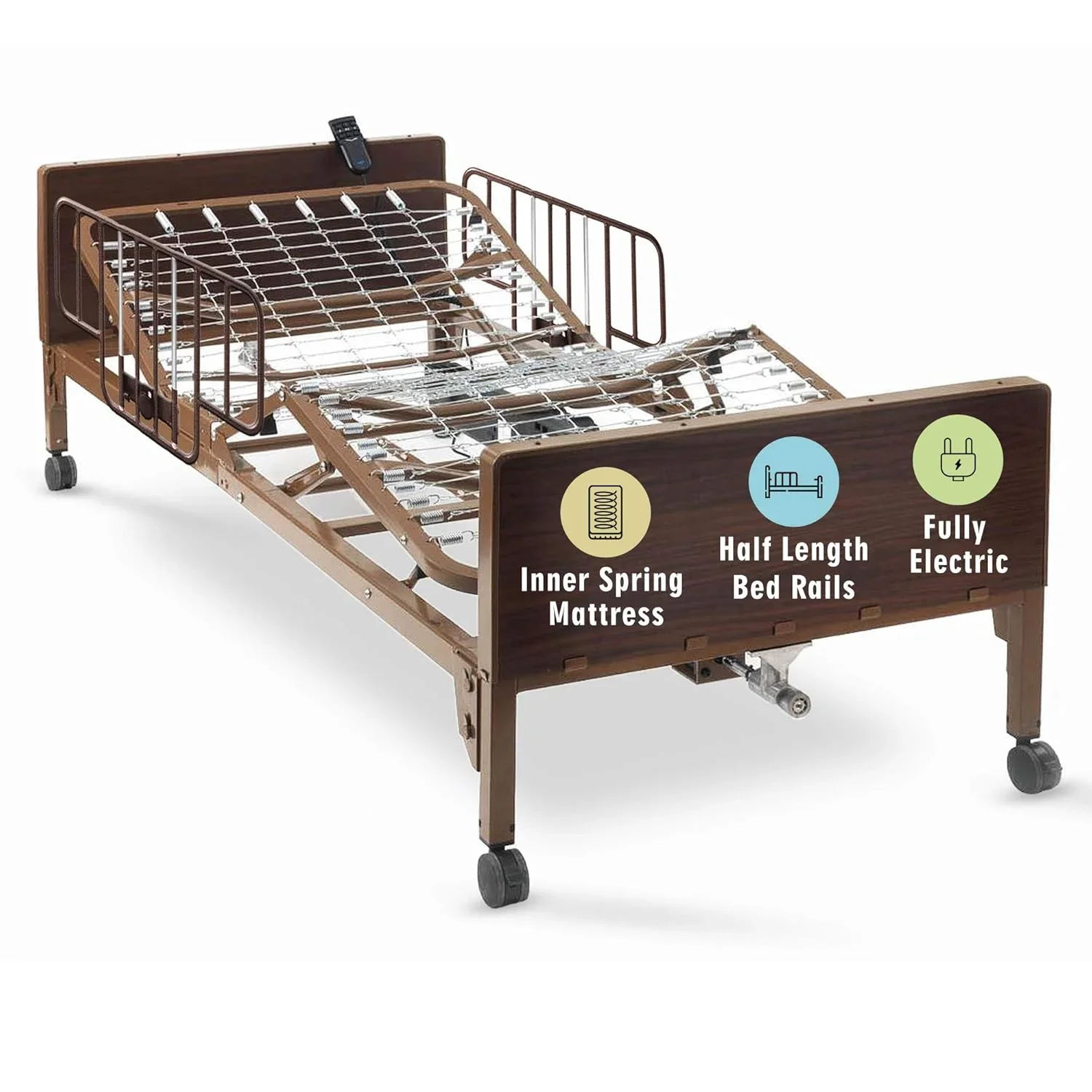
If you need a chair this week rather than next month, a trial rental solves that timing problem. Seventhchakra rents standard wheelchairs starting at $500.00 with same-day delivery across the Greater Vancouver area, no deposit required, which gives you a real chair to test your measurements against while you sort out a longer-term or custom solution.
Key Takeaways
Tall users get a comfortable fit by measuring knee-to-heel, seat depth, and seat-to-floor height first, then matching those numbers to an adjustable or tall-configuration chair.
| Point | Details |
|---|---|
| Measure before you shop | Capture knee-to-heel, seat depth, and seat-to-floor height while wearing your actual shoes and cushion. |
| Target tall benchmarks | Aim for a 21.5 to 23 inch seat-to-floor height and a seat depth of 20 inches or more. |
| Prioritise adjustability | Extended footrests, adjustable backrests, and moveable axle position matter more than brand or colour. |
| Get an objective fitting | A clinician or ATP fitting with documented measurements prevents long-term postural problems. |
| Rent to solve urgency | Seventhchakra offers same-day, no-deposit wheelchair rentals from $500.00 across Greater Vancouver, including bariatric and extra-wide options. |
Table of Contents
- Wheelchair sizing for tall users: how to measure yourself correctly
- Which wheelchair features actually matter for taller people
- What happens during a professional wheelchair fitting
- Renting a tall-configuration wheelchair when you need one fast
- Weight capacity and frame strength for taller users
- Posture support and pressure relief for tall bodies
- How height affects manoeuvrability and stability
- Customization options and their real limits for very tall individuals
- Transporting and storing a larger wheelchair
- Getting a tall-configuration wheelchair fast in Vancouver
- Sources
- FAQ
Wheelchair sizing for tall users: how to measure yourself correctly
Getting the numbers right matters more than picking a brand or a colour. A wheelchair that’s two inches too short in the seat depth will leave your thighs unsupported for years. Here’s what to measure and why each one counts.
- Knee-to-heel length. Sit in a firm chair with your foot flat, then measure from the underside of your thigh (just behind the knee) straight down to your heel. This number sets your footrest height.
- Seat depth. Measure from the back of your buttocks to the inside crease of your knee, then subtract about an inch and a half to leave clearance. Standard chairs offer 16 to 18 inches of seat depth, but taller users often need 20 inches or more for real thigh support.
- Seat-to-floor height. This is the distance from the floor to the top of the seat cushion, footwear and cushion included. Standard manual chairs run 17.5 to 19.5 inches. Tall configurations typically sit at 21.5 to 23 inches to match longer lower limbs.
- Seat width. Measure hip width at the widest point and add roughly one inch of clearance per side.
- Backrest height. Measure from the seat surface up to your shoulder blades, or higher if you need head support. Positioning-focused models can go up to about 35 inches for tall users, according to clinician guidance for patients 6 feet and taller.
- Armrest height. Measure from the seat surface to your elbow with your arm relaxed at a 90-degree bend.
Clinicians recommend measuring with the actual shoes you’ll wear, because even a half-inch sole changes your knee-to-heel length enough to throw off footrest positioning. Cushion thickness does the same thing to seat-to-floor height, so measure with the cushion in place, not the bare frame.
The most common mistake tall users make isn’t underestimating height. It’s overestimating width, adding extra inches “just in case” that make the chair harder to manoeuvre through doorways, or forgetting to recheck backrest and footrest settings after swapping in a thicker cushion.
Pro Tip: Measure twice, once in the morning and once in the evening. Swelling and posture shift through the day, and a fitting done first thing can be off by half an inch by dinner.
Which wheelchair features actually matter for taller people
Not every adjustable feature is worth paying for, but a handful are close to essential once you’re past 6 feet. Prioritise these during any trial or fitting:
- Extended seat-to-floor height options, so your knees aren’t jammed up near your chest
- Length-adjustable footrests that can extend further out than standard swing-away units
- Extended or adjustable backrests, especially if you spend long hours seated
- Height and length-adjustable armrests, since a mismatch here throws off shoulder posture
- Cushions built for a deeper seat pan, not just a thicker version of a standard cushion
Manual versus power is its own decision, and height changes the math slightly. A taller seat-to-floor height can make self-propulsion less efficient because your arms sit at a less favourable angle relative to the pushrim. Experienced fitters usually correct this by shifting the rear axle position forward, which restores propulsion mechanics without sacrificing leg clearance. If you have significant postural needs, a tilt-in-space or positioning model with a taller backrest is worth exploring rather than forcing a standard frame to do a job it wasn’t built for.
During any trial, insist on testing the footrests and backrest at your actual measurements, not the shop’s default setting. Walk away from any chair with a fixed low backrest or footrests that can’t extend past a certain point. Those aren’t adjustable, they’re just smaller versions of the same limitation.
What happens during a professional wheelchair fitting
A proper fitting isn’t someone eyeballing you in a chair for thirty seconds. A clinician-led wheelchair fitting should include objective measurements, trial seating in more than one configuration, and dynamic observation while you actually propel and transfer, not just sit still.
Expect the following:
- A full measurement pass covering everything from the checklist above, done by a clinician or Assistive Technology Professional (ATP)
- Trial seating in at least one tall-configuration chair, with adjustments made in real time
- Observation of your propulsion technique and transfer method, since a chair that feels fine sitting still can still be wrong for how you actually move
- A written measurement sheet you take home, plus a short trial period if the provider offers one
Subjective comfort in the first five minutes doesn’t guarantee a correct fit. Objective fitting is what prevents long-term musculoskeletal problems down the line, and a documented measurement sheet gives you something concrete to bring to a rental provider or a custom builder later.
Pro Tip: If a clinic won’t give you a written copy of your measurements, ask again before you leave. That single sheet of paper saves you from repeating an entire fitting appointment the next time you need equipment.
Renting a tall-configuration wheelchair when you need one fast
Not every situation calls for a custom-built chair. Renting makes sense for short-term recovery, travel, or when you need something reliable while a custom order is in production. Buying and customising makes more sense for daily, long-term use.
When you contact a rental provider, ask specifically for:
- Extended footrests and a taller seat-to-floor height
- A deeper seat pan, not just a wider one
- An adjustable backrest
- Cushion options suited to a deeper seat
- Confirmation that measurements will be verified before delivery, not assumed
Seventhchakra handles this with same-day delivery across the Greater Vancouver area, no upfront deposit, and fully sanitized equipment on arrival. A standard wheelchair rental runs $500.00, and if you also need extra width alongside extra height, the bariatric and extra-wide rental line covers that combination.
Use the rental period productively. Test propulsion over real distances, practise a full transfer, and note how your body feels after several hours, not just the first ten minutes. That trial data becomes the foundation for a future purchase or custom build.
Weight capacity and frame strength for taller users
Height and weight aren’t the same variable, but they’re often linked, and frame strength is where tall users get caught off guard. A standard manual wheelchair frame is typically rated for a specific weight capacity that assumes an average-height user distributing that weight over a standard seat depth. Stretch that same frame to a taller seat-to-floor height and a deeper seat without adjusting the frame construction, and you’re putting more leverage on the same welds and cross-braces.
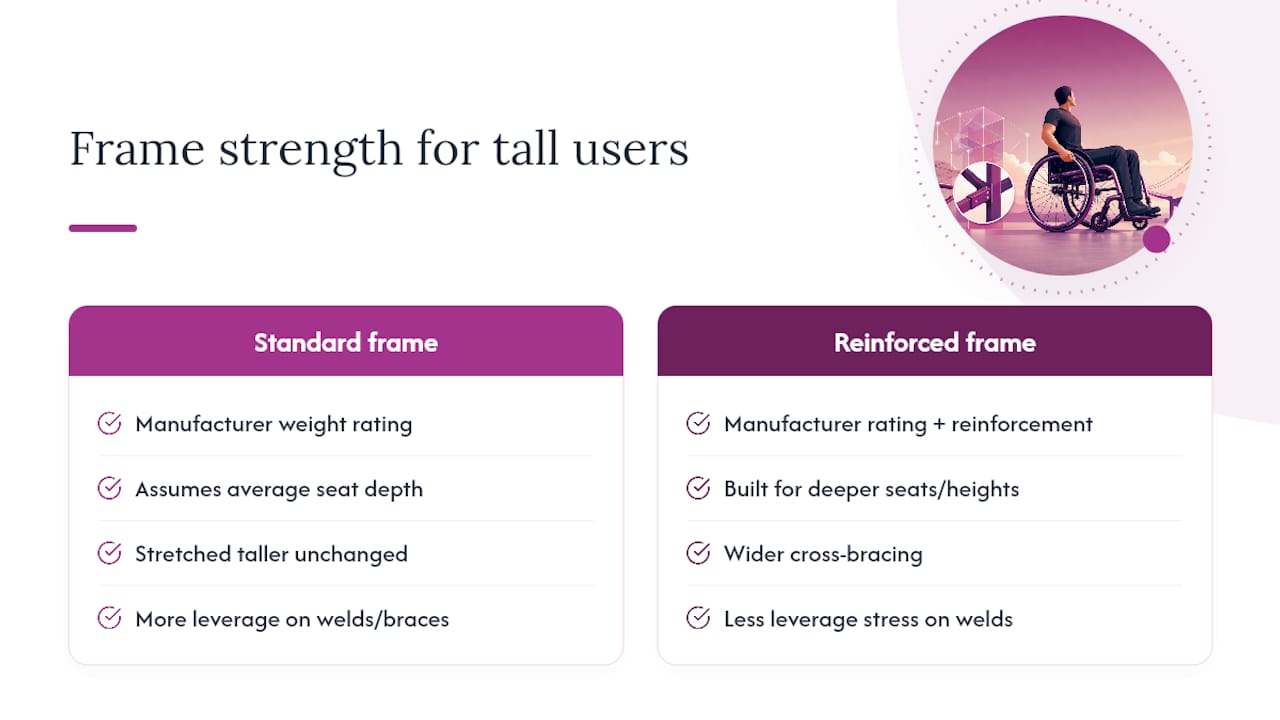
Taller users, especially those who also carry more body weight, should check the manufacturer’s stated weight capacity against their actual weight plus clothing and any equipment carried on the chair, not just their base body weight. A frame rated for 250 pounds with no buffer is a poor match for someone at 240 pounds who also carries a bag.
Reinforced frames, wider cross-bracing, and heavy-duty caster forks are common upgrades on tall configurations built for larger users. If your height comes with a higher body weight, ask specifically whether the tall configuration you’re considering has been reinforced beyond the standard frame, or whether it’s simply a standard frame stretched taller. Those are two different products wearing the same label.
Posture support and pressure relief for tall bodies
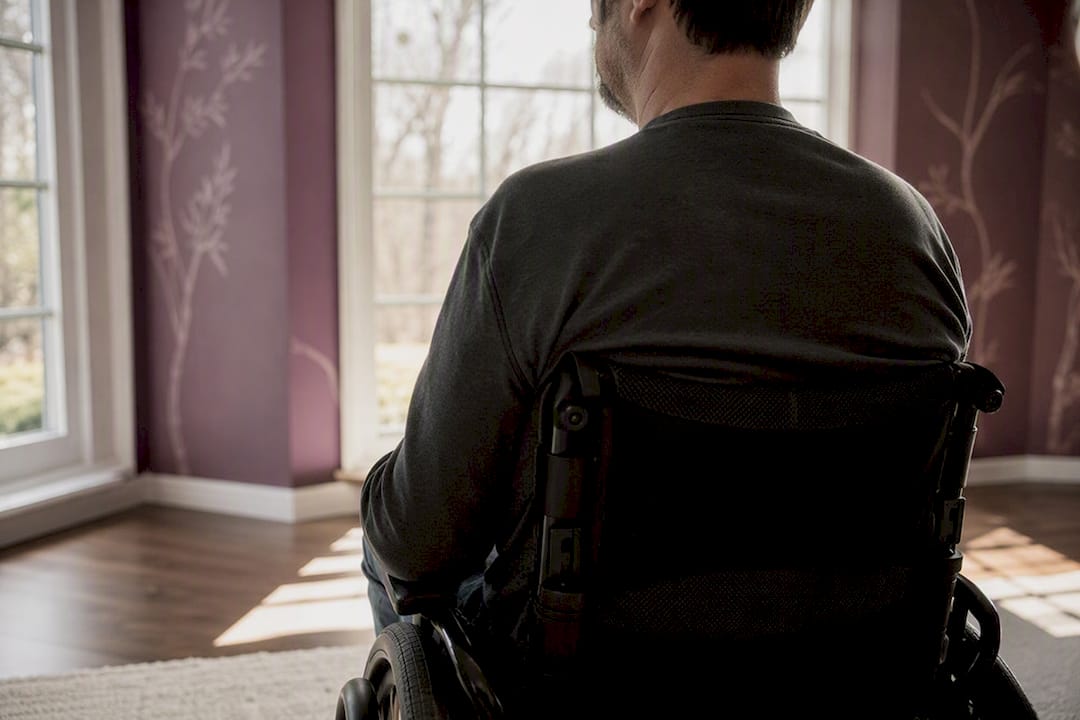
A longer torso and longer limbs change where pressure concentrates and how posture drifts over a seated day. Tall users often have a longer distance between the ischial tuberosities (the sit bones) and the shoulders, which means a standard-height backrest can leave the upper back and shoulder blades unsupported, encouraging a slouched posture that gets worse the longer you sit.
Cushion selection matters as much as the frame here. A cushion designed for a standard 16 to 18 inch seat depth, simply extended in length, doesn’t necessarily distribute pressure correctly across a deeper seat pan. Pressure tends to concentrate at the sit bones if the cushion’s support zones don’t line up with a longer thigh length. This is one of the areas where custom-contoured cushions show up most often in the research on wheelchair customization. They remain the most commonly adapted component for exactly this reason.
Taller users who spend most of the day seated should also look at backrest height in relation to shoulder blade position, not just overall comfort. A backrest that stops mid-shoulder-blade forces constant micro-adjustments to stay upright, which adds up to fatigue and, over months, contributes to postural problems that a properly sized backrest would have prevented from the start.
How height affects manoeuvrability and stability
A taller seat-to-floor height raises your centre of gravity, and that changes how the chair handles. It’s a real trade-off, not a minor detail. A chair set higher for leg clearance can feel less stable on turns, ramps, or uneven surfaces than the same chair at a standard height, particularly for self-propelled manual users leaning to reach the pushrims.
Wheelbase length compounds this. Tall configurations often need a longer frame to accommodate a deeper seat and extended footrests, and a longer wheelbase makes tight turns in narrow hallways or bathrooms noticeably harder. This is precisely why axle position adjustment matters so much for tall users. Moving the rear axle forward compensates for the higher seat height, restoring a workable push angle and keeping the centre of gravity closer to a stable range rather than leaving the chair feeling tippy on an incline.
Before settling on any tall configuration, test it on the surfaces you actually deal with daily; a doorway threshold, a slight ramp, a tight kitchen corner. A chair that feels fine gliding across an open showroom floor can behave very differently in a real hallway. If manoeuvrability is a bigger daily concern than raw leg clearance, ask a fitter about a moderate seat-to-floor increase paired with axle adjustment, rather than jumping straight to the tallest configuration available.
Customization options and their real limits for very tall individuals
For most people over 6 feet, an adjustable or tall-configuration chair covers the need without a fully custom build. But for individuals well beyond average tall range, sometimes called extra tall or high user cases, stock adjustable ranges eventually run out.
That’s where custom fabrication comes in, and the technology behind it has genuinely improved. Advances in 3D scanning and additive manufacturing are making custom components, particularly cushions and headrests, faster to produce and more accessible than they were even a few years back. Parametric modelling lets a fitter scan a body shape and generate a cushion or frame extension built to that exact geometry rather than a stretched version of a standard part.
The limitation is that framed modifications, extended frames or custom headrest mounts, are still less common than custom cushions. They’re feasible through the same additive manufacturing and parametric design workflows, but lead times run longer and cost more than an off-the-shelf tall configuration. If your measurements fall within a tall-configuration manufacturer’s standard adjustable range, that route is faster and cheaper than a fully custom frame. Reserve custom fabrication for cases where standard tall options genuinely don’t reach far enough, not as a first option out of preference.
Transporting and storing a larger wheelchair
A tall-configuration wheelchair is longer and often heavier than a standard one, and that changes how it travels and where it lives at home. Vehicle transport is the first practical hurdle. A longer wheelbase and taller backrest may not fold to the same compact size as a standard chair, which matters if you’re loading it into a sedan trunk rather than an SUV or minivan.
Measure your vehicle’s cargo space against the chair’s folded dimensions before you commit to a purchase, not after. Some tall configurations offer a quick-release backrest or removable footrests specifically to shave inches off the folded size for transport.
At home, storage space needs the same forethought. A chair with a longer wheelbase needs a longer parking spot near an entryway or bedroom, and doorway width becomes a bigger factor when the frame itself is longer, since turning into a doorway takes more clearance than it does with a standard-length chair. If you’re renting rather than buying, this is worth raising with your provider up front. Confirm the folded dimensions and weight before delivery day, so you’re not discovering a transport problem after the chair is already in your home.
A few honest reminders before you commit to a chair
Bring the actual shoes you’ll wear to any fitting, and don’t skip the cushion when you measure seat-to-floor height. It throws the number off more than people expect. Insist on a written measurement sheet, and if a trial period is available, take it. A chair that seems fine after ten minutes in a showroom can feel entirely different after three hours of real use. With the right measurements and a bit of patience, tall users can avoid the postural problems that come from years in an ill-fitted chair and get back to moving through their day without thinking about the chair at all.
Getting a tall-configuration wheelchair fast in Vancouver
Most tall users do not need a fully custom chair. They generally require one built with a taller seat-to-floor height, a deeper seat, and adjustable footrests, and they prefer to get it without waiting weeks for a special order. That’s the gap Seventhchakra fills for families and caregivers across the Greater Vancouver area.

There’s no upfront deposit, delivery happens the same day in most cases, and every chair arrives fully sanitized. If your measurements point toward a bariatric or extra-wide need alongside extra height, the bariatric and extra-wide rental covers both at once instead of forcing a compromise on one dimension. For most tall users, the standard wheelchair rental at $500.00 with adjustable components gives you enough range to test your measurements in a real chair before deciding on a purchase or a custom build. Reach out today and get a chair sized to your actual body, not the average one manufacturers design for.
Sources
- Wheelchair fitting - Physiopedia
- Literature review on customization of manual wheelchair components (2025)
- A clinician’s guide to choosing a wheelchair for patients 6 feet and taller — Broda
- 10 key measurements for manual wheelchair selection — Permobil hub
FAQ
What seat-to-floor height should a tall person look for?
Most tall users do well with a seat-to-floor height greater than the typical range of standard chairs.
How deep should the seat be for a tall wheelchair user?
Standard seat depth runs 16 to 18 inches, but tall users typically need 20 inches or more for proper thigh support.
Can I rent a tall-configuration wheelchair instead of buying one?
Yes. Seventhchakra rents standard and extra-wide wheelchairs with same-day delivery and no deposit across the Greater Vancouver area, which lets you trial the right measurements before committing to a purchase.
Does a taller seat height make a wheelchair harder to push?
It can, since a higher seat raises the centre of gravity and changes the push angle to the wheels, but fitters typically correct this by adjusting the rear axle position forward.
Do I need a fully custom wheelchair if I’m over 6 feet tall?
Most people over 6 feet fit well in an adjustable tall configuration; fully custom frames are usually reserved for individuals whose measurements exceed standard adjustable ranges.