
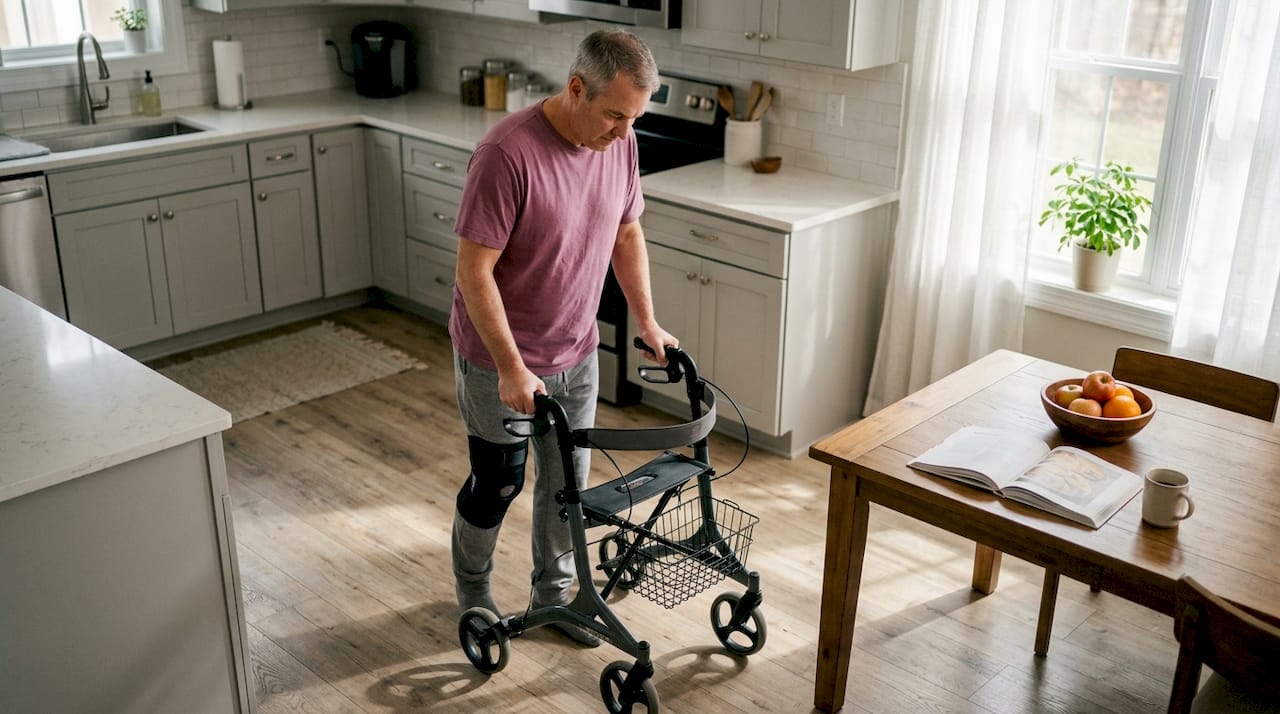
Mobility aids for post-operative patients are devices designed to support safe movement, prevent falls, and protect healing tissue during the weeks after surgery. The American Academy of Orthopaedic Surgeons and Canadian rehabilitation standards both recognise these devices as core tools in home recovery. The main categories include walkers, rollators, canes, knee scooters, and wheelchairs, each suited to a different phase or type of surgery. Choosing the right device at the right time is the single most important decision you will make during rehabilitation.
1. Key types of mobility aids for post-operative patients
Healthcare professionals classify mobility aids by the level of support they provide. Walkers offer maximum stability, rollators support endurance, and canes address minor balance issues. That classification matters because using a device that offers too little support at the wrong stage of recovery directly increases your fall risk.
The main categories of post-surgery mobility devices are:
-
Standard walkers. Four-legged frames with no wheels. Best for the first days after surgery when weight-bearing is severely restricted and balance is poor.
-
Front-wheeled walkers. Two wheels at the front allow a smoother forward motion without lifting the frame completely. Good for patients who struggle to lift a standard walker cleanly.
-
Rollators. Four-wheeled frames with hand brakes and a built-in seat. Suited to patients who can bear more weight but tire quickly and need to rest mid-walk.
-
Canes. Single-point or quad-base canes provide light balance support. Used in the final stages of recovery when strength has largely returned.
-
Knee scooters. A platform for the injured lower leg, propelled by the healthy leg. Ideal for foot, ankle, and lower-leg surgeries where the knee and above are unaffected.
-
Wheelchairs and transport chairs. For patients with very limited mobility or those recovering from procedures affecting both lower limbs. Transport chairs are lighter and pushed by a caregiver.
Each device serves a specific window in recovery. Using the wrong one, or abandoning the right one too early, sets back your progress.
2. Choosing the right walker: features and adaptations
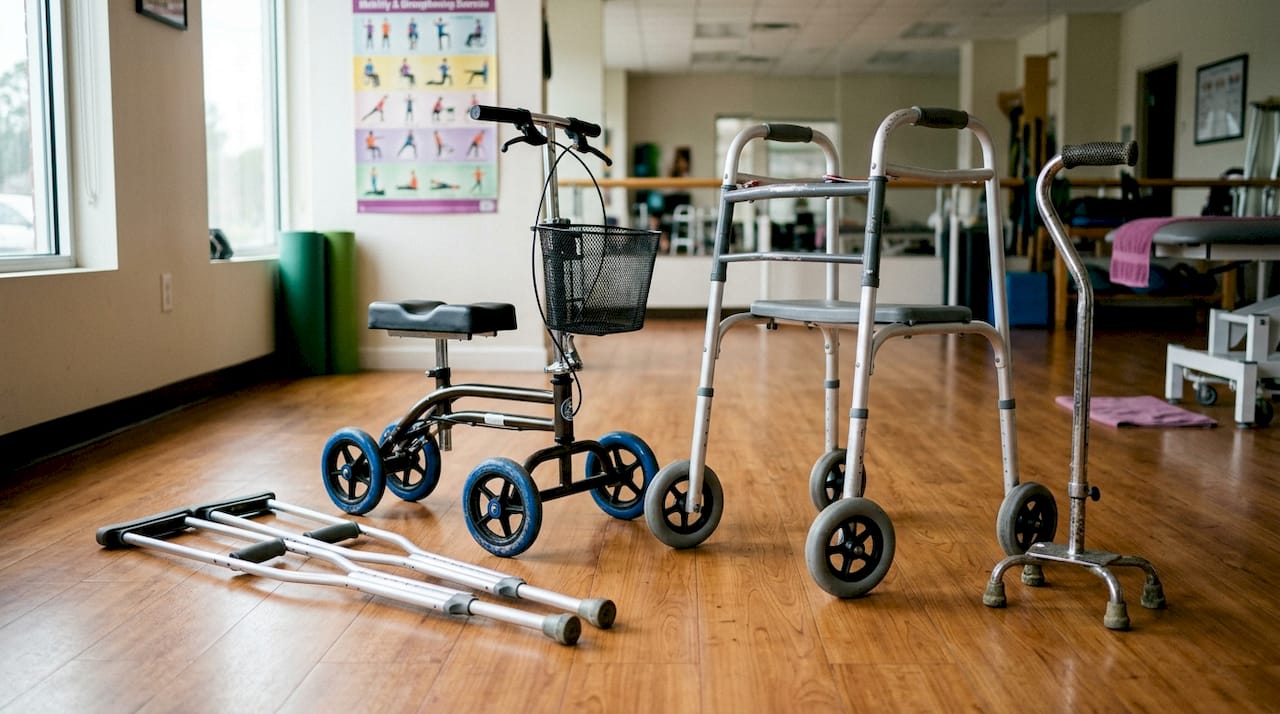
Most post-total knee replacement patients require a walker for 2–6 weeks to manage weight-bearing limitations safely. That window is longer than most patients expect, and the right walker design makes a measurable difference in comfort and safety.
| Walker type | Best for | Key feature | Starting cost |
|---|---|---|---|
| Standard (no wheels) | First days post-op, severe weight-bearing limits | Maximum stability | ~$60 |
| Front-wheeled (2 wheels) | Patients who struggle to lift a full frame | Smoother forward motion | ~$120 |
| Four-wheeled rollator | Later recovery, endurance support | Built-in seat, hand brakes | ~$120 |
| Folding walker | Patients who travel or use vehicles | Compact storage | ~$60 |
Adjustable height is non-negotiable. Your elbow should bend at roughly 15 degrees when your hands rest on the grips. Padded hand grips reduce pressure on the palms, which matters when you are bearing significant weight through your arms for weeks at a time. Foldability is worth paying for if you need to get in and out of a car for follow-up appointments.
Occupational therapists strongly recommend ordering your walker before surgery, not after. Post-op pain and medication impair your ability to research and set up equipment. Having it ready at home, adjusted to your height, removes one source of stress on discharge day.
Pro Tip: Ask your occupational therapist to fit the walker to your height at your pre-surgery appointment. A walker set even two centimetres too high shifts your weight backward and increases fall risk.
3. Using knee scooters and crutches: alternatives and considerations
Knee scooters are the most practical walking aid after surgery for foot, ankle, and lower-leg procedures. 4-wheel steering knee scooters support patients up to 300 lbs and offer superior manoeuvrability compared to traditional crutches. Features like dual disc brakes and handlebar heights adjustable between 35.8 and 44 inches make them adaptable to a wide range of body types.
Key advantages of knee scooters over crutches:
-
Less upper-body demand. Crutches require significant arm, shoulder, and core strength. Many post-op patients lack that strength, especially in the first two weeks.
-
Hands-free capability. Some knee scooter models allow you to carry items while moving, which crutches do not.
-
Reduced fatigue. Propelling a knee scooter uses the healthy leg efficiently. Crutch use on a fatigued body is a leading cause of post-op falls.
-
Better indoor manoeuvrability. Four-wheel steering models navigate tight hallways and kitchens more easily than crutches.
Crutches do have a place in recovery. They are lighter, easier to transport, and appropriate for patients with strong upper bodies and good balance. The problem is that many patients use crutches when fatigued, which sharply increases fall risk. A walker or knee scooter is the safer default for home recovery.
Pro Tip: If you are considering a knee scooter, confirm with your surgeon that your knee and hip are unaffected by the surgery. Knee scooters require full weight-bearing through the bent knee, which rules them out for knee replacement patients.
4. Safety and best practices when using rehabilitation aids at home
Safe use of post-operative support equipment starts before you leave the hospital. Proper fitting by a physiotherapist or occupational therapist is not optional. An ill-fitted device changes your gait, strains compensatory muscles, and creates gait patterns that hinder long-term recovery.
Follow these steps to set up your home safely before surgery:
-
Clear trip hazards. Remove loose rugs, electrical cords, and low furniture from all walking paths.
-
Place reachers in every room. Reachers let you pick up objects without bending, which protects healing joints and reduces the urge to abandon your aid.
-
Add non-slip socks and bath mats. Slippery floors are the most common cause of post-op falls at home.
-
Raise toilet and chair heights. Raised toilet seats and firm chair cushions reduce the effort needed to sit and stand, which protects your surgical site.
-
Set up a ground-floor sleeping area. Stairs are a significant hazard in the first week. Sleeping on the main floor eliminates that risk entirely.
“Patients underestimate their mobility aid needs before leaving hospital. Setting up the home environment in advance, with assistive devices and reachers placed in multiple rooms, dramatically eases the first days of recovery.”
A walker’s broader base reduces fall risk for fatigued post-op patients compared to crutches, which require upper-body strength many patients lack immediately after surgery. Always look ahead, not down, when walking with any aid. Keep your head up, your shoulders back, and move the device forward before stepping.
5. How to progress through mobility aids during recovery stages
Recovery is not linear, and your mobility device should change as your strength and balance improve. Progressing too quickly is as dangerous as staying on a restrictive device too long.
Premature discontinuation of walkers leads to a high incidence of post-op falls. Physical therapist verification of balance and gait mechanics is required before switching to a lesser aid. That is not a formality. It is a clinical assessment that protects you.
A typical progression looks like this:
-
Weeks 1–2. Standard or front-wheeled walker for all movement. No exceptions, even for short distances.
-
Weeks 3–4. Transition to a rollator if endurance is improving but fatigue is still present. A rollator’s seat lets you rest without finding a chair.
-
Weeks 4–6. Move to a single-point cane on the side opposite the surgical leg once your physiotherapist confirms adequate balance.
-
Week 6 and beyond. Gradual reduction of cane use, starting with familiar indoor environments before moving to uneven outdoor surfaces.
Fatigue, balance, and home environment all dictate the appropriate device at each stage. Individualised mobility aid matching, guided by your occupational therapist, produces better outcomes than following a generic timeline. Your surgeon’s protocol, your home layout, and your pre-surgery fitness level all affect the pace.
Key takeaways
The most effective approach to post-operative recovery is matching the right mobility device to each recovery stage, under professional guidance, with your home environment prepared before surgery.
| Point | Details |
|---|---|
| Match device to recovery stage | Use walkers first, progress to rollators and canes as strength and balance improve. |
| Prepare your home before surgery | Set up reachers, clear hazards, and fit your walker before discharge day. |
| Never skip professional fitting | An ill-fitted aid creates compensatory gait patterns that slow long-term recovery. |
| Do not abandon aids too soon | Premature walker discontinuation is a leading cause of post-op falls at home. |
| Knee scooters beat crutches for lower-leg surgery | Four-wheel models support up to 300 lbs and reduce upper-body fatigue significantly. |
What I have learned about mobility aid selection after years of watching patients recover
The most common mistake I see is patients choosing the device that looks least conspicuous rather than the one that actually fits their recovery. A cane looks less “medical” than a walker. That reasoning sends people to emergency rooms.
Choosing aesthetically minimal but physically unsuitable aids increases fall risk and undermines recovery. Safety takes precedence over how a device looks in your hallway. The walker you feel embarrassed about in week two is the reason you are walking unassisted in week eight.
The second mistake is waiting until after surgery to think about equipment. Occupational therapists are clear on this: post-op pain and medication impair your ability to make good decisions. Having assistive devices placed in multiple rooms before surgery removes a layer of stress at the worst possible time.
The third mistake is treating the progression from walker to cane as a personal milestone rather than a clinical one. Your physiotherapist’s sign-off is not bureaucracy. It is the difference between a smooth recovery and a fall that sets you back by months. Individualised plans, built with your care team, consistently outperform self-directed timelines.
— Chandan
Seventhchakra: rental mobility aids delivered to your door in Metro Vancouver
Recovering at home is hard enough without worrying about sourcing the right equipment on short notice.
Seventhchakra provides medical equipment rentals in Richmond BC and across Metro Vancouver, including Surrey and Delta, with same-day delivery and no upfront deposit required. The inventory covers walkers, wheelchairs, hospital beds, and mobility scooters, all sanitised before delivery. Rental terms are flexible, whether you need a walker for three weeks or a wheelchair for three months. Seventhchakra’s team matches equipment to your recovery phase, so you are not guessing which device fits your situation. Contact Seventhchakra directly to confirm availability and arrange delivery before your surgery date.
FAQ
What mobility aids do most patients need after knee surgery?
Most post-knee replacement patients require a walker for the first 2–6 weeks, then progress to a rollator or cane as balance and strength improve.
Are knee scooters safe after foot or ankle surgery?
Knee scooters are safe for foot, ankle, and lower-leg surgeries when the knee is unaffected. Four-wheel models with disc brakes support patients up to 300 lbs and are more stable than crutches for home use.
When can I stop using a walker after surgery?
Stop using a walker only after your physiotherapist confirms your balance and gait mechanics are adequate. Premature discontinuation is a leading cause of post-op falls.
Is a walker or crutches better for home recovery?
A walker is the safer choice for most home recovery situations. Walkers reduce fall risk for fatigued patients because they do not require the upper-body strength that crutches demand.
Can I rent mobility aids instead of buying them?
Renting is the practical choice for short-term recovery. Seventhchakra offers flexible rentals across Vancouver and surrounding areas, with no deposit and same-day delivery available.


