Recommending a scooter vs wheelchair for patients comes down to one core question: can the person walk short distances safely on their worst day? Scooters suit patients who retain some walking ability but fatigue over longer distances. Power wheelchairs are the right choice for patients who cannot walk safely at all, or who need full postural support throughout the day. Occupational therapists and certified mobility suppliers use this walking ability criterion as the primary filter before any other factor. Getting this first decision right protects long-term independence and avoids costly equipment mismatches.
How does walking ability determine scooter vs wheelchair recommendation?
Walking ability is the single most reliable predictor of which device a patient needs. The bedroom-to-bathroom test is the most widely used clinical diagnostic: if a patient cannot walk that short distance safely and consistently, a power wheelchair is the appropriate recommendation. The key word is “consistently.” Patients should be assessed on their worst functional days, not their best.
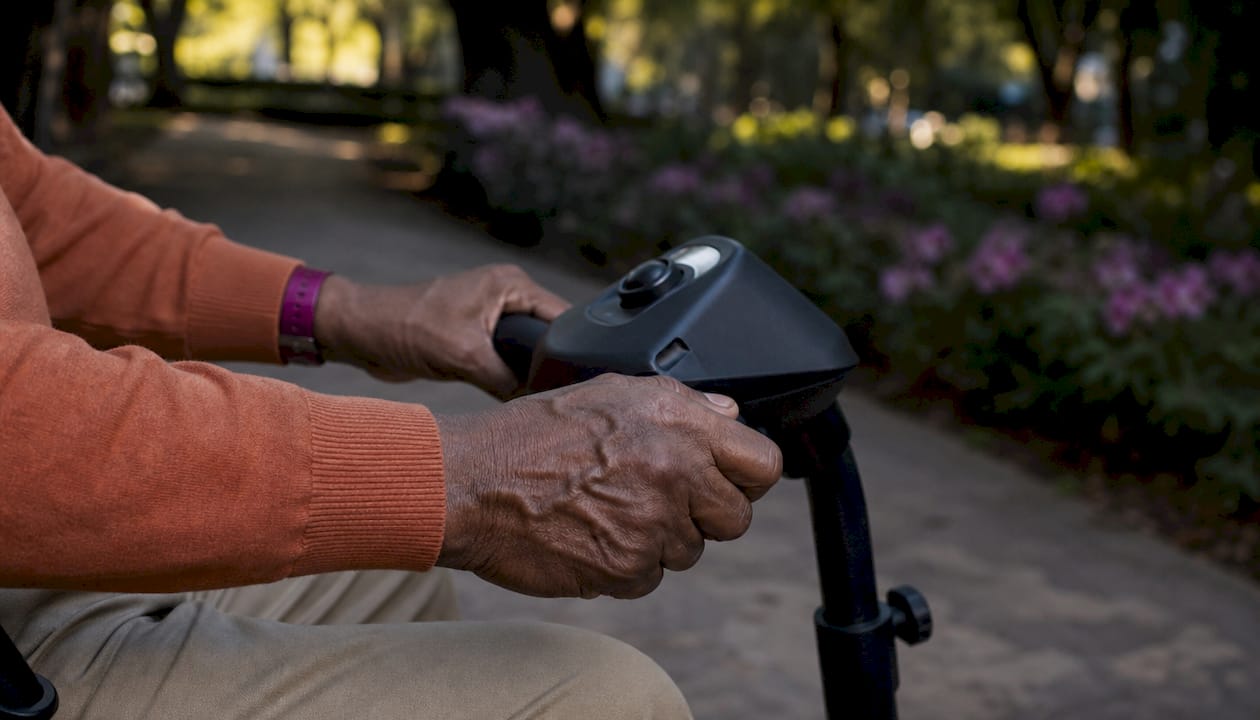
Physical strength matters beyond just walking. Scooters require reasonable arm and shoulder strength to operate the tiller handlebar. Patients with conditions like rheumatoid arthritis, multiple sclerosis, or advanced Parkinson’s disease often lack the grip strength and endurance that tiller steering demands. Power wheelchairs use joystick controls that can be adjusted for patients with limited hand dexterity, making them far more accessible for a wider range of diagnoses.
Postural support is another physical factor that separates the two devices. Scooters offer a basic captain-style seat with minimal lateral support. Power wheelchairs accommodate custom seating systems, headrests, and trunk supports. Patients who cannot maintain an upright sitting posture independently need a power wheelchair, not a scooter.
Key physical criteria to assess before recommending either device:
- Walking distance: Can the patient walk bedroom to bathroom safely every day?
- Grip and arm strength: Can the patient steer a tiller handlebar for extended periods?
- Postural control: Does the patient need lateral trunk or head support?
- Hand function: Does arthritis, fatigue, or weakness affect fine motor control?
- Endurance: Does the patient tire quickly, even when seated?
Pro Tip: Always assess the patient on a typical bad day, not a good one. A patient who walks well on Tuesdays but struggles on Fridays needs a device that works on Fridays.
What environmental and lifestyle factors affect the choice?
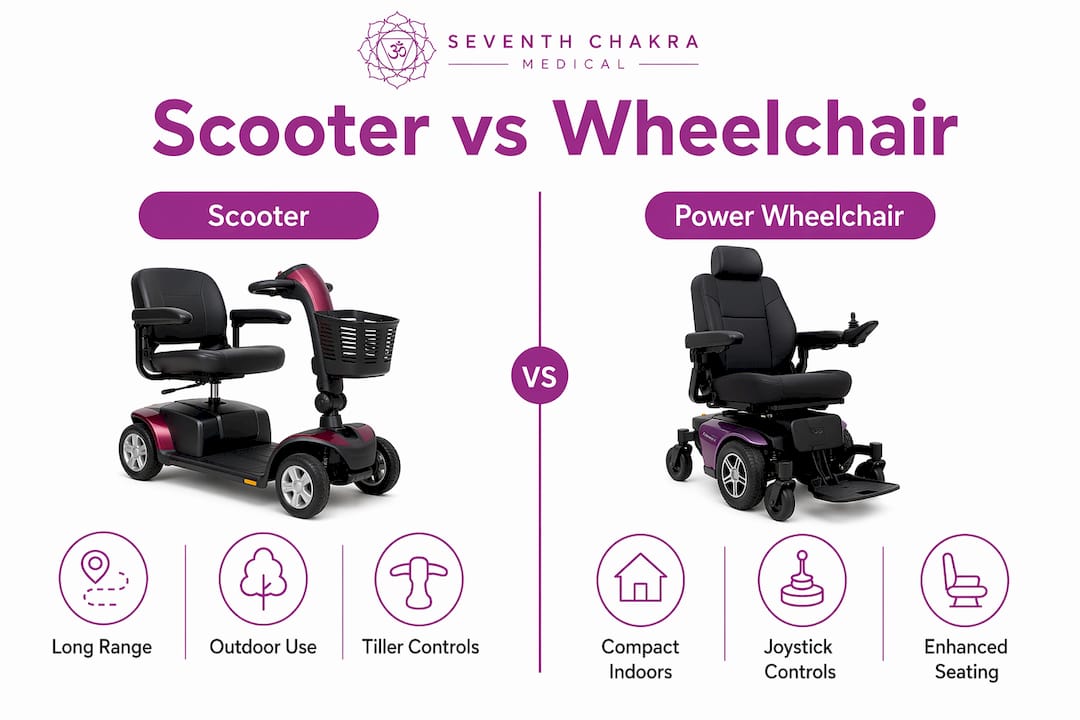
The patient’s daily environment shapes device suitability as much as physical ability does. Scooters excel outdoors. They offer a battery range of 30–60 km and higher top speeds, which makes them practical for errands, parks, and community outings. Power wheelchairs typically offer a range of 15–30 km but compensate with a tighter turning radius that is critical for indoor use.
Home layout is where many families make expensive mistakes. Scooters have a large turning radius and often cannot navigate standard hallway widths or tight corners. Power wheelchairs fit standard 32-inch doorways and manoeuvre through typical home layouts far more reliably. Before purchasing any device, measure every doorway, hallway, and turning area in the home.
Consider these four environmental factors in order:
- Indoor vs outdoor primary use. If the patient spends most of their time at home, a power wheelchair is almost always the better fit.
- Home layout measurements. Measure doorway widths (minimum 32 inches for power chairs), hallway widths, and turning clearances in the kitchen and bathroom.
- Transport and storage. Folding mobility scooters and lightweight power chairs can fit in a car boot. Heavier models require a vehicle ramp or lift.
- Community mobility goals. If the patient wants to visit Granville Island, shop at a farmers’ market, or travel longer distances outdoors, a scooter’s extended battery range is a genuine advantage.
| Factor | Scooter | Power wheelchair |
|---|---|---|
| Battery range | 30–60 km | 15–30 km |
| Indoor turning radius | Large (challenging) | Tight (suitable) |
| Doorway compatibility | Often problematic | Fits 32-inch standard |
| Outdoor performance | High | Moderate |
| Postural support | Basic | Advanced, configurable |
Pro Tip: Many patients benefit from a dual-device approach: a power wheelchair for indoor use and a folding scooter for outdoor errands. This combination covers both environments without compromise.
How do control mechanisms and seating differ between devices?
Control method is one of the most overlooked factors when choosing between scooter or wheelchair for mobility. Scooters use a tiller handlebar that requires the patient to hold, steer, and apply pressure continuously. Patients with hand or wrist arthritis often find tiller steering painful within minutes. That pain leads to avoidance, and avoidance leads to the device sitting unused in a hallway.
Power wheelchairs use joystick controls mounted at the armrest. Joysticks require only minimal finger movement and can be repositioned or swapped for alternative input devices for patients with severe hand limitations. This makes power wheelchairs the safer and more practical choice for patients with progressive neurological conditions or significant upper limb weakness.
Seating differences carry long-term health consequences. Scooters provide a standard captain seat with limited adjustability. Power wheelchairs support fully configurable seating systems, including tilt-in-space, recline, elevating leg rests, and custom cushioning. Patients who spend more than four hours per day in their device need the postural support that only a power wheelchair can provide.
Common control and seating mismatches to avoid:
- Recommending a scooter to a patient with bilateral hand arthritis who cannot grip a tiller.
- Choosing a scooter for a patient who needs pressure-relief seating due to skin integrity concerns.
- Selecting a power wheelchair for a patient who only needs occasional outdoor support and can walk indoors safely.
Purchasing a scooter when a power wheelchair is the clinical need is the most common and costly mistake in mobility aid selection. Scooters end up unused, and patients lose functional independence faster than they would have with the correct device.
What is the step-by-step process for recommending the right device?
A structured approach prevents the most common errors in mobility aid selection. Follow these steps in order:
- Start with a professional assessment. An occupational therapist or certified mobility supplier evaluates physical function, home environment, and mobility goals together. Skipping this step is the root cause of most equipment returns and safety incidents.
- Apply the bedroom-to-bathroom test. Observe the patient walking this distance on a typical day. If they cannot do it safely and consistently, a power wheelchair is the recommendation.
- Assess the home environment. Measure doorways, hallways, and turning areas. Confirm whether the chosen device can physically navigate the home before any purchase.
- Evaluate physical capabilities. Test grip strength, postural control, endurance, and hand function. Match these findings to the control method and seating requirements of each device.
- Review financial and insurance options. Provincial health programmes and private insurance plans in British Columbia may cover part of the cost for medically necessary devices. Rental is a practical option for short-term recovery or trial periods.
- Consider a staged or combined approach. Patients with progressive mobility limitations often benefit from starting with a rollator or manual wheelchair and transitioning to a power device as needs increase. A dual-device strategy can extend independence across different environments.
The right mobility aid is the one that works on the patient’s hardest day, fits through every doorway in their home, and matches their physical ability to control it safely. Choosing based on best-case function is the most common reason devices end up unused.
Families often ask whether renting before buying is worthwhile. The answer is yes, particularly for patients recovering from surgery or stroke, where mobility needs change week to week. Renting a mobility scooter in Vancouver or a power wheelchair for a trial period lets the patient and family confirm fit before committing to a purchase.
Key takeaways
The correct mobility aid recommendation depends on walking ability, physical strength, home environment, and control method suitability, assessed together by a qualified professional.
| Point | Details |
|---|---|
| Walking ability is the primary filter | Use the bedroom-to-bathroom test on the patient’s worst day to determine scooter or wheelchair candidacy. |
| Environment determines device fit | Measure doorways and turning areas before purchasing; scooters often fail indoors due to large turning radius. |
| Control method must match hand function | Patients with arthritis or limited grip strength need joystick-controlled power wheelchairs, not tiller-steered scooters. |
| Dual-device strategy increases independence | A power wheelchair indoors and a folding scooter outdoors covers both environments without compromise. |
| Professional assessment prevents costly errors | Occupational therapists and certified suppliers reduce the risk of mismatched devices and safety incidents. |
What I’ve learned from watching families choose the wrong device
The most consistent pattern I’ve seen is families choosing a scooter because it looks less medical. A scooter feels like a step down from a wheelchair in terms of severity, and that perception drives the decision more than the clinical picture does. The patient ends up with a device they cannot safely control indoors, and within three months, it is parked in the garage.
The bedroom-to-bathroom test sounds almost too simple, but it cuts through the noise immediately. I have watched families spend hours debating battery range and colour options, then realise the patient cannot safely navigate from the bed to the ensuite. That single observation changes everything.
Measuring the home before any decision is non-negotiable in my view. A 32-inch doorway clearance is not a suggestion. Patients who live in older Vancouver homes with 28-inch doorways need to know that before they rent or buy anything. The measurement takes ten minutes and prevents weeks of returns and frustration.
The staged approach is underused. Families treat the first device as a permanent commitment, when the reality is that mobility needs shift. Starting with a four-wheel rollator and moving to a power wheelchair as function declines is not a failure. It is good planning. Renting at each stage keeps the financial risk low and the device matched to current needs.
— Chandan
Mobility aid rentals in Vancouver and Richmond from Seventhchakra
Choosing the right device is easier when you can trial it in your own home before committing. Seventhchakra provides wheelchair and scooter rentals across Vancouver, Richmond, and Surrey, with same-day delivery and no upfront deposit required. Every device is sanitised before delivery.
Whether you are recovering from surgery, supporting an elderly family member, or trialling a device before purchase, Seventhchakra’s team can match you with the right equipment. Patients in Richmond can access the full range of medical equipment rentals in Richmond, and Vancouver residents can reach the team through the Vancouver rental service. Contact Seventhchakra directly for guidance on which device fits your situation.
FAQ
What is the main difference between a scooter and a power wheelchair?
Scooters use tiller handlebars and suit patients who can walk short distances but need help over longer ones. Power wheelchairs use joystick controls and are designed for patients who cannot walk safely or who need full postural support.
How do I know if a patient needs a scooter or a power wheelchair?
Apply the bedroom-to-bathroom test on a typical day. If the patient cannot walk that distance safely and consistently, a power wheelchair is the appropriate recommendation.
Can a patient use both a scooter and a power wheelchair?
Yes. A dual-device strategy works well for many patients: a power wheelchair for indoor use and a folding scooter for outdoor errands, combining the strengths of both devices.
Why is professional assessment so important before choosing a mobility aid?
Purchasing without assessment frequently leads to discomfort, safety risks, and decreased independence. An occupational therapist evaluates physical function, home layout, and mobility goals together to prevent costly mismatches.
Is renting a mobility device a good option for short-term recovery?
Renting is the practical choice for patients recovering from surgery or stroke, where mobility needs change week to week. It allows families to trial a device and confirm fit before making a purchase commitment.