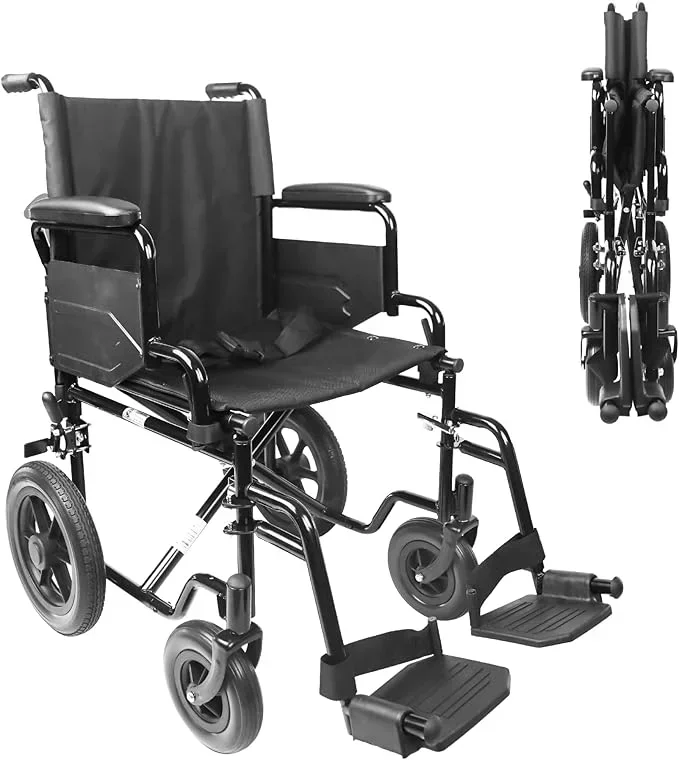
MEPP Covers Up to Three Months: Wheelchair Rental Coverage in BC

In British Columbia, wheelchair rental insurance coverage rarely works the way people expect: no single policy simply pays the bill. The Medical Equipment Provision Program (MEPP) covers eligible residents’ short-term rentals at no cost, private insurers reimburse only with a prescription and pre-approval, and a rental damage waiver is not insurance at all. Before you book anything, get an occupational therapist assessment and call your plan administrator.
TL;DR:
- Damage waivers only cover the rental company’s asset and do not include liability for injury, property damage, or theft beyond limited reimbursements.
- Private insurance and PharmaCare require a prescription, clinical assessment, and pre-approval before rental or purchase, especially for costs over $400.
- Government programs like MEPP cover short-term rentals for eligible residents with urgent needs and financial hardship, usually up to three months.
- Coordinating multiple payers involves timing assessments and approvals to avoid paying full rental costs during delays, with priority on thorough documentation.
- Rental contracts must clearly specify damage coverage, repair liabilities, deposits, and equipment sanitization to prevent disputes and ensure rights enforcement.
Table of Contents
- What is wheelchair rental insurance coverage, and how does a damage waiver differ?
- How do private extended health insurance and PharmaCare reimbursements work?
- Government funding routes: MEPP, income assistance, ICBC, WorkSafeBC and Veterans Affairs
- Coordinating multiple payers without losing weeks to paperwork
- Questions to ask a rental company before you sign anything
- Rental damage waiver costs versus private insurance premiums
- Choosing between a damage waiver and insurance based on your actual risk
- Legal liabilities and your rights as a renter in BC
- How a damage or loss claim actually gets processed
- How Seventh Chakra supports renters through the claims and paperwork maze
- Renting a wheelchair in BC without the deposit headache
- Sources
- FAQ
What is wheelchair rental insurance coverage, and how does a damage waiver differ?
A rental damage waiver, often called a Limited Damage Waiver or LDW, is a fee you pay the equipment supplier so they absorb most of the cost if the wheelchair gets damaged or stolen during your rental. It is not an insurance product. No underwriter is involved, no claim goes to an adjuster, and it does nothing for your medical costs or liability if someone gets hurt using the chair.
Typical LDW coverage includes accidental damage from normal use, partial theft protection (often capped at a percentage of the manufacturer’s price), and sometimes downtime coverage that waives rental fees while the unit is being repaired, according to one Canadian equipment renter’s own damage waiver terms. What it typically excludes matters just as much:
- Damage from clear misuse or neglect, like leaving a power chair out in rain
- Normal wear and tear, such as worn tires or a fraying seat cushion
- Third-party bodily injury or property damage claims
- Loss from leaving the chair unattended in an unsecured location
Because an LDW only protects the rental company’s asset, it can’t replace private liability coverage or a disability insurance plan. Renters who assume the waiver “covers everything” are often surprised when a theft claim gets denied for missing a police report.
How do private extended health insurance and PharmaCare reimbursements work?
Extended health plans and PharmaCare both start from the same requirement: a paper trail proving medical necessity. Insurers routinely deny wheelchair claims when there’s no prescription or clinical assessment on file, because most providers only cover equipment deemed medically necessary by a physician or occupational therapist.
For anything valued at $400 or more, PharmaCare requires pre-approval before the rental or purchase happens, and that pre-approval stays valid for six months from the date it’s granted. Miss that step and you’re paying out of pocket, full stop.
A workable filing sequence looks like this:
- Book an assessment with your physician or an OT through Vancouver Coastal Health or your local clinic.
- Get the written prescription naming the specific device, not just “a wheelchair.”
- Submit the prescription and OT notes to your insurer or PharmaCare for pre-approval before signing a rental agreement.
- Keep every receipt, itemized invoice, and the signed rental agreement together for the claim package.
- Follow up on pre-approval status within the insurer’s stated processing window, since delays are common.
Government funding routes: MEPP, income assistance, ICBC, WorkSafeBC and Veterans Affairs
MEPP is the closest thing BC has to a safety net for short-term equipment needs. It’s built for people with valid MSP coverage, an urgent safety need, and demonstrated financial hardship, and it works through contracted suppliers including the Canadian Red Cross who handle delivery and fitting. Standard rentals run up to three months, with longer access possible for people enrolled in the BC Palliative Care Benefits Program.
Beyond MEPP, several other doors exist depending on your circumstances:
- Income and disability assistance: the ministry contracts with suppliers and follows a “least expensive appropriate” principle, meaning they’ll fund the simplest device that meets your clinical need, not the premium model.
- ICBC: applies when the mobility need stems from a motor vehicle accident, and claims typically start with your adjuster rather than a health program.
- WorkSafeBC: covers equipment tied to a workplace injury, filed through your existing claim number.
- Veterans Affairs Canada: funds equipment for eligible veterans through their case manager, usually requiring the same clinical documentation as private insurers.
Government policy treats these programs as a payer of last resort. By regulation, the ministry expects other resources like private insurance, ICBC, and WorkSafeBC to be considered first, with co-funding available when none of those sources cover the full cost.
Coordinating multiple payers without losing weeks to paperwork
The biggest risk isn’t denial. It’s the gap between an urgent need and a slow approval, where you end up paying full rental rates for weeks while forms move through different offices.
- Get the clinician assessment first. Nothing moves without it.
- Ask about a temporary MEPP rental if you meet eligibility. MEPP can cover you for a short-term period while other funding gets sorted.
- Submit your insurer pre-approval request in parallel, not after the MEPP rental starts.
- Apply for co-funding through income or disability assistance only after confirming what your primary insurer or ICBC will not cover.
PharmaCare pre-approvals last for a limited period from the approval date, so timing your rental start against that window avoids having to reapply mid-rental.
Pro Tip: Build one folder, physical or digital, with your prescription, OT notes, rental agreement, and every invoice as soon as you get them. Insurers ask for this exact bundle, and hunting for a missing receipt after the fact is the single most common reason reimbursements stall.
Questions to ask a rental company before you sign anything
The contract you sign with the equipment supplier matters as much as any insurance paperwork, because it determines what you owe if something goes wrong. Ask directly:
- What does the damage waiver actually cover, and what’s excluded?
- Who pays for repairs if the chair breaks during normal use versus misuse?
- Is there a mandatory deposit, and under what conditions is it withheld?
- How is the equipment sanitized before delivery, and can they confirm this in writing?
- What happens if the chair needs replacing mid-rental? Is there a loaner or downtime credit?
Treat a large mandatory deposit, vague damage definitions, or no written option to decline the waiver as red flags. A reputable supplier gives you a clear condition report at drop-off, ideally with photos and a signature from both sides, and the same at pickup. That two-minute walkaround is what protects you if a dispute comes up later, and it’s the kind of documentation a company like Seventh Chakra’s rental process is built to provide.
Rental damage waiver costs versus private insurance premiums
These two costs solve different problems, which is exactly why comparing them head-to-head trips people up. An LDW is a flat, one-time or daily add-on fee tied to a single rental period, usually a small percentage of the equipment’s value per day. Private insurance premiums, by contrast, are ongoing monthly or annual payments that cover a much wider range of medical costs, of which equipment rental reimbursement is just one line item.
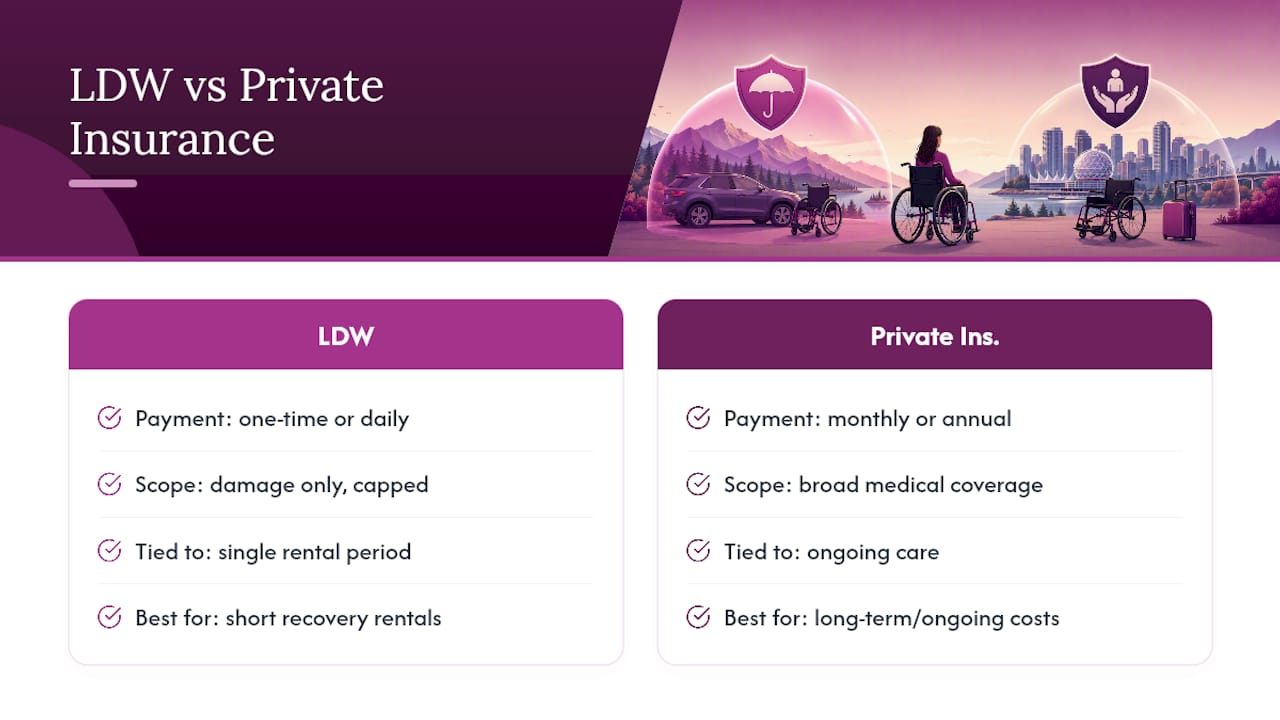
If you’re renting for a short recovery period, say six weeks after knee surgery, the LDW is almost always the cheaper and simpler route. You pay a small daily add-on, skip the prescription and pre-approval paperwork entirely if you’re paying out of pocket, and walk away once the rental ends. There’s no ongoing premium commitment and no claims history risk.
Private insurance makes more financial sense when the rental is one piece of a bigger, ongoing medical picture, when you’re also claiming physiotherapy, other equipment, or home care costs under the same plan. In that case, the administrative cost of getting pre-approval pays for itself because the insurer is covering far more than the wheelchair.
The trap is assuming the LDW protects you the way insurance would if the chair is stolen from your vehicle or someone trips over it in your hallway. It doesn’t extend to liability, and it caps theft reimbursement well below full replacement value in most agreements. Budget for the waiver as a damage cost tool, not a safety net for your broader legal exposure.
Choosing between a damage waiver and insurance based on your actual risk
The decision comes down to two questions: how long do you need the chair, and what’s your realistic risk of damage, theft, or liability exposure during that window?
For a short rental in a controlled setting, home recovery, a hospital-to-home transition, a family visit, the LDW usually wins on cost and simplicity. You’re mostly worried about accidental damage, and the waiver handles that directly without touching your existing coverage or triggering a claims history.
For longer rentals, outdoor or high-traffic use, or situations involving a power wheelchair with a higher replacement cost, lean toward involving your extended health plan even if it means more paperwork upfront. The clinical documentation you gather for insurance reimbursement also strengthens any future equipment purchase decision, since your OT assessment carries forward.
There’s a middle case too: renters who have both. Keep the LDW active for the day-to-day accidental damage risk, and use your extended health plan or PharmaCare pre-approval to offset the rental fee itself. The two aren’t mutually exclusive, and combining them is often the most cost-effective approach for anyone renting longer than a month.
Legal liabilities and your rights as a renter in BC
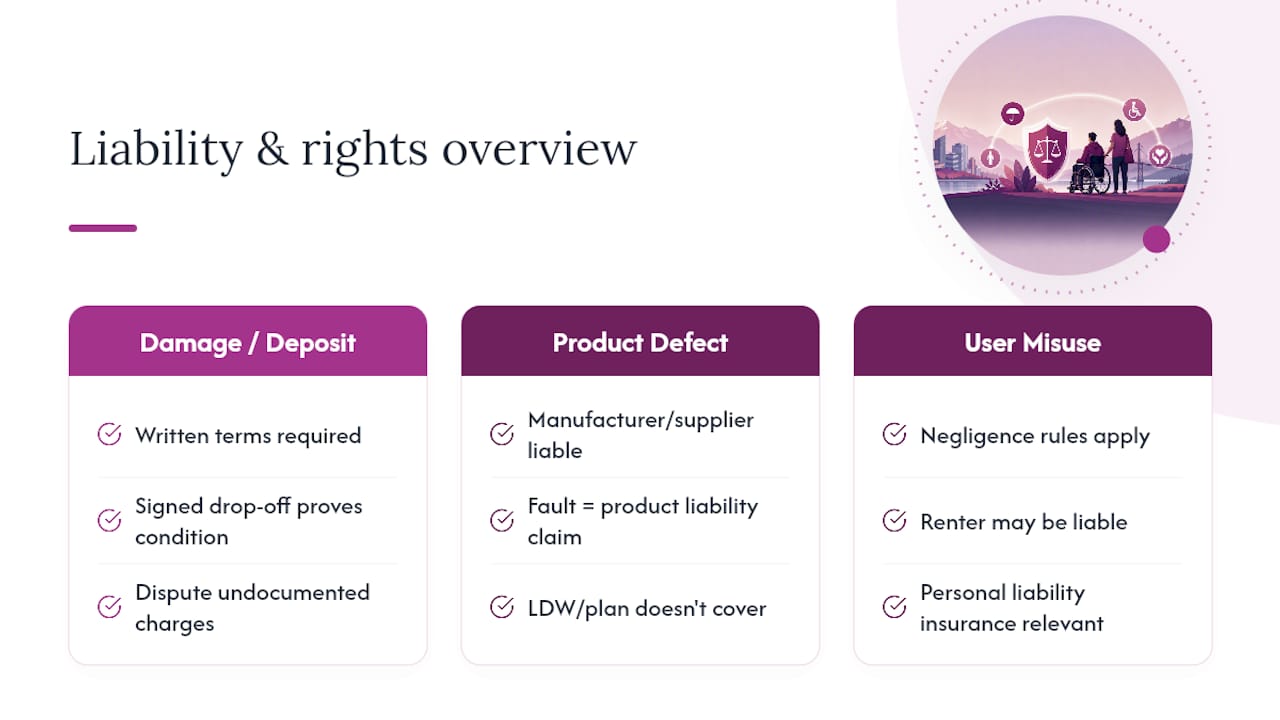
When you sign a rental agreement for a wheelchair or scooter, you’re entering a consumer contract, and BC’s general consumer protection principles around fair contract terms apply the same way they would to any equipment rental. You have the right to a clear, written agreement that states the damage waiver terms, deposit conditions, and repair liability before you hand over payment, not after.
If a supplier tries to charge you for pre-existing damage they didn’t document at pickup, you can dispute the charge, and a signed condition report from drop-off is your strongest evidence. Verbal assurances mean nothing once a deposit is being withheld weeks later.
Liability for injury is a separate matter from equipment damage. If a wheelchair fails due to a manufacturing or maintenance defect and someone is hurt, that’s a product liability question that sits with the supplier or manufacturer, not something an LDW or your extended health plan resolves. If the injury happens because of how the equipment was used, normal negligence principles apply, and that’s where personal liability insurance, if you carry it, becomes relevant.
Renters also have the right to know exactly who’s responsible for what before an issue arises. A supplier that refuses to put damage definitions or deposit conditions in writing is not offering you a fair contract, and you’re within your rights to walk away and rent from a company that will.
How a damage or loss claim actually gets processed
Most disputes happen because someone skipped documentation at the start, so the process below assumes you did it right.
- Report the damage or loss to the rental supplier immediately, ideally within 24 hours.
- Take dated photos of the damage or, in the case of theft, file a police report and get the report number.
- Pull your pickup condition report to compare against the current state of the equipment.
- Submit the incident to the supplier in writing, referencing your rental agreement number and the LDW terms if you purchased one.
- If the supplier disputes your account, request their inspection notes and repair estimate in writing before agreeing to any charge.
- If you’re also filing with an insurer for equipment replacement, attach the same photos, the police report if applicable, and your original prescription documentation.
The whole process moves faster when your pickup and return documentation already exists. A renter who photographed the chair’s condition at drop-off has a clean paper trail; a renter who didn’t is negotiating from a weaker position, often accepting a supplier’s version of events by default.
How Seventh Chakra supports renters through the claims and paperwork maze
Seventh Chakra delivers wheelchairs, scooters, and and hospital bed across Greater Vancouver the same day, with no upfront deposit and full sanitization before every delivery. Clients get a fitting and condition check at drop-off, and Seventh Chakra provides the itemized invoices and rental agreements insurers ask for, so the paperwork side of a wheelchair rental in Vancouver doesn’t become its own project.
— Chandan
Renting a wheelchair in BC without the deposit headache
Most rental companies ask for a deposit before they’ll release equipment, which is exactly the wrong friction point when someone needs a wheelchair the same day they’re discharged from hospital. Seventh Chakra skips that step entirely: no upfront deposit, same-day delivery across Greater Vancouver, and every chair sanitized before it reaches your door.
If you’re weighing a damage waiver against your extended health plan, Seventh Chakra hands you the exact documentation insurers ask for, itemized invoices, a clear rental agreement, and a documented condition report at drop-off, so your claim isn’t held up by missing paperwork. Whether you need a standard wheelchair rental, an electric wheelchair for greater independence, or a hospital bed rental for a home recovery setup, the process starts with a phone call or an online request form. Check availability and book your equipment today, and ask about the insurance documentation package when you call.
Sources
- Medical Equipment Provision Program (MEPP) | Island Health
- Medical equipment and adaptive aids for people with MS | Vancouver Coastal Health
- PharmaCare instruction (pre-approval and Prosthetic & Orthotic Committee notes)
FAQ
Is there a free mobility scooter or wheelchair available for seniors in BC?
Seniors who meet MSP, urgent need, and financial hardship criteria can access a short-term rental through MEPP at no cost, typically for up to three months.
What are the regulations for mobility scooters in BC?
Mobility scooters are generally treated as pedestrian mobility devices on sidewalks and in crosswalks rather than motor vehicles, though rules can vary by municipality, so check local bylaws before travelling on roads.
How much does a wheelchair cost to rent or buy in Canada?
Purchase prices for a standard manual wheelchair start around $500, while rental rates depend on the chair type and rental length, with electric and bariatric models costing more than standard manual units.
Is health coverage free in British Columbia?
MSP covers most physician and hospital services for eligible BC residents, but it does not automatically cover mobility equipment rentals. Those typically require a separate application through MEPP, private insurance, or another funding program.
Does a rental damage waiver count as insurance for a wheelchair rental?
No. A damage waiver limits your liability to the rental supplier for accidental damage or theft, while insurance covers medical necessity and reimbursement and requires a prescription and pre-approval.