Bariatric Walker Width: How to Measure and Choose in Canada
A bariatric walker is wider than a standard one, and the right width depends on two measurements: the person’s body and the narrowest doorway they must pass through. Canadian health authorities list bariatric walkers in a range of about 28 to 40+ inches (71 to 102 cm) overall, so “bariatric” is not one size. If a walker is not working for a short recovery, or the person needs to sit more than they walk, a bariatric wheelchair rental is often the faster fix. Our Greater Vancouver rentals come with same-day delivery, no deposit and sanitized equipment, and a bariatric wheelchair starts from $100 per week.
TL;DR
- Bariatric walkers are sized roughly 28 to 40+ inches (71 to 102 cm) wide, according to Alberta Health Services guidance. Pick the width from the user’s body and your narrowest doorway, not from the product name.
- Check the weight rating on the label. Hospital-grade bariatric walkers are rated at 400 lb (182 kg) and 500 lb (227 kg) in one Manitoba hospital’s care plan, and the rating must exceed the user’s weight, including anything they carry.
- Measure the path, not only the door: hallways, bathroom, bedroom and the turn into each room.
- If a walker is too tight for your home or the person tires quickly, a bariatric wheelchair rental from $100 per week, a mobility scooter from $200 per week or a hospital bed from $175 per week can cover the gap while you wait for an assessment.
Table of Contents
- What “bariatric walker width” actually means
- How wide is wide enough?
- Do you need a bariatric walker at all?
- When a bariatric wheelchair is the better answer
- Beyond the walker: scooters and hospital beds
- Safety checks before first use
- Coverage and rental in Canada
- Perspective
- Rent in Greater Vancouver
- FAQ
- Sources
What “bariatric walker width” actually means
When shoppers search this phrase they usually mean one of three widths, and mixing them up is the most common reason a walker does not fit.
- Overall width: the outside edge of the frame, wheels or legs included. This is the number that has to clear a doorway.
- Inside width (between the handles or legs): the space the user stands in. A wider body needs more of it, or the user ends up pressed against the frame.
- Seat width: on a rollator, the seat you sit on when you rest. It is separate from overall width and is usually narrower than the frame around it.
A bariatric walker or rollator is built wider and stronger than a standard one. The practical difference is weight capacity and frame size. The Indigenous Services Canada mobility benefits list defines a bariatric 4-wheel walker as one with a weight capacity or width greater than a standard 4-wheel walker, with brakes and a seat. Notice the “or”: some models are stronger but not much wider, and some are wider with a modest capacity increase. Read both numbers on the specification sheet.
How wide is wide enough?
There is no single Canadian standard. The Alberta Health Services (AHS) bariatric equipment checklist says plainly that no formal dimension or capacity guidelines exist and leaves the decision to clinical judgment for each person. The AHS inpatient guidelines (version 1.4, March 2022) list bariatric walkers sized 28 to 40+ inches among the equipment to consider for patients with bariatric care needs.
That range is wide on purpose. Here is how to narrow it for your situation.
Step 1: Measure the user
Have the person stand relaxed, with arms slightly out as they would hold walker handles. Measure the widest point of the hips or torso, then note the space they need between the handles for their arms to hang comfortably. The frame should not touch the body when walking. Write the numbers down and take them to whoever is assessing the person.
Step 2: Measure the narrowest point of the route
BC’s Medical Equipment and Devices policy says the person’s immediate environment is a factor in equipment decisions. Narrow door frames may call for a specific model of walker or wheelchair, and hilly terrain may call for a walker with brakes. Walk the real route the person will use and measure:
- the clear opening of the bedroom, bathroom and front doors (measure between the door stop and the open door edge, not the frame, since the open door and hinges take space);
- hallway width, and any corner where the walker has to turn;
- the path to the toilet and the kitchen;
- thresholds, ramps and building entrances in condos and townhouses.
Older Vancouver-area homes and many condo bathrooms have narrow doors, so the bathroom is the usual pinch point.
Step 3: Compare, with a margin
The walker’s overall width must be less than the narrowest clear opening, with room to move without scraping knuckles. If the walker only just fits, plan on it staying in the main living areas and use another solution for the bathroom. A rollator that is 2 inches too wide for a bathroom door is a rollator the person will stop using.
Step 4: Check the weight rating
AHS says selection must ensure the equipment has the proper weight rating, the proper dimensions, and can fit through doorways and the spaces of use, with the capacity clearly labelled. Ratings vary between models. A Winnipeg hospital care plan lists one bariatric walker rated at 500 lb (227 kg) and another at 400 lb (182 kg) and tells staff to consult the label. The NIHB list adds that the user’s weight, including an oxygen holder where applicable, must be within the device’s capacity. Count everything the walker will carry, not just the person.
Our own guide on bariatric walker weight capacity goes through the 400 to 500 lb tiers in more detail.
Do you need a bariatric walker at all?
AHS sets its assessment threshold at a body weight of 113 kg (250 lb) or more, and notes that some people under 113 kg may still need a bariatric assessment because of stature or body shape. Width and capacity are therefore not decided by weight alone. A tall person, or someone with a broad frame, may be more comfortable in wider equipment at a lower weight.
The AHS checklist also points out that wider, higher-capacity equipment can serve people without obesity. If a standard walker feels cramped or flexes under load, that is a fit problem worth raising with the therapist.
Walker or rollator?
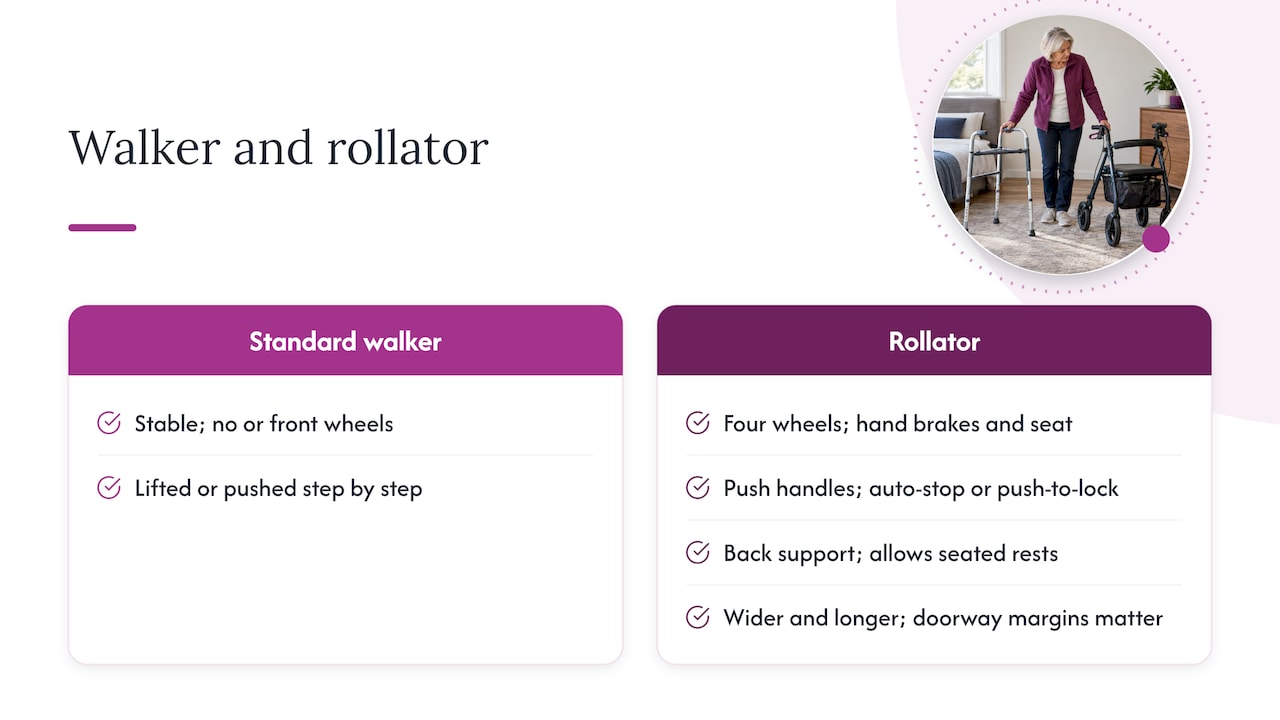
A standard walker has no wheels or only front wheels. It is stable but has to be lifted or pushed forward step by step. A rollator has four wheels, hand brakes and a seat, so it moves smoothly and lets the user rest. According to the NIHB specification, 4-wheel walkers, bariatric ones included, come with a seat, push handles, brakes, auto-stop or push-to-lock, and back support. A rollator is wider and longer in practice, because of the wheels and seat, so doorway margins matter more.
We rent a 4-wheel rollator walker from $60 per week, which suits a recovery period where you want to see how the person manages before committing to a purchase. Our walker height adjustment guide covers the next step, setting handle height once the walker is in the house.
Get the assessment
BC’s policy describes an occupational therapist (OT) or physiotherapist (PT) assessment as considering how the person moves and manages daily activities, their physical and cognitive skills for safe use, product specifications, trial outcomes and the immediate environment. Tell the OT or PT at the start that the person has bariatric needs, and bring your doorway measurements. This is the step where a clinician, not a rental company, decides what is safe for a specific body and diagnosis. Follow their recommendation on type, width and weight rating.
When a bariatric wheelchair is the better answer
A walker asks the user to carry their own weight over distance. After surgery, during illness, with severe joint pain, breathlessness or fatigue, or for a tourist who needs to cover airport or sightseeing distances, a wheelchair is often the safer tool. Funders also treat fit as central: for wheelchairs, the NIHB list requires that the chair fit within the home environment and doorways, meet the person’s weight requirements, and be supported by an OT or PT assessment. The same logic works for a family deciding privately.
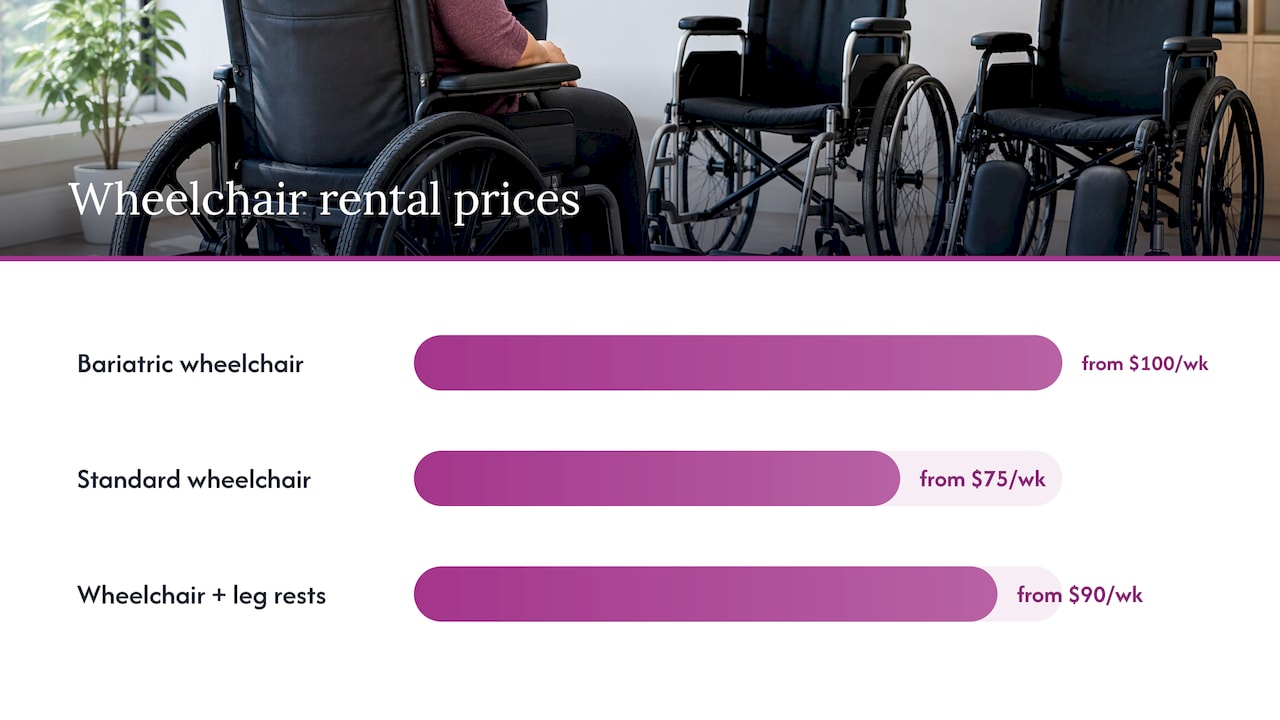
Our Bariatric Wheelchair, extra-wide rental starts from $100 per week. A standard wheelchair starts from $75 per week, and a wheelchair with elevating leg rests from $90 per week. Because a wider chair is also harder to turn in tight halls, apply the same doorway test as above. Our guide to measuring for a bariatric wheelchair shows seat width, depth and the other measurements, and explains why body shape changes seat dimensions.
Quick comparison
| Need | Good fit | Our weekly rental (from) |
|---|---|---|
| Short walks, needs to rest | 4-wheel rollator walker | $60 |
| Cannot walk far, wider frame | Bariatric wheelchair | $100 |
| Standard frame, short-term use | Standard wheelchair | $75 |
| Swollen or elevated legs | Wheelchair with elevating leg rests | $90 |
| Longer outdoor distances, tourists | Mobility scooter | $200 |
| Cannot get in and out of bed safely | Electric hospital bed | $175 |
Prices are our published weekly rental rates. Delivery is charged separately: small items are $30 to $60 one-off per way, and a large install is $250 one-off.
Beyond the walker: scooters and hospital beds
Width thinking applies to the rest of the equipment that arrives with a mobility problem.
Mobility scooter. For visitors to Vancouver or people with longer outdoor distances, a mobility scooter rental starts from $200 per week. Check the width of your building’s entrance, elevator and the room where it will be parked and charged before it arrives.
Hospital bed. A home hospital bed takes up more than the mattress, because rails and the frame add width, and in a bariatric setup the bed is wider again. Plan the room and the route to it. Our hospital bed sizes guide covers dimensions and bariatric widths, and our hospital bed rental is an electric, adjustable bed delivered same day from $175 per week. An overbed table from $25 per week completes the setup.
For the bigger picture of what a household needs, see our caregiver’s guide to choosing mobility equipment.
Safety checks before first use
- Read the label for the weight limit, and confirm the person plus anything carried is under it.
- Test the brakes on level ground before the person sits or leans on the rollator.
- Adjust handle height so the elbows are slightly bent.
- Keep the walker’s path clear of rugs and cords.
- Confirm the person can turn in the bathroom with the walker, or has a plan to park it outside.
These are general points. The person’s therapist or physician sets any limits specific to their condition.
Coverage and rental in Canada
Public coverage depends on the province and the program. For First Nations and Inuit clients, the NIHB list (effective July 29, 2026) covers a bariatric 4-wheel walker with a recommended replacement of one every five years, prescribed by a physician, physician assistant, nurse practitioner, OT or PT. The same list covers walker rentals with prior approval, rented one month at a time. Rules differ in other programs: Alberta’s Aids to Daily Living manual (October 2024) says clients may rent lifters and homecare beds from a vendor for short-term use but that the program does not reimburse rental charges for temporary, short-term needs. In BC, ask the OT, PT or your health authority what applies to you, and ask about private or extended health insurance.
Perspective
Most of the calls we get about walkers and wheelchairs are not about a product. They are about a hallway. A family has a person coming home from hospital and a doorway that was never measured, and by evening they need something that works.
That is why we deliver the same day, set the equipment up and sanitize it before it arrives, with no deposit. A short-term need should not mean a large upfront payment or a week of waiting. Our weekly rental rates are published, and we tailor the term to how long you need the equipment.
Our advice is to measure first, get the assessment, then choose the equipment that fits the person and the house. For many families that is a bariatric wheelchair or a hospital bed in the first week, and a walker when the person is ready for it.
Chandan
Rent in Greater Vancouver
We rent wheelchairs, mobility scooters and hospital beds across Greater Vancouver, including Surrey, Burnaby and Richmond. The equipment comes with same-day delivery, professional setup and sanitizing, and no deposit. Weekly rental rates start at $75 for a wheelchair, $100 for a bariatric wheelchair, $175 for a hospital bed and $200 for a scooter. See everything on our rentals page.
Tell us your doorway and hallway measurements when you order and we will help you match the equipment to your space.
FAQ
How wide is a bariatric walker?
It depends on the model. Alberta Health Services lists bariatric walkers sized from about 28 to 40+ inches (71 to 102 cm) among equipment to consider. Check the overall width on the specification sheet and compare it with your narrowest doorway.
What is the difference between a bariatric rollator and a standard rollator?
A bariatric rollator has a higher weight capacity, a wider frame, or both. The ISC benefits list defines a bariatric 4-wheel walker as one with greater capacity or width than a standard 4-wheel walker, with brakes and a seat. Always confirm the labelled weight limit.
Can I rent a bariatric wheelchair instead of buying a walker?
Yes, if the person needs to sit or be pushed over longer distances, or while a walker assessment is pending. Our bariatric wheelchair rental starts from $100 per week, with same-day delivery in Greater Vancouver.
Who decides which walker is safe for me?
An OT or PT assessment. BC’s policy says it considers how the person moves, their skills for safe use, product specifications, trial results and the home environment. Tell them about any bariatric needs at the start.
Sources
- Alberta Health Services: Guidelines for In-Hospital Care of the Patient with Bariatric Needs
- Alberta Health Services: Bariatric Equipment and Environment Checklist
- Indigenous Services Canada: Mobility equipment and supplies benefits list
- Winnipeg Regional Health Authority: Bariatric Care Plan
- Alberta Aids to Daily Living Program Manual, Section L