Mobility Scooter Insurance in Canada: What You Need to Know
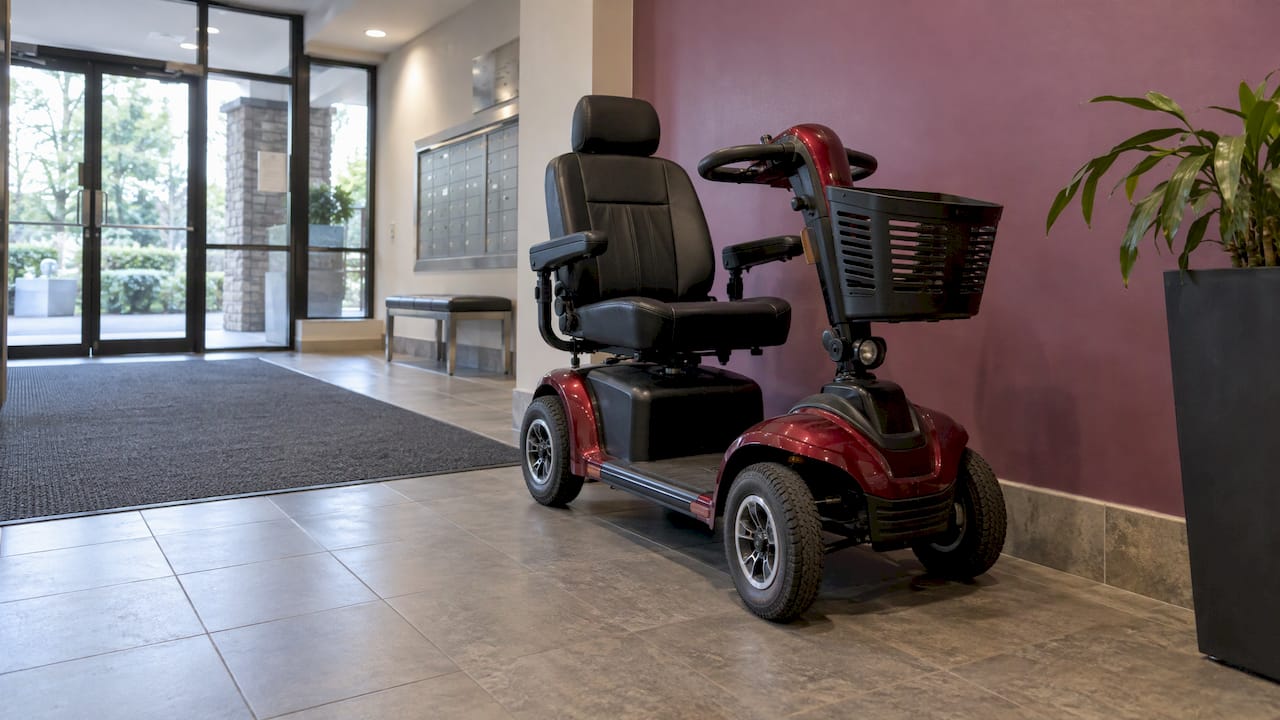
In most of Canada you do not need licence plates or compulsory insurance for a mobility scooter, but you can still insure one, and in some programs you must. In British Columbia, ICBC does not register, license or insure mobility scooters. Cover for theft, damage and liability comes from a home policy or a specialty policy instead. If you need a scooter for a few weeks, because of a recovery, a visit or a trip, renting often removes most of these questions. We rent mobility scooters across Greater Vancouver with no deposit and same-day delivery.
TL;DR
- Mobility scooters are not registered or insured through ICBC in B.C., and operators follow pedestrian rules.
- Optional cover exists: some home policies extend to motorized scooters, and specialty policies offer liability, damage and theft cover.
- Provincial funding differs sharply. B.C. funds conventional scooters up to $3,500 for eligible clients, and Quebec requires users to insure the loaned scooter.
- For short-term needs, renting a scooter from $200 per week avoids purchase, storage and a long insurance decision.
Table of Contents
- Do you need insurance for a mobility scooter in Canada?
- What insurance can cover
- Where insurance is a condition: Quebec
- What a mobility scooter costs, and who helps pay
- Renting instead of buying: what changes
- Scooter, wheelchair or hospital bed: choosing the right rental
- Our perspective
- Need a scooter, wheelchair or hospital bed this week?
- FAQ
- Sources
Do you need insurance for a mobility scooter in Canada?
There is no national rule. Provinces and municipalities decide, and the common pattern is that a true mobility scooter is treated like a pedestrian device, not a motor vehicle.
In British Columbia, ICBC’s guidance says a mobility scooter must be designed for people with limited mobility, be self-propelled, and have a motor that cannot push it faster than 25 km/h on clean, paved, level ground. Operators follow pedestrian rules, which includes using sidewalks but not bike lanes. Local governments can set bylaws for multi-use paths and trails (ICBC). The same page notes that, as of June 2024, operators are covered by B.C.'s vulnerable road user law, which requires drivers to drive safely and give space when passing.
The Motor Vehicle Act points the same way. It counts a person on a wheelchair-like device as a pedestrian, and its registration and licensing rules concern motor vehicles and trailers (Motor Vehicle Act, CanLII). The Act has been amended as recently as 2025, so check the current text on CanLII if your situation is unusual.
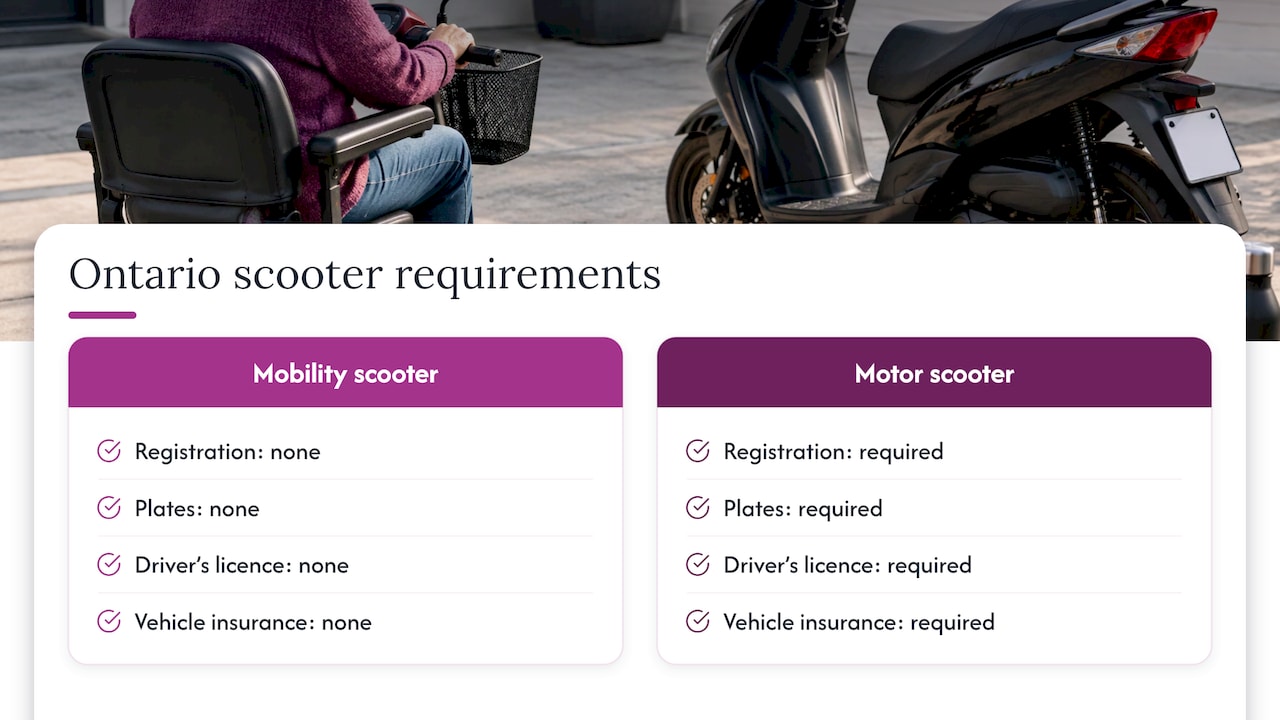
Ontario is similar. One Ontario town’s police page says people on motorized wheelchairs and medical scooters are pedestrians with no registration, plates, driver’s licence or vehicle insurance. Mopeds and motor scooters, by contrast, are vehicles that need all three (Town of LaSalle). That difference matters when you shop. A “scooter” built for a mobility need and a motor scooter for commuting are treated very differently.
If you want sidewalk and path rules for Vancouver, Burnaby and the Seawall in more detail, our guide to sidewalk mobility device rules covers them.
What insurance can cover
No law requires it, but there are good reasons to want cover: a scooter is a high-value item that gets left outside shops and stored in lobbies, and a collision with a pedestrian can raise a liability claim. Two routes exist.
Your home, tenant or condo policy
Some home policies already extend to scooters. One major insurer’s FAQ states its home policy covers losses from non-business ownership of motorized wheelchairs, including motorized scooters with more than two wheels designed for disabled persons (Scotia Home & Auto). Terms vary by insurer, so ask your own broker or insurer what your policy says about mobility devices, limits and exclusions.
A specialty policy
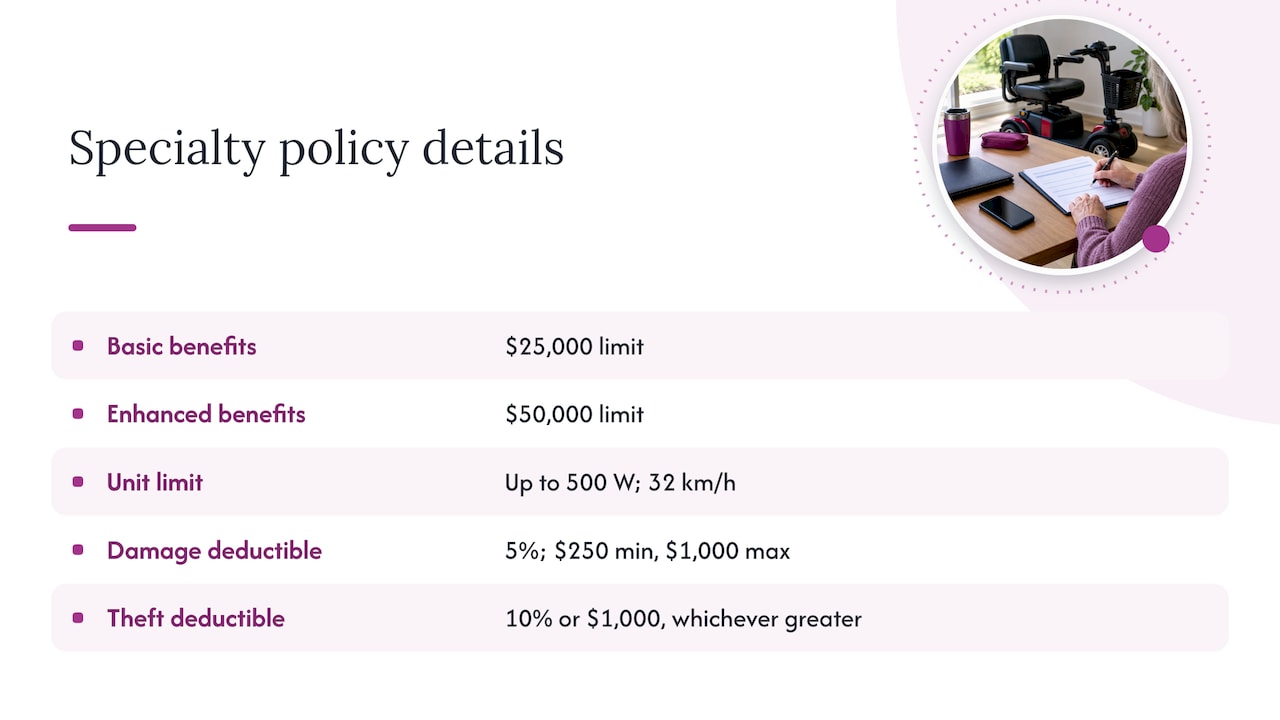
Specialty policies exist for scooters and electric wheelchairs. One Canadian program lists third-party liability, All Perils physical damage and theft cover, plus Accident Benefits with $25,000 Basic and $50,000 Enhanced limits, for units up to 500 watts and 32 km/h. Its FAQ also says liability cover is required to add Accident Benefits, that replacement-cost cover is available for units bought new within three years by the original owner, and that a claim may be denied if the unit does not meet provincial regulations at the time (Pedal Power FAQ). The same FAQ sets higher deductibles after a prior claim: 5% of value (minimum $250, maximum $1,000) for damage, and 10% of insured value or $1,000, whichever is greater, for theft on an electric scooter.
Two practical points follow. First, the speed limit and regulatory fit matter, so confirm your scooter’s motor and top speed before you buy cover. Second, theft is the claim that costs the most to prevent and recover from. Our mobility scooter theft prevention guide lists the habits that reduce the risk.
Where insurance is a condition: Quebec
Quebec’s government scooter program loans a four-wheel scooter to eligible residents, with no fees or deductibles, but all allocated equipment must be insured by the user. Eligibility turns on a motor impairment that causes a persistent inability to walk under 30 metres, or a severe cardiorespiratory impairment, and on living at home with safe storage (Gouvernement du Québec). The provincial health insurer’s separate technical aids program does not cover three- or four-wheel scooters, which fall under the other government programs (RAMQ).
What a mobility scooter costs, and who helps pay
Purchase prices vary widely with range, weight capacity, folding design and whether the scooter is built for indoor or all-terrain use. The most reliable published figures are the funding ceilings set by government, because they show what a province considers a reasonable total cost.
| Program | What it provides | Key conditions |
|---|---|---|
| B.C. Medical Equipment and Devices policy (updated 17 December 2025) | Conventional scooters up to $3,500 total cost; bariatric up to $4,500 | Eligible for general health supplements, pre-approval, prescription or therapist confirmation, no other resources, assessment that a wheelchair is unlikely to be needed within 5 years |
| Ontario Assistive Devices Program | Pays 75% of the approved price or maximum contribution, or a grant | Ontario residency, valid health card, disability needing the equipment for 6 months or more; full funding possible for Ontario Works, ODSP or ACSD recipients |
| Quebec scooter program | Loaner scooter, no fees or deductibles | Mobility criteria, home storage, user insures the equipment |
| Veterans Affairs Canada, POC 13 | Power mobility devices for eligible Veterans | Prescribed by a VAC-approved health professional |
In B.C., the policy page adds that contracted providers give a free assessment, free delivery and in-home set-up, and a two-year all-inclusive service coverage on scooters. It also notes co-funding may be considered when, for example, an insurer pays part of an item’s cost. For how provincial coverage and private benefits fit together in practice, see our page on insurance and funding for medical equipment and our guide to MSP coverage for medical equipment.
These programs are built for long-term, assessed needs. A recovery after surgery, a family visit, or a trip to Vancouver rarely fits a funding timeline, and that is where renting comes in.
Renting instead of buying: what changes
When the need is weeks or a few months, a rental changes the insurance question in practical ways:
- No purchase to protect. You are not carrying a $3,000-plus asset on your own home policy.
- No storage problem. When the need ends, the scooter goes back.
- No long wait. Funding approvals need assessments and pre-approval. A rental can be on your doorstep the same day.
- Predictable cost. You pay a weekly rate for the period you need.
Our mobility scooter rental starts from $200 per week, with no deposit, same-day delivery in Greater Vancouver, and sanitization before delivery. Delivery fees are posted openly on our delivery fee page: small items are $30 to $60 one-off per way, and large installs are $250 one-off. If you are a visitor, our guide to mobility scooter rental in Vancouver explains how it works, and we also cover delivery to Vancouver hotels.
Before you rent any equipment, tell your home or tenant insurer what you are bringing home, so you know what your policy says about it. A short call is enough.
Scooter, wheelchair or hospital bed: choosing the right rental
Many people who ask about scooters really need to match the device to the situation.
Mobility scooter
Best for people who can transfer on and off a seat and steer, but tire walking distances. It suits errands, the Seawall and travel. Rental is from $200 per week on our mobility scooter rental page.
Wheelchair
Best when a caregiver will push, when you need to be moved indoors, or when a scooter’s size does not fit your home. A standard wheelchair rental is from $75 per week on our wheelchair rental page. We also rent a bariatric wheelchair from $100 per week and a wheelchair with elevating leg rests from $90 per week. In B.C., a prescription route exists for some funded equipment, which our wheelchair prescription guide explains.
Hospital bed
Best for recovery at home, palliative situations or caregiving where raising the head or knees matters. Our electric, adjustable hospital bed rental is delivered same day, from $175 per week.
If you live with a condition like MS and are weighing options, our guide to MS mobility aids compares scooters and wheelchairs by need.
Our perspective
Most of the calls we get about scooter insurance come from people who have been told, three different ways, that it is both required and not required. The honest answer is that in B.C. the scooter is treated as a pedestrian device, so the choice to insure is yours, and it depends on how long you will have it and how much it is worth.
What we see is that the need rarely arrives on a schedule. A fall, a surgery, a parent flying in: families need equipment today, not after an approval process. That is why we built our service around no deposit, same-day delivery, professional set-up and sanitized equipment, with prices posted openly.
If your need is short, rent. You get the scooter, wheelchair or hospital bed you need this week, at a weekly rate you can see before you call, and you can talk to us about the terms that fit your situation.
Chandan
Need a scooter, wheelchair or hospital bed this week?
We deliver mobility scooters, wheelchairs and electric hospital beds across Greater Vancouver, including Burnaby, Richmond and Surrey, with no deposit. Scooters start from $200 per week, wheelchairs from $75 per week and hospital beds from $175 per week. See the full range on our rentals page or book your mobility scooter rental.
FAQ
Can you insure a mobility scooter in Canada?
Yes. Some home policies extend to motorized scooters designed for people with disabilities, and specialty policies offer liability, damage and theft cover. Terms and limits differ by insurer, so confirm the details with yours.
Are mobility scooters covered by insurance in B.C.?
ICBC does not register, license or insure them, so cover is optional and comes through a home or specialty policy. Provincial help is separate: B.C. funds conventional scooters up to $3,500 for clients who meet its conditions.
Do I need a licence to drive a mobility scooter in Canada?
Not for a true mobility scooter. In B.C. and in the Ontario example above, operators follow pedestrian rules and need no driver’s licence, plates or vehicle insurance. Mopeds and motor scooters are different and do require them.
How much does a mobility scooter cost in Canada?
Buying prices depend on range, weight capacity and features. B.C. funds conventional scooters up to a $3,500 total cost and bariatric ones up to $4,500 for eligible clients. To rent instead, our scooters start from $200 per week.
Sources
- ICBC: Electric wheelchairs
- Motor Vehicle Act, RSBC 1996, c 318, CanLII
- Town of LaSalle: Important Information
- Scotia Home & Auto: Home insurance FAQ
- Pedal Power: FAQs
- Gouvernement du Québec: Mobility scooter program
- RAMQ: Devices that compensate for a physical deficiency
- Ontario Assistive Devices Program
- Veterans Affairs Canada: Programs of Choice