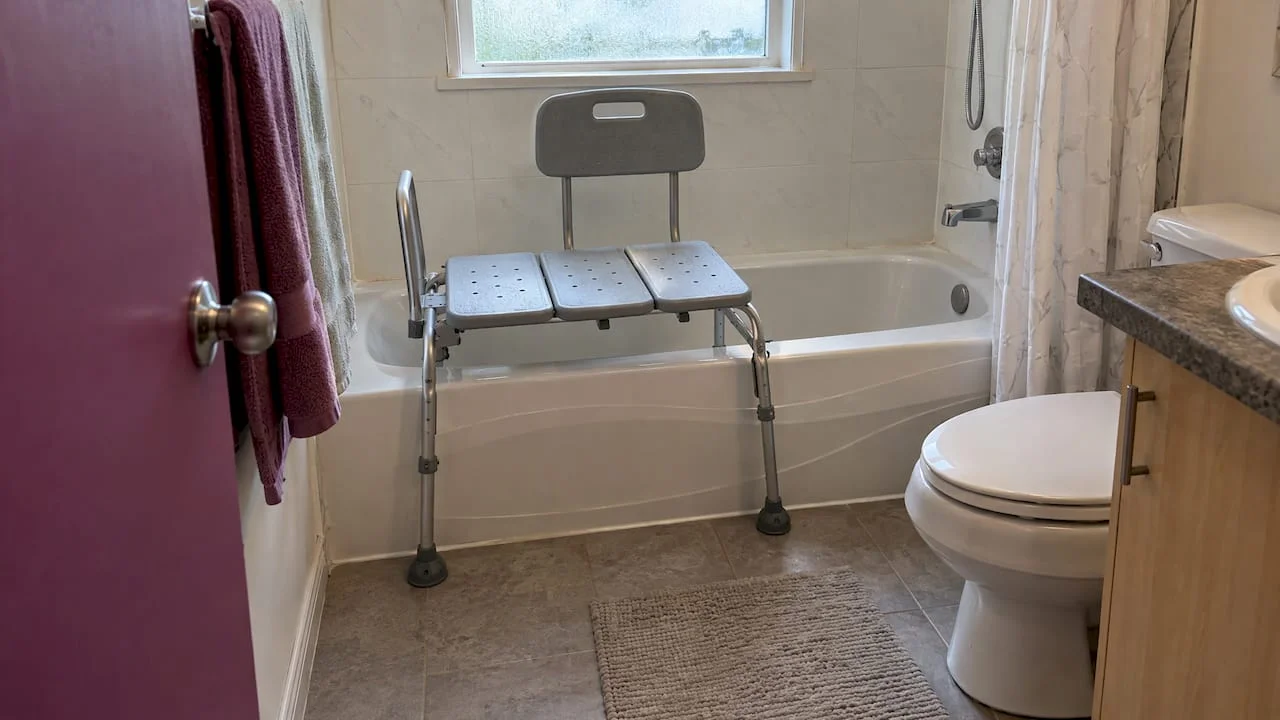
Narrow Doorway Wheelchair: How to Check the Fit Before You Rent

A wheelchair fits a narrow doorway when its overall width, measured at the widest point of the wheels or handrims, is clearly less than the usable opening of the door. Most standard chairs are narrower than the 850 mm opening that building codes expect, but older Vancouver-area homes, condo bathrooms and hallways often fall short of it. Measure first, then choose the chair. If you are renting for a recovery at home, we deliver wheelchairs, hospital beds and mobility scooters across Greater Vancouver the same day, with no deposit, so a measured-and-confirmed choice can be in your home quickly.
TL;DR
- Standard wheelchairs run roughly 584 mm to 685 mm wide overall, and BC’s code sets the clear width of an accessible doorway at 850 mm minimum.
- Measure the doorway with the door open, from the face of the door to the edge of the door stop, not the frame’s inside width.
- Overall width comes from seat width, so a snug seat is the first way to get a narrower chair.
- Turning space matters as much as the door: a chair that clears the doorway can still get stuck in a hallway corner or bathroom.
- We rent wheelchairs from $75 per week, hospital beds from $175 per week and mobility scooters from $200 per week, delivered same day with no deposit.
Table of Contents
- What counts as a narrow doorway for a wheelchair
- How to measure the doorway and the chair
- Why seat width sets the overall width
- Doorway width is only half of the question
- Which rental chair suits a tight home
- If the chair does not fit the door
- What to tell us when you book
- Our view on narrow doorways
- Get a chair that fits, delivered the same day
- FAQ
- Sources
What counts as a narrow doorway for a wheelchair
The benchmark most people use is the code for accessible buildings. The British Columbia Building Code, Section 3.8, requires every doorway on an accessible path of travel to have a clear width of at least 850 mm. For a swinging door, that is measured from the face of the door when it is open 90° to the outside edge of the stop on the frame. The same section allows 810 mm for the doorway to at least one bathroom in an accessible residential suite.
That is a rule for buildings designed to be accessible. Your own home was probably not. Many houses built decades ago have bedroom and bathroom doors of 24 to 30 inches (610 to 762 mm), and the frame, hinges and stop all take a bite out of the opening. If your doorway is under 850 mm, it does not mean a wheelchair is impossible. It means you need to compare real numbers.
The Ontario Building Code’s explanatory note on the same 850 mm requirement gives a useful range: standard wheelchairs measure from 584 mm to 685 mm overall. So the narrowest standard chair has about 266 mm of margin in an 850 mm door, and the widest has about 165 mm. In a 700 mm door, the widest standard chair does not pass at all, and even a narrow one leaves very little room for your knuckles on the wheels.

How to measure the doorway and the chair
Most fitting mistakes come from measuring the wrong thing. Work through these steps.
- Open the door to 90° and measure the clear opening. Use a tape from the face of the open door to the outside edge of the stop on the frame. The Ontario note explains that the door and the stop both intrude on the frame opening, so the inside width of the frame overstates what a chair can use.
- Check for anything that sticks out. The same note limits projections in the clear width: nothing below 865 mm above the floor, and no more than 100 mm between 865 mm and 2030 mm. Door hardware, trim and radiators count.
- Try opening the door wider. The note points out that many doors can open further than 90°, which can win back the width you need. Door stops and closers also reduce the opening, so look at them.
- Get the chair’s overall width, not its seat width. Overall width is measured across the outside of the wheels or handrims. A chair listed with an 18-inch seat is wider than 18 inches once the wheels are on.
- Allow room for hands. Manual users push on the handrims, so a chair that just squeaks through will scrape knuckles. Leave a few centimetres on each side where you can.
- Check the approach. A door at the end of a narrow hall needs space to line up straight. Measure the hallway width and any turn into the door.
The Nova Scotia Health Association’s wheelchair seating guide gives the same advice for choosing a chair: measure the home’s doorways and ask for the width a particular wheelchair model needs to get through. When you call us, have your narrowest door width, hallway width and the room you most need to reach ready. Those three numbers let us talk through which of our chairs is a sensible match.
Why seat width sets the overall width
If you need the narrowest possible chair, start with the seat. The peer-reviewed chapter Wheelchair Selection explains that seat width is based on the widest point across the hips and thighs plus up to 5 cm (2 inches) in total for side clearance. It also notes that overall wheelchair width is dictated by the seat width, so a seat that is no wider than it needs to be gives the narrowest frame, and narrower chairs improve handrim propulsion and manoeuvrability for manual users.
In practice, this means two people choosing a “standard wheelchair” may need different chairs. A slim adult recovering from a hip operation does not need the same seat as someone who wants room for a bulky winter coat. A seat that is too wide makes the chair harder to push through every door in the house. A seat that is too tight is uncomfortable over hours of sitting. Tell us your approximate hip width when you book and we can discuss the options.
For larger users the opposite problem appears: a wider seat means a wider chair and a tighter door. Our guide to bariatric wheelchair sizing walks through measuring for that case. Our extra-wide bariatric wheelchair rental starts from $100 per week.
Doorway width is only half of the question
A chair that passes the door can still fail the room behind it. Turning is where tight homes catch people out.
Accessibility Standards Canada’s accessible-ready housing standard, CAN/ASC-2.8:2025, sets these planning figures:
| Space | Minimum |
|---|---|
| Clear floor space, stationary wheelchair | 820 mm by 1,390 mm |
| Turning diameter | 1,800 mm |
| T-turn | 1,800 mm by 1,200 mm by 1,200 mm |
| Interior path of travel | 1,200 mm wide |
| Doorway | 860 mm wide |
| Turning diameter, power-assisted wheelchair | may need 2,100 mm |
| Turning diameter, scooter | may need 3,150 mm |
The national standard CSA B651-18 gives slightly different figures: 1,700 mm by 1,700 mm for an unobstructed U-turn, and accessible routes at least 1,000 mm wide. For bedrooms, the BC Building Code (Section 3.8.3.22) asks for a 1,500 mm turning area on one side of the bed in accessible sleeping rooms.
These numbers are design targets for new accessible buildings, not rules your existing home has to meet. They are useful because they tell you what a chair typically needs. If your bathroom is 1,200 mm across, you will probably be able to enter and exit, but a full turn is unlikely, and you should plan to go in forwards and back out, or to transfer at the door.
We have a longer explanation in our article on wheelchair turning radius, which is worth reading if your hallway has a corner.

Which rental chair suits a tight home
Here is how the main choices compare for a narrow doorway. Prices are our published weekly rates, from the delivery date, with no deposit.
| Equipment | Weekly rate | Where it works best |
|---|---|---|
| Standard wheelchair | from $75 | Everyday use at home and on outings, with a pusher or self-propelled |
| Transport chair | from $75 | A caregiver pushing the user, for appointments and visits |
| Wheelchair with elevating leg rests | from $90 | Recovery when the leg needs to be raised |
| Mobility scooter | from $200 | Longer distances outdoors, for people who can transfer safely |
| Bariatric wheelchair | from $100 | Users who need an extra-wide seat |
Wheelchair or transport chair for indoor use
For a home with tight doors, a standard wheelchair or transport chair is usually where we start, because it can be moved around furniture and pivoted in small spaces. If a caregiver will be doing the pushing, a transport chair is a good fit for getting to appointments. If the user wants to push themselves, a standard wheelchair is the way to go. Our lightweight wheelchair rental is available by the month if the chair will be lifted in and out of a car often, and our lightweight chair guide for caregivers explains what to look for.
Where a mobility scooter fits
A scooter is built for distance: errands, a stroll along the seawall, getting around as a visitor. Because it needs more turning room, the same planning standard cited above notes that scooters may need a 3,150 mm turning diameter. That makes a scooter the choice for outdoors and larger rooms, while a wheelchair takes over inside the tighter parts of the house. The Nova Scotia guide likewise notes that Group 1 power wheelchairs offer a narrower turning radius than scooters for home use. Many of our renters use both: a scooter for outings and a wheelchair for indoors. Tell us where you will use it and we will help you decide.
Hospital beds are a doorway question too
A hospital bed has to get into the room before it can help anyone, and it often goes through the narrowest door in the house. Our electric, adjustable hospital bed rental starts from $175 per week and is delivered same day. Read our guide to hospital bed doorway clearance for Vancouver homes before you choose a room, and measure the route from the front door as well as the bedroom door. For the larger install, our delivery fee is $250, one-off, and small items cost $30 to $60 per way. Details are on our delivery fees page.
If the chair does not fit the door
Before you give up on a room, run through the options in order.
- Open the door wider. As the Ontario note observes, many doors swing past 90°, which can recover the clear width you need. Look at the stop and any closer too.
- Choose a narrower seat. Dropping the seat width reduces the overall width, as the seating chapter explains.
- Rearrange the route. Moving a table, a bin or a shoe rack can win more space at a turn than any change to the door.
- Set up the main living area on one floor. A hospital bed and a chair in the room nearest the bathroom can mean you rarely need the narrowest doors.
- Plan permanent changes separately. Widening an opening is a renovation. Accessibility Standards Canada notes in CAN/ASC-2.8:2025 that wider doorways are more straightforward and cost-effective to build in at the start than to retrofit later. For a longer stay at home, this guide to accessible home renovations covers what to change first.
For a short recovery, a rental plus a small rearrangement is usually quicker than any building work. Our article on mobility equipment for small spaces goes through more ideas.
What to tell us when you book
A few facts let us match the equipment to your home without guesswork:
- the narrowest door width on the route, measured as described above
- the width of the hallway and where it turns
- the room the user needs to reach, and whether a bathroom transfer is needed
- who will be moving the chair: the user, a caregiver, or both
- how long you need it, since rentals run weekly and our terms are tailored to the situation
If a clinician has assessed you, follow their recommendations. The Nova Scotia guide describes a power wheelchair as something that follows an assessment involving a physician, an occupational therapist or physiotherapist, and an assistive technology professional. Ask your therapist about the chair type and seat dimensions, then tell us the measurements so we can match them.
Our view on narrow doorways
Most families call us after they have already discovered the problem: the chair came home and the bathroom door says no. Measuring takes ten minutes and saves a stressful day.
Our approach is to start with the doorway, the hallway and the person, then pick the equipment. We deliver the same day across Greater Vancouver, we set the equipment up, and every item is sanitized before it arrives. There is no deposit, and our pricing is published so you can see what a week of a wheelchair, a scooter or a hospital bed costs before you call.
If the first choice is not the right one for your home, a rental lets you adjust without having bought something that does not suit. That is the point of renting for a recovery: the equipment should follow your needs, not the other way round.
Chandan
Get a chair that fits, delivered the same day
We rent wheelchairs from $75 per week, mobility scooters from $200 per week and electric hospital beds from $175 per week to families, caregivers, visitors and healthcare providers in Vancouver, Burnaby, Richmond, Surrey and the surrounding area. Delivery is same day, equipment is professionally set up and sanitized, and we ask for no deposit.
See every option and current rates on our rentals page, or start with the wheelchair rental page and have your doorway measurements ready.
FAQ
How wide does a door have to be for a wheelchair to go through?
Standard wheelchairs are about 584 mm to 685 mm wide overall, according to the Ontario Building Code’s explanatory note. The BC Building Code asks for a clear width of 850 mm in accessible doorways, and allows 810 mm for a bathroom doorway in an accessible residential suite. A narrower door can work with a narrower chair, but leave room for your hands.
Where do I measure a doorway for a wheelchair?
Open the door to 90° and measure from the face of the door to the outside edge of the door stop. This is the clear width. The frame’s inside width is larger than the real opening, so it can mislead you.
Is a scooter or a wheelchair better for a small home?
A wheelchair turns in less space, so it is the usual choice inside a small home. A scooter is the better tool for outings and longer distances. Planning standards allow far more turning room for scooters, so measure your rooms before deciding where it will be used.
Can I rent a wheelchair for just a few days or weeks?
Yes. Our rates are weekly, starting at $75 per week for a standard wheelchair, with no deposit. Delivery is same day in Greater Vancouver, and we tailor the rental terms to how long you need the equipment.
Sources
- Ontario Building Code, A-3.8.3.3.(1) Doorway Width
- British Columbia Building Code 2018, Section 3.8 Accessibility (Rev2)
- British Columbia Building Code 2018, Section 3.8 Accessibility
- Nova Scotia Health Association, Wheelchair Seating & Positioning Guide
- Wheelchair Selection (Dudgeon, Deitz and Dimpfel, 2014)
- Accessibility Standards Canada, CAN/ASC-2.8:2025, Clearances and areas
- CSA B651-18 Accessible design for the built environment