
Sanitizing reduces germs on a surface to a lower level. Disinfecting uses a registered product to kill most disease-causing microbes on an object. Sterilizing destroys all microbial life, including spores. For the equipment most families rent or borrow, such as wheelchairs, walkers, scooters and hospital beds, the standard that applies is neither extreme: it is thorough cleaning with detergent and water, followed by low-level disinfection. This guide explains the terms, shows where mobility aids sit, and gives you a routine you can follow at home, plus what to ask a rental company before anything arrives at your door.
TL;DR
- Cleaning removes soil. Sanitizing lowers germ counts. Disinfecting kills most germs on a surface. Sterilizing kills everything, spores included.
- Wheelchairs, walkers and bed frames are “non-critical” items under the Spaulding system. They touch intact skin only, so cleaning plus low-level disinfection is the expected standard.
- Disinfectant does not work well on visible dirt. Clean first, then apply the product and keep the surface wet for the full contact time on the label.
- Follow the manufacturer’s instructions for each item, and use products with a Health Canada Drug Identification Number (DIN).
- When you rent, ask what was done to the equipment before delivery and whether it is documented.
Table of Contents
- The four terms, in plain words
- How the Spaulding system sorts equipment
- The two-step routine for home use
- Equipment by equipment: what to focus on
- How often to clean
- What to ask a rental company about sanitization
- Our perspective
- Renting the three items people ask about most
- Common mistakes
- FAQ
- Sources
The four terms, in plain words
These words get swapped in everyday speech and in product marketing. In infection control they are separate steps with separate meanings.
| Term | What it does | Typical method | Where you see it |
|---|---|---|---|
| Cleaning | Physically removes dust, soil and organic matter. Removes microbes rather than killing them. | Detergent, water, scrubbing or wiping | Every item, every time |
| Sanitizing | Reduces germs to a safer level. Does not claim to kill all of them. | Lower-strength products, hot water, wipes | Food surfaces, general household use |
| Disinfecting | Kills most disease-causing microbes on an inanimate object. Not usually bacterial spores. | Chemical disinfectant used for a set contact time | Healthcare, home care, shared equipment |
| Sterilizing | Destroys all microbial life, including spores. | Steam autoclave, specialized chemical processes | Surgical instruments, anything entering sterile tissue |
Public Health Ontario’s best practices document defines cleaning as the physical removal of foreign and organic material using water, detergents and mechanical action, and notes that cleaning removes microorganisms rather than killing them. That one distinction explains most of what follows.
Where “sanitizing” fits
“Sanitizing” is the loosest of the four. In common use it describes bringing germ numbers down to a level considered safe, and it is most familiar from food service. The CDC’s disinfection guideline is built around disinfection and sterilization for healthcare, and that is the vocabulary clinicians use for equipment. So when a rental company says equipment is “sanitized”, the useful follow-up is: what steps, with which product, and is it recorded? The word alone does not tell you whether the equipment was cleaned, disinfected, or only wiped.

Why sterilization rarely applies to mobility aids
Sterilization is reserved for items that enter sterile tissue, such as surgical instruments. A wheelchair frame or a bed rail cannot be autoclaved and does not need to be. Asking for “sterile” equipment is a sign the terms have been mixed up, not a higher standard worth paying for.
How the Spaulding system sorts equipment
Canadian infection prevention guidance uses the Spaulding classification to decide how much processing an item needs. Public Health Ontario’s Spaulding table sets out three levels:
- Critical: items that enter sterile tissue, including the vascular system. These require cleaning followed by sterilization.
- Semi-critical: items that contact mucous membranes or non-intact skin. These require high-level disinfection at minimum.
- Non-critical: items that touch only intact skin, such as wheelchairs, walkers and bedpans. These require cleaning followed by low-level disinfection, and in some cases cleaning alone is acceptable, because they carry the lowest risk of passing on infection.
That third tier is where almost everything we rent sits: wheelchairs, transport chairs, mobility scooters, rollator walkers, overbed tables and hospital bed frames. Hospitals run validated protocols with trained staff. At home, the target is more modest and more achievable: remove soil, disinfect high-touch surfaces properly, and do not damage the equipment in the process. The Public Health Agency of Canada’s routine practices guidance makes the same point: disinfection cannot be effective if equipment has not been physically cleaned first, because organic soil can inactivate disinfectants or block their action.
What changes if a wound or body fluid is involved
If equipment has been contaminated with blood, stool or other body fluid, or the user has an infection such as C. diff, the situation is different from routine upkeep. Ask the user’s nurse, home care coordinator or doctor which product to use, because some common disinfectants perform differently against specific organisms. Health Canada’s guidance notes, for example, that quaternary ammonium products can have reduced activity against certain pathogens like Candida auris, which is why institutions sometimes choose chlorine or hydrogen peroxide based products in those cases. That is a decision for a clinician who knows the situation, not a rule for every household.
The two-step routine for home use
HealthLink BC’s guidance on reducing germs and infection in the home describes disinfecting as a process that starts with cleaning. Its core message matches the professional guidelines: wash off soil with detergent and water, then disinfect. Here is what that looks like for the equipment you are most likely to use.
Step 1: Clean
- Put on disposable gloves.
- Wipe the equipment with a cloth, detergent and warm water. Use friction. Scrubbing or wiping is what lifts soil, spraying alone does not.
- Pay attention to crevices: seat seams, armrest joints, handgrips, bed rail hinges, control buttons and the underside of tables.
- Wipe off the soap residue with a cloth dampened with clean water if the disinfectant label asks for it.
Public health guidance repeatedly stresses this point: disinfectants often fail when applied over visible soil. Many people reach for the spray first and skip this step. It is the one that matters most.
Step 2: Disinfect
- Choose a product with a DIN. Health Canada’s hard surface disinfectants monograph describes the DIN as the market authorization for disinfectants used on non-critical medical devices, environmental surfaces and inanimate objects.
- Read the label for the contact time, the length of time the surface must stay visibly wet. Rushing this is the most common reason a disinfectant does not do its job.
- Apply with a cloth or wipe so you get even coverage, then let it sit for the full time.
- Let it air dry, or rinse and dry if the label directs you to for skin-contact surfaces.
Step 3: Check the manufacturer’s instructions
Public Health Ontario’s reprocessing materials for long-term care state that reusable equipment must be reprocessed according to the manufacturer’s instructions regardless of care setting. In practice that means a few things:
- Upholstery, vinyl and foam may react badly to bleach or alcohol-heavy products.
- Electronics on scooters, hand controls and bed pendants should never be soaked or sprayed directly. Apply product to a cloth and wipe.
- Batteries and charging ports stay dry. Unplug before cleaning.
- If the manual is missing, ask the supplier for the cleaning guidance before you use anything harsh.
HealthLink BC mentions that for some equipment, a mix of one part vinegar to three parts water is a cleaning option, but chemical disinfectants should always be used as directed on the label. Vinegar is a cleaner here, not a registered disinfectant, so do not treat it as a substitute for step 2.
Equipment by equipment: what to focus on
Different items collect different things. These are the touch points we would prioritize.
| Equipment | High-touch areas | Watch for |
|---|---|---|
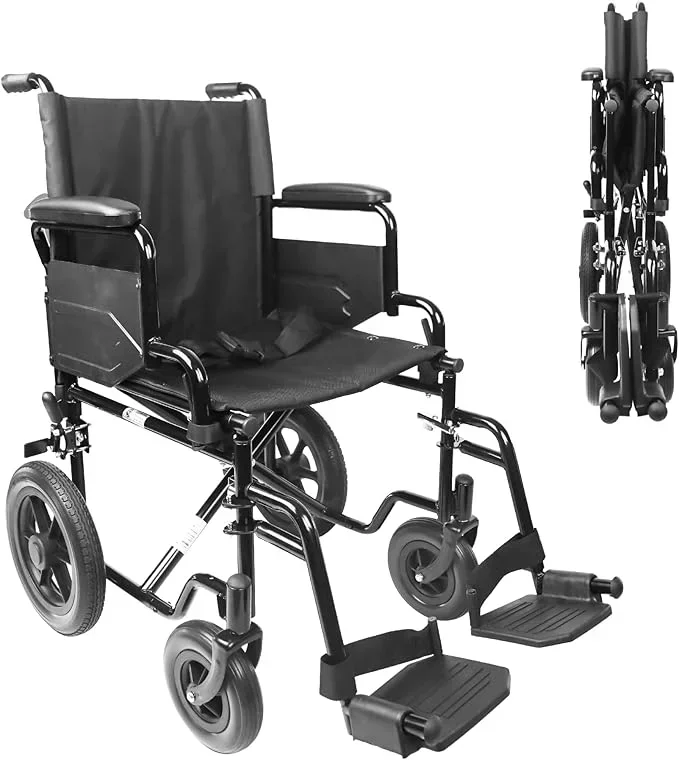
| Wheelchair or transport chair | Armrests, push handles, seat and backrest seams, brake levers, footplates | Fabric seat: check the care label before applying liquids |
| Mobility scooter | Tiller handles, throttle, key and display, seat, armrests | Never spray into the display or controls; keep the battery compartment dry |
| Hospital bed | Side rails, hand pendant, headboard and footboard, mattress cover seams | Wipe the pendant cord and buttons using a lightly dampened cloth only |
| Rollator or walker | Hand grips, brake handles, seat, basket | Clean rubber tips, since buildup there raises slip risk |
| Overbed table | Whole top surface, edges, height lever | Food residue under the lip |
On walkers, HealthLink BC’s walker guidance says the rubber tips should be clean and in good condition to help prevent slipping, and replacements are sold through medical supply stores and pharmacies. Cleaning is a safety task as well as a hygiene one.
One more caution: standard walkers and commode-style chairs are not necessarily designed for showers or wet areas. Soaking them to clean them, or using them in the shower when they are not rated for it, can cause rust, loosened joints and a slippery floor. If you need to move through a bathroom, ask for equipment made for it.
How often to clean
There is no single schedule that fits every home. A reasonable approach for a household managing a recovery:
- Daily: wipe the high-touch surfaces (handles, rails, pendant, armrests) with detergent and water, or with a disinfectant wipe that carries a DIN and suits the surface.
- Weekly: a full clean and disinfect of the whole item, including seams and undersides.
- Any time: after visible soiling, after a spill, after illness in the home, or when a different person starts using the item.
- On handover: when equipment arrives and before it leaves, so you know its condition, and so does the next user.
If the person using the equipment has a weakened immune system or an active infection, ask their care team whether the routine should be stricter.
What to ask a rental company about sanitization
Because the word is loosely used, the question to ask is about process. We suggest these five:
- What steps were done between the last customer and me? You are looking for cleaning first, then disinfection, not only a wipe.
- What products are used? They should be authorized for use in Canada, with a DIN.
- Is it documented? A reprocessing record you can see is the strongest sign of a real process. We wrote about this in why Vancouver caregivers should ask for the reprocessing log.
- Is the equipment inspected for wear? Cracked upholstery and rusted joints cannot be cleaned properly, whatever product is used.
- Does it arrive ready to use, with setup? A bed that is delivered and assembled by trained staff is handled less by you and your family.
On your side of the exchange, a photo checklist for returning rental equipment protects you by recording the condition on both ends.
Our perspective
We see the same misunderstanding often: families assume that a spray bottle is the whole job, and that “sanitized” on a listing guarantees a process. Neither is quite true. Equipment is only as clean as the first step, the physical removal of soil, which is the least glamorous and most skipped.

So here is how we think about it. Every item we rent is sanitized before delivery, and we want you to be able to ask how, because a good answer is a sign of a good supplier. We rent wheelchairs, mobility scooters and hospital beds with no deposit and same-day delivery across Greater Vancouver, and in that setting an item may go to a household where someone is recovering from surgery or managing a chronic condition. That is the reason we treat clean equipment as part of safety, not as an extra.
Our advice to families is simple. Do not pay extra for the word “sterile”; it is not what a wheelchair needs. Ask what was done, ask to see it, and then keep up a simple clean-then-disinfect routine at home using the maker’s instructions. If anything about the equipment looks worn or feels unclean on arrival, tell us at once.
— Chandan
Renting the three items people ask about most
When the equipment needs to be in the house today, these are the items where hygiene, fit and delivery matter at once. Prices below are our published rental rates.
- Hospital bed: electric, adjustable and delivered same day, from $175 per week. Large installs carry a $250 one-off delivery fee, listed on our delivery fees page.
- Standard wheelchair: from $75 per week. Small item delivery and pickup is $30 to $60 one-off per way.
- Mobility scooter: from $200 per week, useful for visitors and for people who can walk short distances but not long ones.
There is no deposit on any of them. If you are planning a hospital discharge, our home discharge equipment checklist covers what to line up, and our page on same-day medical equipment in Vancouver explains how delivery works. You can see everything we offer on the rentals page.
Common mistakes
- Spraying and wiping instantly. If the product dries or is wiped within seconds, it did not have its contact time.
- Skipping the clean. A disinfectant on top of visible soil is wasted.
- Using a food-surface sanitizer where a disinfectant is needed. Check the label for what the product claims.
- Mixing products. Do not combine bleach with other cleaners.
- Soaking electronics or upholstery. It damages equipment and does not improve results.
- Using a household cleaner, then assuming the job is done for an infectious illness. Ask the care team.
- Forgetting the small parts. Brake levers, pendants and grips are touched constantly.
FAQ
What is the difference between disinfecting and sanitizing?
Sanitizing lowers the number of germs on a surface to a level considered safe, while disinfecting kills most disease-causing microbes on an object using a registered chemical product. Disinfecting is the term healthcare settings use, and it is the standard for reusable equipment like wheelchairs. Neither replaces cleaning first.
Does a wheelchair or walker need to be sterilized?
No. Under the Spaulding system, items that touch only intact skin are non-critical, which calls for cleaning followed by low-level disinfection. Sterilization is for instruments that enter sterile tissue.
Can I use household cleaners on rented medical equipment?
Yes, for routine cleaning, if the product suits the material and you follow the manufacturer’s instructions. For disinfecting, choose a product with a Health Canada DIN and follow the label’s contact time. Check upholstery and electronics first, since some products damage them.
What should I do if equipment has been in contact with body fluids?
Wear gloves, remove the fluid and soil with detergent and water, then disinfect according to the product label. If the user has a known infection, ask their nurse or doctor which disinfectant to use.
How can I tell if a rental company really sanitizes its equipment?
Ask what steps are taken between customers, which products are used, and whether there is a record you can see. A clear, specific answer is a good sign. A one-word answer is not.
Sources
- Best Practices for Cleaning, Disinfection and Sterilization in All Health Care Settings, Public Health Ontario
- Spaulding’s Classification of Medical Equipment/Devices, Public Health Ontario
- Routine Practices and Additional Precautions, Public Health Agency of Canada
- Caregiving: Reducing Germs and Infection in the Home, HealthLink BC
- Using a Walker, HealthLink BC
- Hard Surface Disinfectants Monograph, Health Canada
- Reprocessing standards for IPAC leads in long-term care, Public Health Ontario
- Guideline for Disinfection and Sterilization in Healthcare Facilities, CDC